


Questions
Newest firstShowing 51–53 of 53 questions
- 51. A gas molecule of mass \(M\) at the surface of the Earth has kinetic energy equivalent to \(0\,^oC\). If it were to go up straight without colliding with any other molecules, how high it would rise? Assume that the height attained is much less than radius of the earth. (\(k_B\) is Boltzmann constant) 2014 Medium
- 52. An ideal monoatomic gas is confined in a cylinder by a spring loaded piston of cross section \(8.0\times10^{-3}\, m^2\) . Initially the gas is at \(300\, K\) and occupies a volume of \(2.4\times10^{-3}\, m^3\) and the spring is in its relaxed state as shown in figure. The gas is heated by a small heater until the piston moves out slowly by \(0.1\, m\). The force constant of the spring is \(8000\, N/m\) and the atmospheric pressure is \(1.0\times10^5\, N/m^2\) . The cylinder and the piston are thermally insulated. The piston and the spring are massless and there is no friction between the piston and the cylinder. The final temperature of the gas will be: (Neglect the heat loss through the lead wires of the heater . The heat capacity of the heater coil is also negligible)
 2014 Hard
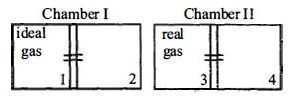
- 53. There are two identical chambers, completely thermally insulated from surroundings. Both chambers have a partition wall dividing the chambers in two compartments. Compartment \(1\) is filled with an ideal gas and Compartment \(3\) is filled with a real gas. Compartments \(2\) and \(4\) are vacuum . A small hole (orifice) is made in the partition walls and the gases are allowed to expand in vacuum Statement \(-1\) : No change in the temperature of the gas takes place when ideal gas expands in vacuum. However, the temperature of real gas goes down (cooling) when it expands in vacuum Statement \(-2\) : The internal energy of an ideal gas is only kinetic. The internal energy of a real gas is kinetic as well as potential
 2013 Medium
No questions on this page match these filters.