


enEnglishguગુજરાતી
JEE Mains · Physics · STD 11 - કાર્ય, ઊર્જા અને પાવર
- JEE Mains 2020
- મધ્યમ
- MCQ
\(\mathrm{m}\) દળનો પદાર્થ \(A\) એક ગ્રહની ફરતે \(R\) ત્રિજ્યાની કક્ષામાં ભ્રમણ કરે છે.બીજો \(\frac{\mathrm{m}}{2}\) દળ ધરાવતો પદાર્થ \(B\) પદાર્થ \(A\) સાથે પદાર્થ \(A\)ના વેગથી અડધા વેગથી અથડાય છે.આ અથડામણ સંપૂર્ણ અસ્થિતિસ્થાપક અથડામણ હોય તો બંને ભેગા પદાર્થ.....
જવાબ ચકાસવા માટે એક વિકલ્પ પસંદ કરો.
જવાબ અને ઉકેલ
સાચો જવાબ
(A) ગ્રહની ફરતે ઉપવલયકાર કક્ષામાં ભ્રમણ કરવાનું શરૂ કરે
પગલાવાર ઉકેલ
વિગતવાર સમજૂતી
Initially, the body of mass \(\mathrm{m}\) is moving in a circular orbit of radius \(\mathrm{R} .\) So it must be moving with orbital speed.
\(\mathrm{v}_{0}=\sqrt{\frac{\mathrm{GM}}{\mathrm{R}}}\)
After collision, let the combined mass moves with speed \(v_{1 }\)
\({\mathrm{mv}_{0}+\frac{\mathrm{m}}{2} \frac{\mathrm{v}_{0}}{2}=\left(\frac{3 \mathrm{m}}{2}\right) \mathrm{v}_{1}}\)
\({\mathrm{v}_{1}=\frac{5 \mathrm{v}_{0}}{6}}\)
since after collision, the speed is not equal to orbital speed at that point. So motion cannot be circular. since velocity will remain tangential, so it cannot fall vertically towards the planet. Their speed after collision is less than escape speed \(\sqrt{2} v_{0}, \quad\)
so they cannot escape gravitational field. So their motion will be elliptical around the planet.
Physics ના વધુ પ્રશ્નો
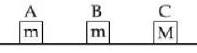
- આકૃતિમાં બતાવ્યા પ્રમાણે ત્રણ ચોસલા \(A, B\) અને \(C\) ને લીસી સમક્ષિતિજ સપાટી પર મુકવામાં આવેલા છે. \(A\) અને \(B\) નું એકસરખુ દળ \(m\) છે જ્યારે \(C\) નું દળ \(M\) છે. ચોસલા \(A\) ને ચોસલા \(B\) તરફ પ્રારંભિક ઝડપ \(v\), આપવામાં આવે છે જેને લીધે એ ચોસલા \(B\) જોડે સંપૂર્ણ અસ્થિતિસ્થાપક અથડામણ અનુભવે છે. આ સંયુક્ત દળ પણ ચોસલા \(C\) સાથે સંપૂર્ણ અસ્થિતિસ્થાપક અથડામણ અનુભવે છે. અને આ આખી ઘટનામાં પ્રારંભિક ગતિ ઊર્જા \(\frac{5}{6}\) ભાગ જેટલી ઊર્જાનો વ્યય થાય છે.તો \(M/m \) નું મૂલ્ય શું હશે?
 JEE Mains 2019 અઘરું
- \(6.230 \,cm\) વ્યાસ ધરાવતી એક સોનાની રીંગને કેટલા તાપમાને (\( ^{\circ} C\) માં) ગરમ કરવી જોઈએ કે જેથી તે \(6.241 \,cm\) વ્યાસ ધરાવતી લાકડાની બંગડી ઉપર ચઢી (ફિટ) જાય. બંને વ્યાસો ઓરડાના \(\left(27^{\circ} C \right)\) તાપમાને માપેલ છે. સોનાનો રેખીય પ્રસરણાંક \(\alpha_{ L }=1.4 \times 10^{-5} \,K ^{-1}\) આપેલ છે.JEE Mains 2022 મધ્યમ
- એક લાંબા, પાતળા સુવાહક તારનો વિચાર કરો જેમાંથી I જેટલો નિયમિત પ્રવાહ વહે છે. "M" દળ અને " \(q\) " વિદ્યુતભાર ધરાવતા એક કણને તારથી " \(a\) " અંતરે, તારમાંના પ્રવાહની દિશામાં \(v_0\) જેટલી ઝડપથી મુક્ત કરવામાં આવે છે. ચુંબકીય બળને કારણે કણ તાર તરફ આકર્ષાય છે. જ્યારે તે તારથી \(x\) અંતરે હોય છે ત્યારે કણ પાછો ફરે છે. \(x\) નું મૂલ્ય શોધો. [જ્યાં \(\mu_0\) એ શૂન્યાવકાશની પરમિયબિલિટી છે].JEE Mains 2025 અઘરું
- એકી-આયનીકૃત મેગ્નેશીયમ પરમાણુ \(( A=24)\) ને \(5 \,keV\) ની ગતિઊર્જ જેટલો પ્રવેગિત કરવામાં આવે છે, અને \(0.5 \,T\) મૂલ્ય ધરાવતા યુંબકીકીય ક્ષેત્ર \(B\) માં લંબરૂપે પ્રક્ષિપ્ત (ફેંકવામા) આવે છે. ગતિપથની ત્રિજ્યા .............. \(cm\) થશે.JEE Mains 2022 મધ્યમ
- એક \(ac\) જનરેટરમાં \(14 \times 10^{-2}\) ક્ષેત્રફળ વાયુ અને \(100\) આંટા ધરાવતું લંબચોરસ ગૂંચળું \(3.0\,T\) મૂલ્યના સમાન ચુંબકીય ક્ષેત્રમાં અક્ષને લંબ દિશામાં \(360\) પરિભ્રમણ મિનિટથી ભ્રમણ કરે છે. તો ઉત્પન્ન થયેલ મહત્તમ \(emf\) નું મૂલ્ય \(............V\) થશે. (\(\left.\pi=\frac{22}{7}\right.\) લો.)JEE Mains 2023 સરળ
- પ્રકાશની માધ્યમ \('A'\) અને \('B'\) માં ઝડપ અનુક્રમે \(2.0 \times 10^{10} \,cm / s\) અને \(1.5 \times 10^{10} \,cm / s\) છે. પ્રકાશકિરણ માધ્યમ \(B\) માંથી \(A\) માં '\(\theta\) ' જેટલા આપાતકોણે દાખલ થાય છે. જો કિરણ પૂર્ણ આંતરિક પરાવર્તન અનુભવે તો ...........JEE Mains 2022 મધ્યમ
JEE Mains ના વધુ PYQ
- સ્પ્રિંગનો સ્પ્રિંગ અચળાંક \((k)\) પ્રાયોગિક રીતે શોધવા માટે, એક વિદ્યાર્થી સમયના માપનમાં \(2 \%\) ધન ત્રુટિ અને દળના માપનમાં \(1 \%\) ઋણ ત્રુટિ કરે છે. \(\mathrm{k}\) ના મૂલ્યના નિર્ધારણમાં ટકાવારી ત્રુટિ _______ છે.JEE Mains 2024 અઘરું
- એક \(500\; g\) દળનો ગોળો સમક્ષિતિજ સમતલમાં સરક્યાં વગર ગબડે છે.તેનું કેન્દ્ર \(5.00\; \mathrm{cm} / \mathrm{s}\) ની ઝડપથી ગતિ કરતું હોય તો તેની ગતિઉર્જા કેટલી હશે?JEE Mains 2020 મધ્યમ
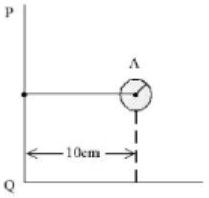
- ધન ગોળા \(A\) અક્ષ \(PQ\) ને અનુલક્ષીને ચાકગતિ કરે છે. જો ગોળાની ત્રિજ્યા \(5\,cm\) હોય, તો તેની અક્ષ \(PQ\) ને અનુલક્ષીને ચક્રાવર્તન ત્રિજ્યા \(\sqrt{x}\; cm\) થશે. અહી \(x\) નું મૂલ્ય \(........\) હશે.
 JEE Mains 2023 મધ્યમ
- આપેલ પરિપથમાં \(5 \,{V}\) ના ઝેનર ડાયોડને શ્રેણી અવરોધ સાથે જોડીને \(50 \,V\) ના પાવર સપ્લાય સાથે જોડેલ છે. જો મહત્તમ ઝેનર પ્રવાહ \(90\, {mA}\) હોય તો શ્રેણી અવરોધનું લઘુતમ મૂલ્ય (\(\Omega \) માં) કેટલું હોવું જોઈએ?
 JEE Mains 2021 અઘરું