


JEE Mains · Chemistry · STD 11 - 2. structure of atom
Which of the following is the energy of a possible excited state of hydrogen ? ............ \(\mathrm{eV}\)
- A \(-3.4\)
- B \(+6.8\)
- C \(+13.6\)
- D \(-6.8\)
Answer & Solution
Correct Answer
(A) \(-3.4\)
Step-by-step Solution
Detailed explanation
For \(1 ^{st}\) excited state, the value of \(n=2\) By putting the value of \(n,\) we get the value of energy. Thus, the energy of electron in first excited state of hydrogen atom \(=-\frac{13.6}{n^{2}}=-\frac{13.6}{4}=-3.4 \mathrm{eV}\).
See the Complete Solution
Get step-by-step explanations for this and 2.5 Lakh+ more JEE, NEET & CET questions.
- Unlock all solutions
- Practice the full chapter
- Track accuracy across PYQs
4.8 rated on Google Play · 14,000+ reviews
More questions from Chemistry
- Given below are two statements . Statement \(I :\) In \(CuSO _{4} .5 H _{2} O , Cu - O\) bonds are present. Statement \(II :\) In \(CuSO _{4} .5 H _{2} O\), ligands coordinating with \(Cu\) \((II)\) ion are \(O\)-and \(S\)-based ligands. In the light of the above statements, choose the correct answer from the options given belowJEE Mains 2022 Medium
- The bond angle \(H-X-H\) is the greatest in the compoundJEE Mains 2016 Hard
- The correct sequential order of the reagents for the given reaction is.
 JEE Mains 2022 Hard
 - The addition of \(HI\) in the presence of peroxide catalyst does not follow anti-Markovnikov's rule becauseJEE Mains 2013 Hard
-
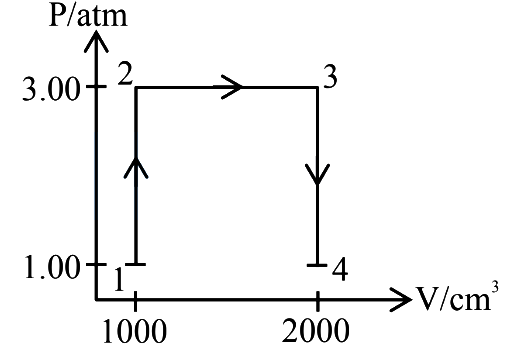
A perfect gas \((0.1 \mathrm{~mol})\) having \(\overline{\mathrm{C}}_{\mathrm{v}}=1.50 \mathrm{R}\) (independent of temperature) undergoes the above transformation from point 1 to point 4. If each step is reversible, the total work done (w) while going from point 1 to point 4 is \((-)\) ________ J (nearest integer) \(\left[\right.\) Given : \(\left.\mathrm{R}=0.082 \mathrm{~L} \mathrm{~atm} \mathrm{~K}^{-1} \mathrm{~mol}^{-1}\right]\)JEE Mains 2025 Medium - Benzyl isocyanide can be obtained by: Choose the correct answer from the options given below:
 JEE Mains 2023 Medium
More PYQs from JEE Mains
- The ratio \((R)\) of output resistance \(r_0\), and the input resistance \(r_i\) in measurements of input and output characteristics of a transistor is typically in the rangeJEE Mains 2016 Medium
- Let the abscissae of the two points \(P\) and \(Q\) be the roots of \(2 x ^{2}- rx + p =0\) and the ordinates of \(P\) and \(Q\) be the roots of \(x^{2}-s x-q=0\). If the equation of the circle described on \(PQ\) as diameter is \(2\left( x ^{2}+ y ^{2}\right)-11 x -14 y -22=0\), then \(2 r+s-2 q+p\) is equal toJEE Mains 2022 Hard
- A particle of mass \('{m}'\) is moving in time \('t'\) on a trajectory given by \(\overrightarrow{{r}}=10 \alpha {t}^{2}\, \hat{{i}}+5 \beta({t}-5)\, \hat{{j}}\) Where \(\alpha\) and \(\beta\) are dimensional constants. The angular momentum of the particle becomes the same as it was for \({t}=0\) at time \({t}=\) .....\(seconds.\)JEE Mains 2021 Hard
- The ratio of the weights of a body on the Earth's surface to that on the surface of a planet is \(9 : 4\). The mass of the planet is \(\frac{1}{9}^{th}\) of that of the Earth. If \('R'\) is the radius of the Earth, what is the radius of the planet ? (Take the planets to have the same mass density)JEE Mains 2019 Medium
- Which of the following are correct expression for torque acting on a body?
A. \(\vec{\tau}=\vec{r}\times\vec{L}\)
B. \(\vec{\tau}=\frac{\mathrm{d}}{\mathrm{dt}}(\overrightarrow{\mathrm{r}} \times \overrightarrow{\mathrm{p}})\)
C. \(\vec{\tau}=\overrightarrow{\mathrm{r}} \times \frac{\mathrm{d} \mathrm{p}}{\mathrm{dt}}\)
D. \(\vec{\tau}=\mathrm{I} \vec{\alpha}\)
E. \(\vec{\tau}=\overrightarrow{\mathrm{r}} \times \overrightarrow{\mathrm{F}}\)
( \(\overrightarrow{\mathrm{r}}=\) position vector; \(\overrightarrow{\mathrm{p}}=\) linear momentum;
\(\overrightarrow{\mathrm{L}}=\) angular momentum; \(\vec{\alpha}=\) angular acceleration;
\(I=\) moment of inertia; \(\vec{F}=\) force; \(t=\) time)
Choose the correct answer from the options given below :JEE Mains 2025 Easy - If the earth suddenly shrinks to \(\frac{1}{64}\) th of its original volume with its mass remaining the same, the period of rotation of earth becomes \(\frac{24}{ x } h\). The value of \(x\) is \(.......\)JEE Mains 2023 Hard