


JEE Advanced · Chemistry · 23. Coordination Compounds
Among the following metal carbonyls, the \(\mathrm{C}-\mathrm{O}\) bond order is lowest in
- A \(\left[\mathrm{MO}(\mathrm{CO})_6\right]^{+}\)
- B \(\left[\mathrm{Fe}(\mathrm{CO})_5\right]\)
- C \(\left[\mathrm{Cr}(\mathrm{CO})_6\right]\)
- D \(\left[\mathrm{V}(\mathrm{CO})_6\right]^{-}\)
Answer & Solution
Correct Answer
(B) \(\left[\mathrm{Fe}(\mathrm{CO})_5\right]\)
Step-by-step Solution
Detailed explanation
(a) \(\mathrm{Mn}^{+}=3 d^5 4 s^1\) In presence of \(\mathrm{CO}\) effective configuration \(=3 d^6 4 s^0, 3\) lone pair for back bonding with vacant orbital of \(\mathrm{C}\) in \(\mathrm{CO}\).
(b) \(\mathrm{Fe}^{\circ}=3 d^6 4 s^2\) in presence of \(\mathrm{CO}\) effective configuration \(=3 d^8, 4\) lone pair for back bonding with \(\mathrm{CO}\).
(c) \(\mathrm{Cr}^{\circ}=3 d^5 4 s^1\), effective configuration \(=3 d^6\)
3 lone pair for back bonding with \(\mathrm{CO}\).
(d) \(\mathrm{V}^{-}=3 d^4 s^2\), effective configuration \(=3 d^6, 3\) lone pair for back bonding with \(\mathrm{CO}\). Maximum back bonding in \(\mathrm{Fe}(\mathrm{CO})_5\), therefore \(\mathrm{CO}\) bond order is lowest here.
(b) \(\mathrm{Fe}^{\circ}=3 d^6 4 s^2\) in presence of \(\mathrm{CO}\) effective configuration \(=3 d^8, 4\) lone pair for back bonding with \(\mathrm{CO}\).
(c) \(\mathrm{Cr}^{\circ}=3 d^5 4 s^1\), effective configuration \(=3 d^6\)
3 lone pair for back bonding with \(\mathrm{CO}\).
(d) \(\mathrm{V}^{-}=3 d^4 s^2\), effective configuration \(=3 d^6, 3\) lone pair for back bonding with \(\mathrm{CO}\). Maximum back bonding in \(\mathrm{Fe}(\mathrm{CO})_5\), therefore \(\mathrm{CO}\) bond order is lowest here.
See the Complete Solution
Get step-by-step explanations for this and 2.5 Lakh+ more JEE, NEET & CET questions.
- Unlock all solutions
- Practice the full chapter
- Track accuracy across PYQs
4.8 rated on Google Play · 14,000+ reviews
More questions from Chemistry
- We have taken a saturated solution of \(\mathrm{AgBr}, K_{\mathrm{sp}}\) is \(12 \times 10^{-14}\). If \(10^{-7}\) mole of \(\mathrm{AgNO}_3\) are added to 1 litre of this solution, find conductivity (specific conductance) of this solution in terms of \(10^{-7} \mathrm{Sm}^{-1}\) units.
\( \text {Given, } \lambda_{\left(\mathrm{Ag}^{+}\right)}^{\circ} =6 \times 10^{-3} \mathrm{Sm}^2 \mathrm{~mol}^{-1},\) \(\lambda_{\left(\mathrm{Br}^{-}\right)}^{\circ}=8 \times 10^{-3} \mathrm{Sm}^2 \mathrm{~mol}^{-1}, \)
\( \lambda_{\left(\mathrm{NO}_3^{-}\right)} =7 \times 10^{-3} \mathrm{Sm}^2 \mathrm{~mol}^{-1},\)JEE Advanced 2006 Hard - The correct statement(s) regarding defects in solids is (are)JEE Advanced 2009 Medium
- During sodium nitroprusside test of sulphide ion in an aqueous solution, one of the ligands coordinated to the metal ion is converted toJEE Advanced 2025 Easy
- A closed vessel with rigid walls contains 1 mol of and 1 mol of air at 298 K. Considering complete decay of to , the ratio of the final pressure to the initial pressure of the system at 298 K isJEE Advanced 2015 Hard
- Among PbS, CuS, HgS, MnS, , NiS, CoS, and , the total number of black coloured sulphides isJEE Advanced 2014 Easy
- Paragraph:
Thermal decomposition of gaseous \(\mathrm{X}_{2}\) to gaseous \(\mathrm{X}\) at \(298 \mathrm{~K}\) takes place according to the following equation:
\(\mathrm{X}_{2}(\mathrm{~g}) \rightleftharpoons 2 \mathrm{X}(\mathrm{g})\)
The standard reaction Gibbs energy, \(\Delta_{r} G^{\circ}\), of this reaction is positive. At the start of the reaction, there is one mole of \(\mathrm{X}_{2}\) and no \(\mathrm{X}\). As the reaction proceeds, the number of moles of \(\mathrm{X}\) formed is given by \(\beta\). Thus, \(\beta_{\text {equilibrium }}\) is the number of moles of \(\mathrm{X}\) formed at equilibrium. The reaction is carried out at a constant total pressure of \(2\) bar. Consider the gases to behave ideally. (Given : \(R=0.083 \mathrm{~L}\) bar \(\mathrm{K}^{-1} \mathrm{~mol}^{-1}\) )
Question:
The INCORRECT statement among the following, for this reaction, isJEE Advanced 2016 Hard
More PYQs from JEE Advanced
- Let (the set of all real numbers) be a positive, non-constant and differentiable function such that and . Then the value of lies in the interval:JEE Advanced 2013 Hard
- Paragraph:
Let \(V_r\) denotes the sum of the first \(r\) terms of an arithmetic progression \((A P)\) whose first term is \(r\) and the common difference is \((2 r-1)\). Let \(T_r=V_{r+1}-V_r-2\) and \(Q_r=T_{r+1}-T_r\) for \(r=1,2, \ldots\)
Question:
The sum \(V_1+V_2+\ldots+V_n\) isJEE Advanced 2007 Medium - \(5.6 \mathrm{~L}\) of helium gas at STP is adiabatically compressed to \(0.7 \mathrm{~L}\). Taking the initial temperature to be \(T_1\), the work done in the process isJEE Advanced 2011 Hard
- Which one of the following statement is WRONG in the context of X-rays generated from X-ray tube?JEE Advanced 2008 Hard
- The concentration of \(R\) in the reaction \(R \longrightarrow P\) was measured as a function of time and the following data is obtained :
\(\begin{array}{lllll}{[R] \text { (molar) }} & 1.0 & 0.75 & 0.40 & 0.10 \\ t \text { (min) } & 0.0 & 0.05 & 0.12 & 0.18\end{array}\)
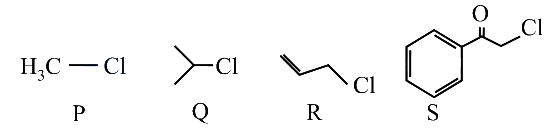
The order of the reaction isJEE Advanced 2010 Easy - KI in acetone, undergoes SN2 reaction with each of P, Q, R and S. The rates of the reaction vary as
 JEE Advanced 2013 Medium