


JEE Advanced · Physics · 13. Thermodynamics
\(5.6 \mathrm{~L}\) of helium gas at STP is adiabatically compressed to \(0.7 \mathrm{~L}\). Taking the initial temperature to be \(T_1\), the work done in the process is
- A \(\frac{9}{8} R T_1\)
- B \(\frac{3}{2} R T_1\)
- C \(\frac{15}{8} R T_1\)
- D \(\frac{9}{2} R T_1\)
Answer & Solution
Correct Answer
(A) \(\frac{9}{8} R T_1\)
Step-by-step Solution
Detailed explanation
At STP, 22.4 L of any gas is 1 mole.
\(
\therefore \quad 5.6 \mathrm{~L}=\frac{5.6}{22.4}=\frac{1}{4} \text { moles }=n
\)
In adiabatic process,
\(
\begin{array}{rlrl}
& T V^{\gamma-1} & =\text { constant } \\
& \therefore & T_2 V_2^{\gamma-1} & =T_1 V_1^{\gamma-1} \\
& \text { or } & T_2 & =T_1\left(\frac{V_1}{V_2}\right)^{\gamma-1}
\end{array}
\)
\(
\begin{aligned}
& \gamma=\frac{C_p}{C_V}=\frac{5}{3} \text { for monoatomic He gas. } \\
& \therefore \quad T_2=T_1\left(\frac{5.6}{0.7}\right)^{\frac{5}{3}-1}=4 T_1 \\
& \because \text { Further in adiabatic process, } \\
& Q=0 \\
& \therefore \quad W+\Delta U=0 \\
& \text { or } \quad W=-\Delta U \\
& =-n C_V \Delta T \\
& =-n\left(\frac{R}{\gamma-1}\right)\left(T_2-T_1\right) \\
& =-\frac{1}{4}\left(\frac{R}{\frac{5}{3}-1}\right)\left(4 T_1-T_1\right) \\
& =-\frac{9}{8} R T_1 \\
&
\end{aligned}
\)
\(\therefore\) Correct option is (a).
Analysis of Question
(i) From calculation point of view question is moderately tough.
(ii) Volume of gas is decreasing. Therefore, work done by the gas should be negative.
\(
\therefore \quad 5.6 \mathrm{~L}=\frac{5.6}{22.4}=\frac{1}{4} \text { moles }=n
\)
In adiabatic process,
\(
\begin{array}{rlrl}
& T V^{\gamma-1} & =\text { constant } \\
& \therefore & T_2 V_2^{\gamma-1} & =T_1 V_1^{\gamma-1} \\
& \text { or } & T_2 & =T_1\left(\frac{V_1}{V_2}\right)^{\gamma-1}
\end{array}
\)
\(
\begin{aligned}
& \gamma=\frac{C_p}{C_V}=\frac{5}{3} \text { for monoatomic He gas. } \\
& \therefore \quad T_2=T_1\left(\frac{5.6}{0.7}\right)^{\frac{5}{3}-1}=4 T_1 \\
& \because \text { Further in adiabatic process, } \\
& Q=0 \\
& \therefore \quad W+\Delta U=0 \\
& \text { or } \quad W=-\Delta U \\
& =-n C_V \Delta T \\
& =-n\left(\frac{R}{\gamma-1}\right)\left(T_2-T_1\right) \\
& =-\frac{1}{4}\left(\frac{R}{\frac{5}{3}-1}\right)\left(4 T_1-T_1\right) \\
& =-\frac{9}{8} R T_1 \\
&
\end{aligned}
\)
\(\therefore\) Correct option is (a).
Analysis of Question
(i) From calculation point of view question is moderately tough.
(ii) Volume of gas is decreasing. Therefore, work done by the gas should be negative.
See the Complete Solution
Get step-by-step explanations for this and 2.5 Lakh+ more JEE, NEET & CET questions.
- Unlock all solutions
- Practice the full chapter
- Track accuracy across PYQs
4.8 rated on Google Play · 14,000+ reviews
More questions from Physics
- In an -ray tube, electrons emitted from a filament (cathode) carrying current hit a target (anode) at a distance from the cathode. The target is kept at a potential higher than the cathode resulting in emission of continuous and characteristic X-rays. If the filament current is decreased to the potential difference is increased to and the separation distance is reduced to thenJEE Advanced 2020 Medium
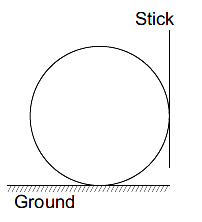
- A boy is pushing a ring of mass \(2 \mathrm{~kg}\) and radius \(0.5 \mathrm{~m}\) with a stick as shown in the figure. The stick applies a force of \(2 \mathrm{~N}\) on the ring and rolls it without slipping with an acceleration of \(0.3 \mathrm{~m} / \mathrm{s}^2\). The coefficient of friction between the ground and the ring is large enough that rolling always occurs and the coefficient of friction between the stick and the ring is \(\frac{P}{10}\). The value of \(P\) is
 JEE Advanced 2011 Hard
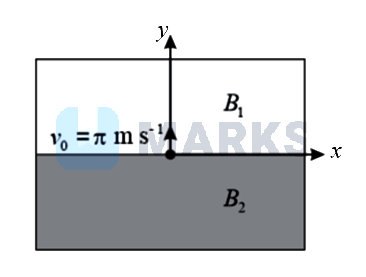
 - In the , the region has a uniform magnetic field and the region has another uniform magnetic field . A positively charged particle is projected from the origin along the positive with speed at , as shown in the figure. Neglect gravity in this problem. Let be the time when the particle crosses the from below for the first time. If , the average speed of the particle, in , along the in the time interval is ________.
 JEE Advanced 2018 Medium
 - an isotope of Iodine that decays to an isotope of Xenon with a half-life of . A small amount of a serum labelled with is injected into the blood of a person. The activity of the amount of injected was Becquerel (Bq). It is known that the injected serum will get distributed uniformly in the blood stream in less than half an hour. After 11.5 hours, 2.5 ml of blood is drawn from the person's body, and gives an activity of . The total volume of blood in the person's body, in litres is approximately (you may use \(\mathrm{e}^{\mathrm{x}} \approx 1+\mathrm{x}\) for \(|\mathrm{x}|<<1\) and \(\ln 2 \approx 0.7\)).JEE Advanced 2017 Easy
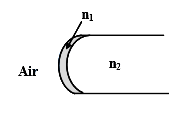
- A transparent thin film of uniform thickness and refractive index is coated on the convex spherical surface of radius R at one end of a long solid glass cylinder of refractive index , as shown in the figure. Rays of light parallel to the axis of the cylinder traversing through the film from air to glass get focused at distance f1 from the film, while rays of light traversing from glass to air get focused at distance f2 from the film. Then
 JEE Advanced 2014 Medium
 - A hydrogen atom in its ground state is irradiated by light of wavelength Taking hc/e = m and the ground state energy of hydrogen atom as , the number of lines present in the emission spectrum isJEE Advanced 2016 Medium
More PYQs from JEE Advanced
- Consider the following reaction,
\(2 \mathrm{H}_2(\mathrm{~g})+2 \mathrm{NO}(\mathrm{g}) \rightarrow \mathrm{N}_2(\mathrm{~g})+2 \mathrm{H}_2 \mathrm{O}(\mathrm{g})\)
which follows the mechanism given below:
\(2 \mathrm{NO}(\mathrm{g}) \stackrel{k_1}{\underset{k_{-1}}{\rightleftharpoons}} \mathrm{N}_2 \mathrm{O}_2(\mathrm{~g})\) \(\quad\) (fast equlibrium)
\(\mathrm{N}_2 \mathrm{O}_2(\mathrm{~g})+\mathrm{H}_2(\mathrm{~g}) \xrightarrow{k_2} \mathrm{~N}_2 \mathrm{O}(\mathrm{g})+\mathrm{H}_2 \mathrm{O}(\mathrm{g})\) \(\quad\)(slow reaction)
\(\mathrm{N}_2 \mathrm{O}(\mathrm{g})+\mathrm{H}_2(\mathrm{~g}) \xrightarrow{k_3} \mathrm{~N}_2(\mathrm{~g})+\mathrm{H}_2 \mathrm{O}(\mathrm{g})\) \(\quad\) (fast reaction)
The order of the reaction is_____JEE Advanced 2024 Medium - Liquids A and B form ideal solution over the entire range of composition. At temperature , equimolar binary solution of liquids A and B has vapour pressure . At the same temperature, a new solution of A and B having mole fractions , respectively, has vapour pressure of . The value of , in the new solution is ____.
(Given that the vapour pressure of pure liquid A is at temperature )JEE Advanced 2018 Medium - The \(\beta\)-decay process, discovered around 1900 , is basically the decay of a neutron \((n)\). In the laboratory, a proton \((p)\) and an electron \(\left(e^{-}\right)\)are observed as the decay products of the neutron. Therefore, considering the decay of a neutron as a two-body decay process, it was predicted theoretically that the kinetic energy of the electron should be a constant. But experimentally, it was observed that the electron kinetic energy has continuous spectrum. Considering a three-body decay process, i.e.
\(n \rightarrow p+e^{-}+\bar{v}_{e}\), around 1930, Pauli explained the observed electron energy spectrum. Assuming the anti-neutrino \(\left(\bar{v}_{e}\right)\) to be massless and possessing negligible energy, and the neutron to be at rest, momentum and energy conservation principles are applied. From this calculation, the maximum kinetic energy of the electron is \(0.8 \times 10^{6} \mathrm{eV}\). The kinetic energy carried by the proton is only the recoil energy.
Question:
What is the maximum energy of the anti-neutrino?JEE Advanced 2012 Medium - A student performs an experiment for determination of \(g\left(=\frac{4 \pi^2 l}{T^2}\right), l \approx 1 \mathrm{~m}\), and he commits an error of \(\Delta l\). For \(T\) he takes the time of \(n\) oscillations with the stop watch of least count \(\Delta T\) and he commits a human error of \(0.1 \mathrm{~s}\). For which of the following data, the measurement of \(g\) will be most accurate?JEE Advanced 2006 Easy
- Paragraph:
A point charge \(Q\) is moving in a circular orbit of radius \(R\) in the \(x-y\) plane with an angular velocity \(\omega .\) This can be considered as equivalent to a loop carrying a steady current \(\frac{Q \omega}{2 \pi}\). A uniform magnetic field along the positive \(z\)-axis is now switched on, which increases at a constant rate from 0 to \(B\) in one second. Assume that the radius of the orbit remains constant. The application of the magnetic field induces an emf in the orbit. The induced emf is defined as the work done by an induced electric field in moving a unit positive charge around a closed loop. It is known that, for an orbiting charge, the magnetic dipole moment is proportional to the angular momentum with a proportionality constant \(\gamma\).
Question:
The change in the magnetic dipole moment associated with the orbit, at the end of the time interval of the magnetic field change, isJEE Advanced 2013 Medium - Area of the cross-section of a wire is measured using a screw gauge. The pitch of the main scale is . The circular scale has divisions and for one full rotation of the circular scale, the main scale shifts by two divisions. The measured readings are listed below.
What are the diameter and cross-sectional area of the wire measured using the screw gauge?Measurement condition Main scale reading Circular scale reading Two arms of gauge touching each other without wire division divisions Attempt-: With wire divisions divisions Attempt-: With wire divisions divisions JEE Advanced 2022 Medium