


JEE Advanced · Chemistry · 17. Electrochemistry
We have taken a saturated solution of \(\mathrm{AgBr}, K_{\mathrm{sp}}\) is \(12 \times 10^{-14}\). If \(10^{-7}\) mole of \(\mathrm{AgNO}_3\) are added to 1 litre of this solution, find conductivity (specific conductance) of this solution in terms of \(10^{-7} \mathrm{Sm}^{-1}\) units.
\( \text {Given, } \lambda_{\left(\mathrm{Ag}^{+}\right)}^{\circ} =6 \times 10^{-3} \mathrm{Sm}^2 \mathrm{~mol}^{-1},\) \(\lambda_{\left(\mathrm{Br}^{-}\right)}^{\circ}=8 \times 10^{-3} \mathrm{Sm}^2 \mathrm{~mol}^{-1}, \)
\( \lambda_{\left(\mathrm{NO}_3^{-}\right)} =7 \times 10^{-3} \mathrm{Sm}^2 \mathrm{~mol}^{-1},\)
- A 11
- B 22
- C 33
- D 55
Answer & Solution
Correct Answer
(D) 55
Step-by-step Solution
Detailed explanation
Suppose the solubility of \(\mathrm{AgBr}\) in \(10^{-7} \mathrm{MAgNO}_3\) is \(\mathrm{mol} / \mathrm{L}\)
\(
\begin{aligned}
& \underset{s \mathrm{~mol} / \mathrm{L}}{\mathrm{AgBr}} \rightleftharpoons \mathrm{Ag}^{+}+\mathrm{Br}^{-} \\
& \mathrm{AgNO}_3 \rightleftharpoons \mathrm{Ag}^{+}+\mathrm{NO}_3^{-} \\
& 10^{-7} \mathrm{M} \quad 10^{-7} \mathrm{M} \times 10^{-7} \mathrm{M} \\
& \text { Total }\left[\mathrm{Ag}^{+}\right]=\left(s+10^{-7}\right) \mathrm{M} \\
& K_{\mathrm{sp}} \text { of } \mathrm{AgBr}=\left[\mathrm{Ag}^{+}\right]\left[\mathrm{Br}^{-}\right] \\
& 12 \times 10^{-14}=\left(s+10^{-7}\right)(s)=s^2+10^{-7} s \\
& s^2+10^{-7} s-12 \times 10^{-14}=0\end{aligned}
\)
On solving \(s=3 \times 10^{-7} \mathrm{M}\)
Hence, \(\left[\mathrm{Br}^{-}\right]=3 \times 10^{-7} \mathrm{M}=3 \times 10^{-7} \times 10^3\)\(\mathrm{~m}^3=3 \times 10^{-4} \mathrm{~m}^3\)
\(
\left[\mathrm{Ag}^{+}\right]=\left(3 \times 10^{-7}+10^{-7}\right) \mathrm{M}=4 \times 10^{-7} \times\) \(10^3 \mathrm{~m}^3=4 \times 10^{-4} \mathrm{~m}^3
\)
\(
\left[\mathrm{NO}_3^{-}\right]=10^{-7} \mathrm{M}=10^{-7} \times 10^{+3}=\) \(1 \times 10^{-4} \mathrm{~m}^3
\)
\(
\because \lambda=\frac{k}{C} \text { or } k=\lambda \times C
\)
\(\therefore k_{\mathrm{Br}^{-}} =3 \times 10^{-4} \times 8 \times 10^{-3} \mathrm{Sm}^{-1}\) \(=24 \times 10^{-7} \mathrm{Sm}^{-1} \)
\( k_{\mathrm{Ag}^{+}} =4 \times 10^{-4} \times 6 \times 10^{-3} \mathrm{Sm}^{-1}\) \(=24 \times 10^{-7} \mathrm{Sm}^{-1} \)
\( k_{\mathrm{NO}_3^{-}} =1 \times 10^{-4} \times 7 \times 10^{-3}=7 \times 10^{-7} \mathrm{Sm}^{-1} \)
\( k_{\text {Total }} =k_{\mathrm{Br}^{-}}+k_{\mathrm{Ag}^{+}}+k_{\mathrm{NO}_3^{-}} \)
\( =\left(24 \times 10^{-7}+24 \times 10^{-7}+7 \times 10^{-7} \mathrm{Sm}^{-1}\right. \text { ) } \)
\( =55 \times 10^{-7} \mathrm{Sm}^{-1} \)
\( \left.=\mathbf{5 5} \mathbf{S m}^{-1} \text { (in term of } 10^{-7} \mathrm{Sm}^{-1}\right)\)
\(
\begin{aligned}
& \underset{s \mathrm{~mol} / \mathrm{L}}{\mathrm{AgBr}} \rightleftharpoons \mathrm{Ag}^{+}+\mathrm{Br}^{-} \\
& \mathrm{AgNO}_3 \rightleftharpoons \mathrm{Ag}^{+}+\mathrm{NO}_3^{-} \\
& 10^{-7} \mathrm{M} \quad 10^{-7} \mathrm{M} \times 10^{-7} \mathrm{M} \\
& \text { Total }\left[\mathrm{Ag}^{+}\right]=\left(s+10^{-7}\right) \mathrm{M} \\
& K_{\mathrm{sp}} \text { of } \mathrm{AgBr}=\left[\mathrm{Ag}^{+}\right]\left[\mathrm{Br}^{-}\right] \\
& 12 \times 10^{-14}=\left(s+10^{-7}\right)(s)=s^2+10^{-7} s \\
& s^2+10^{-7} s-12 \times 10^{-14}=0\end{aligned}
\)
On solving \(s=3 \times 10^{-7} \mathrm{M}\)
Hence, \(\left[\mathrm{Br}^{-}\right]=3 \times 10^{-7} \mathrm{M}=3 \times 10^{-7} \times 10^3\)\(\mathrm{~m}^3=3 \times 10^{-4} \mathrm{~m}^3\)
\(
\left[\mathrm{Ag}^{+}\right]=\left(3 \times 10^{-7}+10^{-7}\right) \mathrm{M}=4 \times 10^{-7} \times\) \(10^3 \mathrm{~m}^3=4 \times 10^{-4} \mathrm{~m}^3
\)
\(
\left[\mathrm{NO}_3^{-}\right]=10^{-7} \mathrm{M}=10^{-7} \times 10^{+3}=\) \(1 \times 10^{-4} \mathrm{~m}^3
\)
\(
\because \lambda=\frac{k}{C} \text { or } k=\lambda \times C
\)
\(\therefore k_{\mathrm{Br}^{-}} =3 \times 10^{-4} \times 8 \times 10^{-3} \mathrm{Sm}^{-1}\) \(=24 \times 10^{-7} \mathrm{Sm}^{-1} \)
\( k_{\mathrm{Ag}^{+}} =4 \times 10^{-4} \times 6 \times 10^{-3} \mathrm{Sm}^{-1}\) \(=24 \times 10^{-7} \mathrm{Sm}^{-1} \)
\( k_{\mathrm{NO}_3^{-}} =1 \times 10^{-4} \times 7 \times 10^{-3}=7 \times 10^{-7} \mathrm{Sm}^{-1} \)
\( k_{\text {Total }} =k_{\mathrm{Br}^{-}}+k_{\mathrm{Ag}^{+}}+k_{\mathrm{NO}_3^{-}} \)
\( =\left(24 \times 10^{-7}+24 \times 10^{-7}+7 \times 10^{-7} \mathrm{Sm}^{-1}\right. \text { ) } \)
\( =55 \times 10^{-7} \mathrm{Sm}^{-1} \)
\( \left.=\mathbf{5 5} \mathbf{S m}^{-1} \text { (in term of } 10^{-7} \mathrm{Sm}^{-1}\right)\)
See the Complete Solution
Get step-by-step explanations for this and 2.5 Lakh+ more JEE, NEET & CET questions.
- Unlock all solutions
- Practice the full chapter
- Track accuracy across PYQs
4.8 rated on Google Play · 14,000+ reviews
More questions from Chemistry
- Paragraph:
Properties such as boiling point, freezing point and vapour pressure of a pure solvent change when solute molecules are added to get homogeneous solution. These are called colligative properties. Applications of colligative properties are very useful in day-to-day life. One of its examples is the use of ethylene glycol and water mixture as anti-freezing liquid in the radiator automobiles.
A solution \(M\) is prepared by mixing ethanol and water. The mole fraction of ethanol in the mixtrue is \(0.9\)
Given Freezing point depression constant of water \(\left(k^{\text {water }}\right)=1.86 \mathrm{~K} \mathrm{~kg} \mathrm{~mol}^{-1}\)
Freezing point depression constant of ethanol \(\left(k_f^{\text {ethanol }}\right)=2.0 \mathrm{Kkg} \mathrm{mol}^{-1}\)
Boiling point elevation constant of water \(\left(k_b^{\text {water }}\right)=0.52 \mathrm{Kkg} \mathrm{mol}^{-1}\)
Boiling point elevation constant of ethanol \(\left(k_b^{\text {ethanol }}\right)=1.2 \mathrm{Kkg} \mathrm{mol}^{-1}\)
Standard freezing point of water \(=273 \mathrm{~K}\)
Standard freezing point of ethanol \(=155.7 \mathrm{~K}\)
Standard boiling point of water \(=373 \mathrm{~K}\)
Standard boiling point of ethanol \(=351.5 \mathrm{~K}\)
Vapour pressure of pure water \(=328 \mathrm{~mm}\) of \(\mathrm{Hg}\)
Vapour pressure of pure ethanol \(=40 \mathrm{~mm}\) of \(\mathrm{Hg}\)
Molecular weight of water \(=18 \mathrm{~g} \mathrm{~mol}^{-1}\)
Molecular weight of ethanol \(=46 \mathrm{~g} \mathrm{~mol}^{-1}\)
In answering the following questions, consider the solutions to be ideal dilute solutions and solutes to be non-volatile and non-dissociative.
Question:
The freezing point of the solution \(M\) isJEE Advanced 2008 Medium - A compound \(\mathrm{M}_{\mathrm{p}} \mathrm{X}_{\mathrm{q}}\) has cubic close packing (ccp) arrangement of \(\mathrm{X}\). Its unit cell structure is shown below. The empirical formula of the compound is
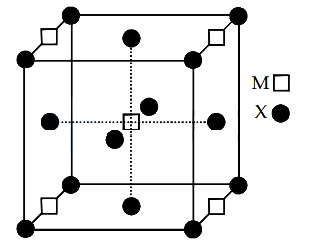 JEE Advanced 2012 Hard
 - The correct statement about the following disaccharide is
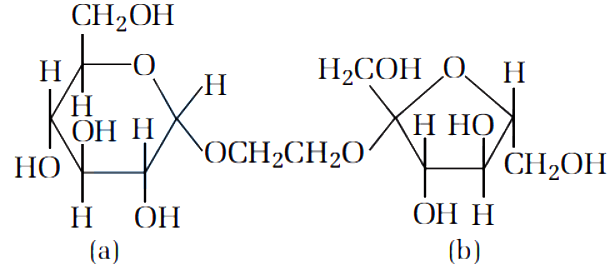 JEE Advanced 2010 Medium
 - Liquids and form ideal solution for all compositions of and at . Two such solutions with and mole fractions of have the total vapor pressures of and bar, respectively. What is the vapor pressure of pure liquid in bar?JEE Advanced 2020 Medium
- Match the reactions (in the given stoichiometry of the reactants) in List-I with one of their products given in List-II and choose the correct option.
List - I List - II (P) \(P _2 O _3\) \(+~3 H _2 O \rightarrow\) (1) \(P ( O )\left( OCH _3\right)\) \(Cl _2\) (Q) \(P _4+3 NaOH\) \(+~3 H _2 O \rightarrow\) (2) \(H _3 PO _3\) (R) \(PCl _5+ CH _3\) \(COOH \rightarrow\) (3) \(PH _3\) (S) \(H _3 PO _2\) \(+~2 H _2 O ~+\) \(4 AgNO _3 \rightarrow\) (4) \(POCL _3\) (5) \(H _3 PO _4\) JEE Advanced 2023 Medium - Paragraph:
Thermal decomposition of gaseous \(\mathrm{X}_{2}\) to gaseous \(\mathrm{X}\) at \(298 \mathrm{~K}\) takes place according to the following equation:
\(\mathrm{X}_{2}(\mathrm{~g}) \rightleftharpoons 2 \mathrm{X}(\mathrm{g})\)
The standard reaction Gibbs energy, \(\Delta_{r} G^{\circ}\), of this reaction is positive. At the start of the reaction, there is one mole of \(\mathrm{X}_{2}\) and no \(\mathrm{X}\). As the reaction proceeds, the number of moles of \(\mathrm{X}\) formed is given by \(\beta\). Thus, \(\beta_{\text {equilibrium }}\) is the number of moles of \(\mathrm{X}\) formed at equilibrium. The reaction is carried out at a constant total pressure of \(2\) bar. Consider the gases to behave ideally. (Given : \(R=0.083 \mathrm{~L}\) bar \(\mathrm{K}^{-1} \mathrm{~mol}^{-1}\) )
Question:
The equilibrium constant \(K_{P}\) for this reaction at \(298 \mathrm{~K},\) in terms of \(\beta_{equilibrium}\) isJEE Advanced 2016 Medium
More PYQs from JEE Advanced
- Which of the following halides react(s) with \(\mathrm{AgNO}_{3}(\mathrm{aq})\) to give a precipitate that dissolves in \(\mathrm{Na}_{2} \mathrm{~S}_{2} \mathrm{O}_{3}(\mathrm{aq})\) ?JEE Advanced 2012 Medium
- Two spherical bodies \(A\) (radius \(6 \mathrm{~cm}\) ) and \(B\) (radius \(18 \mathrm{~cm}\) ) are at temperatures \(T_1\) and \(T_2\), respectively. The maximum intensity in the emission spectrum of \(A\) is at \(500 \mathrm{~nm}\) and in that of \(B\) is at \(1500 \mathrm{~nm}\). Considering them to be black bodies, what will be the ratio of the rate of total energy radiated by \(A\) to that of \(B\) ?JEE Advanced 2010 Hard
- Let \(A B C D\) be a quadrilateral with area 18 , with side \(A B\) parallel to the side \(C D\) and \(A B=2 C D\). Let \(A D\) be perpendicular to \(A B\) and \(C D\). If a circle is drawn inside the quadrilateral \(A B C D\) touching all the sides, then its radius isJEE Advanced 2007 Hard
- Let \(f\) be a real-valued function defined on the interval \((0, \infty)\), by \(f(x)=\ln x+\int_0^x \sqrt{1+\sin t} d t\). Then which of the following statement(s) is (are) true ?JEE Advanced 2010 Medium
- A soft plastic bottle, filled with water of density \(1 \mathrm{gm} / \mathrm{cc}\), carries an inverted glass test-tube with some air (ideal gas) trapped as shown in the figure. The test-tube has a mass of \(5 \mathrm{gm}\), and it is made of a thick glass of density \(2.5 \mathrm{gm} / \mathrm{cc}\). Initially the bottle is sealed at atmospheric pressure \(p_{0}=10^{5} \mathrm{~Pa}\) so that the volume of the trapped air is \(v_{0}=3.3 \mathrm{cc}\). When the bottle is squeezed from outside at constant temperature, the pressure inside rises and the volume of the trapped air reduces. It is found that the test tube begins to sink at pressure \(p_{0}+\Delta p\) without changing its orientation. At this pressure, the volume of the trapped air is \(v_{0}-\Delta v\).
Let \(\Delta v=X\) cc and \(\Delta p=Y \times 10^{3} \mathrm{~Pa}\).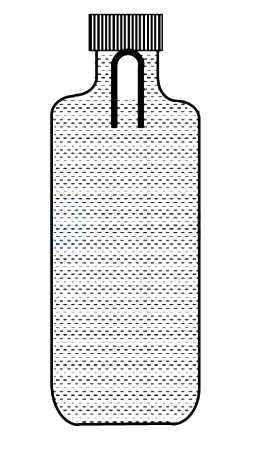
The value of is ____.JEE Advanced 2021 Hard - A block hangs vertically at the bottom end of a uniform rope of constant mass per unit length. The top end of the rope is attached to a fixed rigid support at O. A transverse wave pulse (Pulse 1) of wavelength is produced at point O on the rope. The pulse takes time to reach point A. If the wave pulse of wavelength is produced at point A (Pulse 2) without disturbing the position of M it takes time to reach point O. Which of the following options is/are correct?
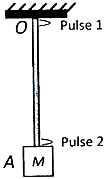 JEE Advanced 2017 Medium