


JEE Advanced · Mathematics · 5. Sequences & Series
Paragraph:
Let \(V_r\) denotes the sum of the first \(r\) terms of an arithmetic progression \((A P)\) whose first term is \(r\) and the common difference is \((2 r-1)\). Let \(T_r=V_{r+1}-V_r-2\) and \(Q_r=T_{r+1}-T_r\) for \(r=1,2, \ldots\)
Question:
The sum \(V_1+V_2+\ldots+V_n\) is
- A \(\frac{1}{12} n(n+1)\left(3 n^2-n+1\right)\)
- B \(\frac{1}{12} n(n+1)\left(3 n^2+n+2\right)\)
- C \(\frac{1}{2} n\left(2 n^2-n+1\right)\)
- D \(\frac{1}{3}\left(2 n^3-2 n+3\right)\)
Answer & Solution
Correct Answer
(B) \(\frac{1}{12} n(n+1)\left(3 n^2+n+2\right)\)
Step-by-step Solution
Detailed explanation
\(V_r=\frac{r}{2}[2 r+(r-1)(2 r-1)]=\frac{1}{2}(2 r^3-\) \(r^2+r) \)
\( \therefore \Sigma V_r=\frac{1}{2}\left[2 \Sigma r^3-\Sigma r^2+\Sigma r\right] \)
\( =\frac{1}{2}\left[2\left(\frac{n(n+1)}{2}\right)^2-\frac{n(n+1)(2 n+1)}{6}+\frac{n(n+1)}{2}\right] \)
\( =\frac{1}{12} n(n+1)\left(3 n^2+n+2\right) \text {. }\)
\( \therefore \Sigma V_r=\frac{1}{2}\left[2 \Sigma r^3-\Sigma r^2+\Sigma r\right] \)
\( =\frac{1}{2}\left[2\left(\frac{n(n+1)}{2}\right)^2-\frac{n(n+1)(2 n+1)}{6}+\frac{n(n+1)}{2}\right] \)
\( =\frac{1}{12} n(n+1)\left(3 n^2+n+2\right) \text {. }\)
See the Complete Solution
Get step-by-step explanations for this and 2.5 Lakh+ more JEE, NEET & CET questions.
- Unlock all solutions
- Practice the full chapter
- Track accuracy across PYQs
4.8 rated on Google Play · 14,000+ reviews
More questions from Mathematics
- Paragraph:
Let \(O\) be the origin, and \(\overrightarrow{O X}, \overrightarrow{O Y}, \overrightarrow{O Z}\) be three unit vectors in the directions of the sides \(\overrightarrow{Q R}, \overrightarrow{R P}\), \(\overrightarrow{P Q}\), respectively, of a triangle \(P Q R\).
Question:
\(|\overrightarrow{O X} \times \overrightarrow{O Y}|=\)JEE Advanced 2017 Easy - In a triangle the sum of two sides is x and the product of the same two sides is y. If (where c is the third side of the triangle) then the ratio of the inradius to the circumradius of the triangle isJEE Advanced 2014 Medium
- Which of the following inequalities is/are TRUE?JEE Advanced 2020 Hard
- Let \((x, y, z)\) be points with integer coordinates satisfying the system of homogeneous equations \(3 x-y-z=0,-3 x+z=0,-3 x+2 y+z=0\). Then, the number of such points for which \(x^2+y^2+z^2 \leq 100\) isJEE Advanced 2009 Medium
- Three randomly chosen non negative integers are found to satisfy the equation . Then the probability that is even, is
JEE Advanced 2017 Medium - Paragraph:
Let \(V_r\) denotes the sum of the first \(r\) terms of an arithmetic progression \((A P)\) whose first term is \(r\) and the common difference is \((2 r-1)\). Let \(T_r=V_{r+1}-V_r-2\) and \(Q_r=T_{r+1}-T_r\) for \(r=1,2, \ldots\)
Question:
\(T_r\) is alwaysJEE Advanced 2007 Hard
More PYQs from JEE Advanced
- In an experiment to determine the focal length \((f)\) of a concave mirror by the \(u-v\) method, a student places the object pin \(A\) on the principal axis at a distance \(x\) from the pole \(P\). The student looks at the pin and its inverted image from a distance keeping his/her eye in line with PA. When the student shifts his/her eye towards left, the image appears to the right of the object pin. ThenJEE Advanced 2007 Easy
- A freshly prepared sample of a radioisotope of half-life 1386 s has activity \({10}^{3}\) disintegrations per second. Given that In 2 = 0.693, the fraction of the initial number of nuclei (expressed in nearest integer percentage) that will decay in the first 80 s after preparation of the sample isJEE Advanced 2013 Medium
- Let
Column 1 contains information about zeros of , and
Column 2 contains information about the limiting behaviour of , and at infinity.
Column 3 contains information about increasing-decreasing nature of andColumn 1 Column 2 Column 3 (I) for some (i) (P) is increasing in (II) for some (ii) (Q) is decreasing in (III) for some (iii) (R) is increasing in (IV) for some (iv) (S) is decreasing in JEE Advanced 2017 Hard - Consider three planes
\[
P_1: x-y+z=1, P_2: x+y-z=-1
\]
and \(P_3: x-3 y+3 z=2\)
Let \(L_1, L_2\) and \(L_3\) be the lines of intersection of the planes \(P_2\) and \(P_3, P_3\) and \(P_1, P_1\) and \(P_2\), respectively.
Statement 1 Atleast two of the lines \(L_1, L_2\) and \(L_3\) are non-parallel.
Statement 2 The three planes do not have a common point.JEE Advanced 2008 Medium - A current carrying infinitely long wire is kept along the diameter of a circular wire loop, without touching it, the correct statement(s) is(are)JEE Advanced 2012 Medium
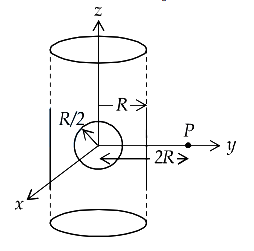
- An infinitely long solid cylinder of radius \(R\) has a uniform volume charge density \(\rho\). It has a spherical cavity of radius \(R / 2\) with its centre on the axis of the cylinder, as shown in the figure. The magnitude of the electric field at the point \(P\), which is at a distance \(2 R\) from the axis of the cylinder, is given by the expression \(\frac{23 \rho R}{16 K \varepsilon_{0}}\). The value of \(k\) is
 JEE Advanced 2012 Medium