


- JEE Mains 2019
- मध्यम
- MCQ
नीचे बाएँ स्तंभ में विभिन्न संचार विधायें एवं दायें स्तंभ में तरंगों के प्रकार दिये गये है।
| \(A.\) आप्टिकल फाइबर संचार | \(P.\) पराध्वनि |
| \(B.\) रेडार | \(Q.\) अवरक्त प्रकाश |
| \(C.\) सोनार | \(R.\) सूक्ष्म तरंगे |
| \(D.\) मोबाइल फोन | \(S.\) रेडियो तरंगे |
उत्तर और हल
(B) \(A -Q, B -S, C -P, D -R\)
चरण-दर-चरण हल
विस्तृत व्याख्या
For fiber optics with glass fibers, we use light in the infrared region which has wavelengths longer than visible light, typically around \(850,1300\) and \(1550 \mathrm{nm}\). Scattering is caused by light bouncing off atoms or molecules in the glass.
\(Radar -Radiowave\)
Radar is a detection system that uses radio waves to determine the range, angle, or velocity of objects.
\(Sonar -ultrasound\)
Sonar, as used in robotics means having an ultrasonic emitter and ultrasonic receiver. There is also some sonar with a single emitter/receiver. However, they all use ultrasonic sound ways in order to sense the distance to an object.
\(Mobilephones -microwave\)
we use microwaves as a power transmitter to our mobile phones. For this, we require a sensor, a rectenna circuit and a filer on our mobile phone. The microwave is sent with the message by the transmitter using an antenna at frequency \(2.24 \mathrm{GHz}\).
Physics के और प्रश्न
- यदि एक संधारित्र का आवेश \(2\,C\) से बढ़ता है तो इसमें संचित ऊर्जा \(44\, \%\) से बढ़ती है। संधारित्र पर मूल आवेश ज्ञात कीजिए (कूलाम में)JEE Mains 2022 मध्यम
- त्रिज्या \(r\) तथा लंबाई \(L\) के इस्पात के एक तार का यंग मापांक \(Y\) है। यदि तार की त्रिज्या \(r\) और लंबाई \(L\) को दोगुना कर दिया जाए, तो \(Y\) का मान होगाJEE Mains 2026 आसान
- एक उपग्रह को पृथ्वी के चारों ओर \(‘R’\) त्रिज्या की वृत्तीय कक्षा में तथा अन्य उपग्रह को \(1.02\,R\) त्रिज्या की कक्षा में स्थापित किया गया है। दोनों उपग्रहों के परिक्रमण कालों में ......... \((\%)\) प्रतिशत अन्तर होगाJEE Mains 2021 मध्यम
- चित्रानुसार पतली वृत्ताकार डिस्क \(x y\) समतल में है। \(z\) तथा \(z'\) के सापेक्ष जड़त्व आघूर्णों का अनुपात होगा
 JEE Mains 2018 कठिन
- 'm' द्रव्यमान के एक पिंड को मूल-बिंदु से एक ऊर्ध्वाधर \(x y\) तल में x-अक्ष से \(45^{\circ}\) के कोण पर प्रारंभिक वेग \(\mathrm{v}_0\) के साथ प्रक्षेपित किया जाता है। जब यह अधिकतम ऊँचाई पर पहुँचता है, तब मूल-बिंदु के सापेक्ष पिंड के कोणीय संवेग का परिमाण और दिशा क्या होगा? [g गुरुत्वीय त्वरण है]JEE Mains 2025 आसान
- दो लघु द्विध्रुव \((A, B)\), A पर \(\pm 2 \mu C\) आवेश और लंबाई 1 cm है और B पर \(\pm 4 \mu C\) आवेश और लंबाई 1 cm है। इन्हें चित्र में दर्शाए अनुसार उनके केंद्रों से 80 cm की दूरी पर रखा गया है। दोनों द्विध्रुवों के केंद्रों से समदूरस्थ एक बिंदु \(P\) पर विद्युत क्षेत्र ___________ N/C है।
 JEE Mains 2026 आसान
JEE Mains के और PYQ
- कक्ष तापमान पर एक तापक तन्तु का प्रतिरोध \(100 \Omega\) है। जब इसे \(220 \;V\) के स्रोत से जोड़ते हैं तो इसमें \(2\;A\) की एक स्थायी धारा प्रवाहित होती है और इसका तापमान कक्ष के तापमान से \(500^{\circ} C\) ज्यादा हो जाता है। तापक तन्तु के प्रतिरोध का ताप गुणांक कितना है ?JEE Mains 2018 कठिन
- सूची \(I\) को सूची \(II\) से मिलाइये।
नीचे दिये गये विकल्पों से सही उत्तर चुनिएँ:सूची \(-I\) (भौतिक राशियां) सूची\(-II\) (विभीय सूत्र) \((A)\) दाब प्रवणता \((I)\) \(\left[ M ^0 L ^2 T ^{-2}\right]\) \((B)\) ऊर्जा घनत्व \((II)\) \(\left[ M ^1 L ^{-1} T ^{-2}\right]\) \((C)\) वैद्युत क्षेत्र \((III)\) \(\left[ M ^1 L ^{-2} T ^{-2}\right]\) \((D)\) गुप्त ऊष्मा \((IV)\) \(\left[ M ^1 L ^1 T ^{-3} A ^{-1}\right]\) JEE Mains 2023 मध्यम - एक सरल लोलक को एक ऐसे स्थान पर रखा गया है कि इसकी पृथ्वी तल से दूरी पृथ्वी की त्रिज्या के समान है। यदि डोरी की लंबाई \(4\) मी. हो, तो सूक्ष्म दोलन का आवर्त काल _______ होगा। [दिया है, \(\mathrm{g}=\pi^2 \mathrm{~ms}^{-2}\) ]JEE Mains 2024 कठिन
- द्रव्यमान \(20\, g\) वाले एक कण को चित्रानुसार किसी वक्र के अनुदिश बिन्दु \(A\) से प्रारम्भिक वेग \(5 \, m / s\) से विरामावस्था से छोड़ा जाता है। बिन्दु \(A\), बिन्दु \(B\) से ऊँचाई \(h\) पर है। कण घर्षणरहित सतह पर फिसलता है। जब कण बिन्दु \(B\) पर पहुँचता है तो \(O\) के सापेक्ष इसका संवेग \(.........\,kg - m^2/s\) होगा। (दिया है : \(g =10 \,m / s ^{2}\) )
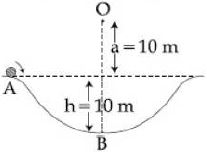 JEE Mains 2019 मध्यम
- पृथ्वी तल पर एक वस्तु का पलायन वेग \(11.2\) km/s है। यदि किसी ग्रह की त्रिज्या पृथ्वी की त्रिज्या की एक तिहाई तथा द्रव्यमान का एक छटवाँ भाग हो तो ग्रह पर पलायन वेग _______ है।JEE Mains 2024 कठिन
- एक आदर्श गैस दाब \(P_0\) तथा आयतन \(\mathrm{V}_0\) की अवस्था में है। इसे समतापीय रूप से इसके प्रारंभिक आयतन \(\left(\mathrm{V}_0\right)\) के 4 गुना तक प्रसारित किया जाता है, फिर समदाबीय रूप से इसके मूल आयतन तक संपीडित किया जाता है। अंततः, इसे अपनी प्रारंभिक अवस्था में वापस लाने के लिए निकाय को समआयतनिक रूप से गर्म किया जाता है। इस प्रक्रिया में विनिमय की गई ऊष्मा की मात्रा कितनी है?JEE Mains 2025 मध्यम