


- JEE Mains 2022
- कठिन
- MCQ
\(A.\) चालक के तापमान में वृद्धि के साथ, इलेक्ट्रॉनों के अपवाह वेग का मान घटता है। \(B.\) अपवाह वेग का मान, दिए हुए चालक के अनुप्रस्थ काट के क्षेत्रफल के व्युत्क्रमानुपाती होता है। \(C.\) अपवाह वेग, चालक पर आरोपित विभवान्तर के मान पर निर्भर नहीं करता है। \(D.\) इलेक्ट्रॉनों के अपवाह वेग का मान, चालक की लम्बाई के व्युत्क्रमानुपाती होता है। \(E.\) चालक के तापमान में वृद्धि के साथ, अपवाह वेग का मान बढ़ता है। नीचे दिए गए विकल्पों में से सही उत्तर चुनिए :
उत्तर और हल
(B) केवल \(A\) एवं \(D\)
चरण-दर-चरण हल
विस्तृत व्याख्या
\(v _{ d }=\left(\frac{ e \tau}{ m }\right)\left(\frac{\Delta V }{\ell}\right)\)
\(\Delta V=\) Potential difference applied across the wire
As temperature increases, relaxation time decreases, hence \(V _{ d }\) decreases.
As per formula, \(V _{ d } \propto \frac{1}{\ell}\)
\(v _{ d }=\frac{ I }{\text { neA }}\), as it is not mentioned that current is at steady state neither it is mentioned that \(n\) is constant for given conductor. So it can't be said that \(v _{ d }\) is inversely proportional to \(A\).
\(I=n e A v_{d}=\frac{V}{R}=\frac{V}{\rho \ell} A\)
\(v _{ d }=\frac{ V }{\rho \ell \text { ne }} \quad\left( E =\frac{ V }{\ell}\right)\)
\(v _{ d }=\frac{ eE \tau}{ m }\)
\(\tau\) decrease with temperature increase.
First and fourth statements are correct.
Physics के और प्रश्न
- एक हाइड्रोजन सदृश आयन में, द्वितीय उत्तेजन ऊर्जा अवस्था और मूल अवस्था के बीच ऊर्जा अंतर 108.8 eV है। आयन का परमाणु क्रमांक _______ है।JEE Mains 2025 मध्यम
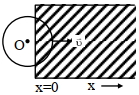
- परिसर \(x\,>\,0\) में \(1\) टेसला का एक अचर चुम्बकीय क्षेत्र लगाया जाता है। त्रिज्या \(1\) मी. का एक धात्वीय वत्ताकार छल्ला \(x\)-अक्ष के अनुदिश \(1\) मी/से वेग से चलता है। \(t =0 \,s\) पर छल्ले का केन्द्र \(O , x =-1\) मी पर है। \(t =1 \,s\) पर छल्ले में प्रेरित वि.वा.बल क्या होगा ?(\(V\) में) (मान लीजिए छल्ले का वेग परिवर्तित नहीं होता है)
 JEE Mains 2021 कठिन
- एक समतल विद्युतचुंबकीय तरंग निर्वात में \(+x\) दिशा के अनुदिश संचरित होती है। कार्तीय निर्देशांक निकाय में तरंग से संबंधित विद्युत क्षेत्र \(\vec{E}\) और चुंबकीय क्षेत्र \(\vec{B}\) सदिशों के घटक ________ हैं।JEE Mains 2025 आसान
- दी गई आकृति में, गुटके \(A, B\) और C का भार क्रमशः \(4 kg, 6 kg\) और 8 kg है। किन्हीं भी दो सतहों के बीच सर्पी घर्षण गुणांक 0.5 है। गुटके C को नियत चाल से खिसकाने के लिए आवश्यक बल \(\overrightarrow{ F }\) _________ N है। ( \(g =10 m / s ^2\) प्रयुक्त करें )
 JEE Mains 2026 मध्यम
- एक समतल वैद्युत चुम्बकीय तरंग का चुम्बकीय क्षेत्र निम्नवत है : \(\overrightarrow{ B }=2 \times 10^{-8} \sin \left(0.5 \times 10^3 x +1.5 \times 10^{11} t \right) \hat{ j } T\) विद्युत क्षेत्र का आयाम होगाJEE Mains 2022 मध्यम
- दिए गए ट्रांजिस्टर प्रवर्धक परिपथ के \(\mathrm{CE}\) (उभयनिष्ठ उत्सर्जक) अभिविन्यास में, \(\mathrm{V}_{\mathrm{CC}}=1 \mathrm{~V}, \mathrm{R}_{\mathrm{c}}=1 \mathrm{k} \Omega\), \(\mathrm{R}_{\mathrm{b}}=100 \mathrm{k} \Omega\) एवं \(\beta=100\) है आधार धारा \(\mathrm{I}_{\mathrm{b}}\) का मान है :
 JEE Mains 2023 मध्यम
JEE Mains के और PYQ
- एक वृत्ताकार लूप पर विचार करें जो एकसमान रूप से आवेशित है और जिसकी त्रिज्या \(\mathrm{a} \sqrt{2}\) है। कार्तीय निर्देशांक प्रणाली के धनात्मक z-अक्ष के अनुदिश उस स्थिति का पता लगाएं जहाँ विद्युत क्षेत्र अधिकतम है यदि वलय को मूल-बिंदु पर xy-तल में रखा हुआ माना गया था :JEE Mains 2025 आसान
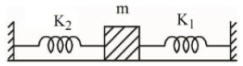
- प्रदर्शित चित्र में एक द्रव्यमान \(m\) दो स्प्रिंगों से जुड़ा है। दोनों स्प्रिंगो के स्प्रिंग नियतांक \(K_1\) व \(K_2\) है। घर्षण रहित सतह के लिए, द्रव्यमान \(m\) के दोलन का आवर्तकाल है:
 JEE Mains 2023 मध्यम