


JEE Mains · Chemistry · STD 11 - 3. Classification of elements and periodicity in properties
ચાર તત્ત્વો \(\mathrm{A}, \mathrm{B}, \mathrm{C}\) અને D ની ઇલેક્ટ્રોનીય રચના નીચે આપેલી છે :
(A) \(1 \mathrm{~s}^2 2 \mathrm{~s}^2 2 \mathrm{p}^3\)
(B) \(1 \mathrm{~s}^2 2 \mathrm{~s}^2 2 \mathrm{p}^4\)
(C) \(1 \mathrm{~s}^2 2 \mathrm{~s}^2 2 \mathrm{p}^5\)
(D) \(1 \mathrm{~s}^2 2 \mathrm{~s}^2 2 \mathrm{p}^2\)
નીચેનામાંથી કયો વિદ્યુતઋણતાનો (પૉલિંગ માપક્રમ) વધતો સાચો ક્રમ છે?
- A A < D < B < C
- B A < C < B < D
- C A < B < C < D
- D D < A < B < C
Answer & Solution
Correct Answer
(D) D < A < B < C
Step-by-step Solution
Detailed explanation
\(\mathrm{N}:-1 \mathrm{~s}^2 2 \mathrm{~s}^2 2 \mathrm{p}^3\) (વિદ્યુતઋણતા \(\left.=3\right)\) \(\mathrm{O}:-1 \mathrm{~s}^2 2 \mathrm{~s}^2 2 \mathrm{p}^4\) (વિદ્યુતઋણતા \(=3.5\)) \(\mathrm{F}:-1 \mathrm{~s}^2 2 \mathrm{~s}^2 2 \mathrm{p}^5\) (વિદ્યુતઋણતા \(=4\))…
See the Complete Solution
Get step-by-step explanations for this and 2.5 Lakh+ more JEE, NEET & CET questions.
- Unlock all solutions
- Practice the full chapter
- Track accuracy across PYQs
4.8 rated on Google Play · 14,000+ reviews
More questions from Chemistry
- \(CH_2Cl_2(DCM)\) નું \(2.6 \times 10^{-3}\) દ્રાવણ બનાવવા માટે અમુક પ્રમાણમાં ડાયક્લોરોમિથેન \((CH_2Cl_2)\) \(671.141\,mL\) ક્લોરોફોર્મ \((CHCl_3)\) માં ઉમેરવામાં આવે છે.તો \(DCM\) ની સાંદ્રતા \(.....\,ppm\) (દળ વડે) છે.(નજીકનો પૂર્ણાંક) આપેલું છેઃ પરમાણુ દળ \(:c =12\)\(H=1,\)\(CI= 35.5\),\(CHCl_3\)ની ઘનતા\(= 1.49\,g\,cm^3\)JEE Mains 2023 Hard
- ખોરાકનું આયર્ન (લોહતત્વ) વડે પ્રબલીકરણ \(\mathrm{FeSO}_4 \cdot 7 \mathrm{H}_2 \mathrm{O}\) નો ઉપયોગ કરીને કરવામાં આવે છે. 150 kg ઘઉંમાં 12 ppm આયર્ન (લોહતત્વ) પ્રાપ્ત કરવા માટે જરૂરી \(\mathrm{FeSO}_4 \cdot 7 \mathrm{H}_2 \mathrm{O}\) નું ગ્રામમાં દળ _______ છે. (નજીકનો પૂર્ણાંક)
[આપેલ છે: \(\mathrm{Fe}, \mathrm{S}\) અને O ના મોલર દળ અનુક્રમે 56, 32 અને \(16 \mathrm{~g} \mathrm{~mol}^{-1}\) છે.]JEE Mains 2025 Medium - એક નિયોપેન્ટાઇલ અને એક વિનાઇલ સમૂહ ધરાવતો સાત કાર્બન સાથેનો હાઇડ્રોકાર્બન જણાવો.JEE Mains 2016 Hard
- \(Gd ^{3+}( Z =64)\) ની સાચી ઇલેક્ટ્રોનિક રચના અને સ્પિન ફક્ત ચુંબકીય ચાકમાત્રા \((BM)\) અનુક્રમે કઈ છે?JEE Mains 2020 Medium
- કાલ્પનિક પરિસ્થિતિને ધ્યાનમાં લો જ્યાં ગૌણ ક્વોન્ટમ આંક \(l\)\(0\) , \(1,2, \ldots \ldots n+1,\) ની કિંમતો લે છે જ્યાં \(n\) એ મુખ્ય ક્વોન્ટમ આંક છે ત્યારે અણુ સંખ્યા સાથેનું તત્વJEE Mains 2020 Hard
- નીચે બે વિધાનો આપેલા છે વિધાન \(I :\) બોહરનો સિદ્ધાંત \(Li ^{+}\) આયનની સ્થિરતા અને લાઇન સ્પેક્ટ્રમ માટે છે. વિધાન \(II :\) બોહરનો સિદ્ધાંત ચુંબકીય ક્ષેત્રની હાજરીમાં વર્ણપટ્ટી રેખાઓનું વિભાજન સમજાવવામાં અસમર્થ હતું. ઉપરોક્ત વિધાનોના પ્ચે આપેલા વિકલ્પોમાંથી સૌથી યોગ્ય જવાબ પસંદ કરો:JEE Mains 2021 Medium
More PYQs from JEE Mains
- સ્પ્રિંગ જેની મૂળભૂત લંબાઈ \(\ell \) અને બળ અચળાંક \(k\) છે તેને \(\ell_1\) અને \(\ell_2\) લંબાઈના બે ભાગમાં વિભાજિત કરવામાં આવે છે જ્યાં \(\ell_1 = n\ell_2\) અને \(n\) પૂર્ણાક છે, તો બંને સ્પ્રિંગના બળ અચળાંકનો ગુણોત્તર \(k_1/k_2\) =JEE Mains 2019 Medium
- \(( S 1): \lim _{ n \rightarrow \infty} \frac{1}{ n ^2}(2+4+6+\ldots \ldots \ldots+2 n)=1\) (S2) : \(\lim _{ n \rightarrow \infty} \frac{1}{ n ^{16}}\left(1^{15}+2^{15}+3^{15}+\ldots \ldots \ldots .+ n ^{15}\right)=\frac{1}{16}\) માથી:JEE Mains 2023 Hard
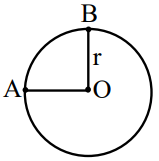
- એકમ લંબાઈ દીઠ સમાન \(\lambda \Omega / m\) અવરોધ ધરાવતો એક તાર \(r\) ત્રિજ્યાના વર્તુળમાં વાળવામાં આવે છે અને તારનો બીજો એક 2 r લંબાઈનો ટુકડો A અને B \(( AOB )\) બિંદુઓ વચ્ચે, આકૃતિમાં દર્શાવ્યા મુજબ, જોડવામાં આવે છે. A અને B બિંદુઓ વચ્ચેનો સમતુલ્ય અવરોધ ___________\(\Omega\) છે.
 JEE Mains 2026 Easy
 - સમતલનું સમીકરણ મેળવો કે જે રેખા \(\frac{x}{2} = \frac{y}{3} = \frac{z}{4}\) ને સમાવે છે અને સમતલ ને લંબ છે કે જે રેખાઓ \(\frac{x}{3} = \frac{y}{4} = \frac{z}{2}\) અને \(\frac{x}{4} = \frac{y}{2} = \frac{z}{3}\) ને સમાવે છે .JEE Mains 2019 Hard
- \(0.8 \,kg m ^{2}\) વ્યાસને અનુલક્ષીને ઝડપ ની ચાકમાત્રા અને \(20\, Am ^{2}\) ચુંબકીય મોમેન્ટ ધરાવતી વતુળકાર કોઈલ છે. કોઈલ શરૂઆતમાં શિરોલંબ છે. અને તે સમક્ષિતિજ વ્યાસને અનુલક્ષીને ભ્રમણ કરે છે. તેના પર \(4T\) \(3\) ચુંબકીયક્ષેત્ર શિરીલંબ છે. લગાવતા તે \(60^{\circ}\) ભ્રમણ કરે ત્યારે કોણીય વેગJEE Mains 2020 Hard
- ધારોકે \(S_K=\frac{1+2+\ldots+K}{K}\) અને \(\sum \limits_{j=1}^n S_j^2=\frac{n}{A}\left(B n^2+C n+D\right)\), જ્યાં \(A, B, C, D \in N\) અને \(A\) ની ન્યૂનતમ કિમત છે. તોJEE Mains 2023 Hard