


JEE Mains · Maths · STD 12 - 9. differential equations
Let \(y=y(x)\) be the solution of the differential equation: \(\dfrac{dy}{dx}+\left(\dfrac{6x^2+(3x^2+2x^3+4)e^{-2x}}{(x^3+2)(2+e^{-2x})}\right)y=2+e^{-2x}\), \(x \in (-1,2)\), satisfying \(y(0)=\dfrac{3}{2}\). If \(y(1)=\alpha(2+e^{-2})\), then \(\alpha\) is equal to:
- A \(\dfrac{13}{8}\)
- B \(\dfrac{6}{13}\)
- C \(\dfrac{12}{13}\)
- D \(\dfrac{13}{12}\)
Answer & Solution
Correct Answer
(D) \(\dfrac{13}{12}\)
Step-by-step Solution
Detailed explanation
The given differential equation is a linear differential equation of the form \(\dfrac{dy}{dx} + P(x)y = Q(x)\), where \(P(x) = \dfrac{6x^2 + (3x^2 + 2x^3 + 4)e^{-2x}}{(x^3+2)(2+e^{-2x})}\) and \(Q(x) = 2 + e^{-2x}\). We can rewrite \(P(x)\) as:…
See the Complete Solution
Get step-by-step explanations for this and 2.5 Lakh+ more JEE, NEET & CET questions.
- Unlock all solutions
- Practice the full chapter
- Track accuracy across PYQs
4.8 rated on Google Play · 14,000+ reviews
More questions from Maths
- Twenty metres of wire is available for fencing off a flowerbed in the form of a circular sector. Then the maximum area (in sq. m) of the flower bed is :JEE Mains 2017 Hard
- If the lengths of the sides of a triangle are in \(A.P.\) and the greatest angle is double the smallest, then a ratio of lengths of the sides of this triangleJEE Mains 2019 Hard
- For \(k \in R\), let the solutions of the equation \(\cos \left(\sin ^{-1}\left(x \cot \left(\tan ^{-1}\left(\cos \left(\sin ^{-1} x\right)\right)\right)\right)\right)=k, 0\,<\,|x|<\,\frac{1}{\sqrt{2}}\) be \(\alpha\) and \(\beta\), where the inverse trigonometric functions take only principal values. If the solutions of the equation \(x ^{2}- bx -5=0\) are \(\frac{1}{\alpha^{2}}+\frac{1}{\beta^{2}}\) and \(\frac{\alpha}{\beta}\), then \(\frac{b}{k^{2}}\) is equal to\(......\)JEE Mains 2022 Hard
- If the area of the region \(S=\left\{(x, y): 2 y-y^2 \leq x^2 \leq 2 y, x \geq y\right\}\) is equal to \(\frac{ n +2}{ n +1}-\frac{\pi}{ n -1}\), then the natural number \(n\) is equal to \(...............\).JEE Mains 2023 Hard
- If \({\Delta _1} = \left| {\begin{array}{*{20}{c}}
x&{\sin \,\theta }&{\cos \,\theta } \\
{\sin \,\theta }&{ - x}&1 \\
{\cos \,\theta }&1&x
\end{array}} \right|\) and \({\Delta _1} = \left| {\begin{array}{*{20}{c}}
x&{\sin \,2\theta }&{\cos \,\,2\theta } \\
{\sin \,2\theta }&{ - x}&1 \\
{\cos \,\,2\theta }&1&x
\end{array}} \right|\), \(x \ne 0\) ; then for all \(\theta \in \left( {0,\frac{\pi }{2}} \right)\)JEE Mains 2019 Hard - The \(8^{\text {th }}\) common term of the series \(S _1=3+7+11+15+19+\ldots . .\) ; \(S _2=1+6+11+16+21+\ldots .\) is \(.......\).JEE Mains 2023 Medium
More PYQs from JEE Mains
- A data consists of \(n\) observations \({x_1},{x_2},......,{x_n}.\) If \(\sum\limits_{i - 1}^n {{{({x_i} + 1)}^2}} = 9n\) and \(\sum\limits_{i - 1}^n {{{({x_i} - 1)}^2}} = 5n,\) then the standard deviation of this data isJEE Mains 2019 Hard
- Let the foot of perpendicular from a point \(P(1,2,-1)\) to the straight line \(L: \frac{x}{1}=\frac{y}{0}=\frac{z}{-1}\) be \(N\). Let a line be drawn from \(P\) parallel to the plane \(x+y+2 z=0\) which meets \(L\) at point \(Q\). If \(\alpha\) is the acute angle between the lines \(\mathrm{PN}\) and \(\mathrm{PQ}\), then \(\cos \alpha\) is equal to \(.....\)JEE Mains 2021 Hard
- In a series of \(2n\) observation, half of them are equal to \('a'\) and remaining half observations are equal to \(' -a'\). If the standard deviation of this observations is \(2\) then \(\left| a \right|\) equalsJEE Mains 2013 Hard
- Let the positive integers be written in the form :
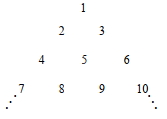
If the \(\mathrm{k}^{\text {th }}\) row contains exactly \(\mathrm{k}\) numbers for every natural number \(\mathrm{k}\), then the row in which the number \(5310\) will be, is .........JEE Mains 2024 Hard - If the integral \(\int {\frac{{\cos \,8x + 1}}{{\cot \,2x - \tan \,2x}}} dx = A\,\cos \,8x + k,\) where \(k\) is an arbitrary constant, then \(A\) is equal toJEE Mains 2013 Hard
- The radius of the smallest circle which touches the parabolas \(y=x^2+2\) and \(x=y^2+2\) isJEE Mains 2025 Medium