


JEE Advanced · Chemistry · 14. Hydrocarbons
The synthesis of 3-octyne is achieved by adding a bromoalkane into a mixture of sodium amide and an alkyne. The bromoalkane and alkyne respectively are
- A \(\mathrm{BrCH}_2 \mathrm{CH}_2 \mathrm{CH}_2 \mathrm{CH}_2 \mathrm{CH}_3\) and \(
\mathrm{CH}_3 \mathrm{CH}_2 \mathrm{C} \equiv \mathrm{CH}\) - B \(\mathrm{BrCH}_2 \mathrm{CH}_2 \mathrm{CH}_3\) and \(\mathrm{CH}_3 \mathrm{CH}_2 \mathrm{CH}_2 \mathrm{C} \equiv \mathrm{CH}\)
- C \(\mathrm{BrCH}_2 \mathrm{CH}_2 \mathrm{CH}_2 \mathrm{CH}_2 \mathrm{CH}_3\) and \(\mathrm{CH}_3 \mathrm{C} \equiv \equiv \mathrm{CH}\)
- D \(\mathrm{BrCH}_2 \mathrm{CH}_2 \mathrm{CH}_2 \mathrm{CH}_3\) and \(\mathrm{CH}_3 \mathrm{CH}_2 \mathrm{C} \equiv \mathrm{CH}\)
Answer & Solution
Correct Answer
(D) \(\mathrm{BrCH}_2 \mathrm{CH}_2 \mathrm{CH}_2 \mathrm{CH}_3\) and \(\mathrm{CH}_3 \mathrm{CH}_2 \mathrm{C} \equiv \mathrm{CH}\)
Step-by-step Solution
Detailed explanation
\(\mathrm{CH}_3-\mathrm{CH}_2-\mathrm{C} \equiv \mathrm{C}-\mathrm{CH}_2\) \(-\mathrm{CH}_2-\mathrm{CH}_2-\mathrm{CH}_3\) There are two (marked) possibility of halides
Thus, in the given context
\(\mathrm{CH}_3 \mathrm{CH}_2 \mathrm{C} \equiv \mathrm{CH}+\mathrm{NaNH}_2 \longrightarrow \)
\(\mathrm{CH}_3 \mathrm{CH}_2-\mathrm{C} \equiv \overline{\mathrm{CNa}^{+}}\)
\(\mathrm{CH}_3 \mathrm{CH}_2 \mathrm{C} \equiv \overline{\mathrm{CNa}} \)
\(\longrightarrow \mathrm{CH}_3 \mathrm{CH}_2 \mathrm{C} \equiv \mathrm{BrCH}_2 \mathrm{CH}_2 \mathrm{CH}_2 \mathrm{CH}_3 \)
\(\text { 3-octyne } \mathrm{CH}_2 \mathrm{CH}_2 \mathrm{CH}_2 \mathrm{CH}_3\)
Hydrocarbon
Conceptual, reaction understanding II
Thus, in the given context
\(\mathrm{CH}_3 \mathrm{CH}_2 \mathrm{C} \equiv \mathrm{CH}+\mathrm{NaNH}_2 \longrightarrow \)
\(\mathrm{CH}_3 \mathrm{CH}_2-\mathrm{C} \equiv \overline{\mathrm{CNa}^{+}}\)
\(\mathrm{CH}_3 \mathrm{CH}_2 \mathrm{C} \equiv \overline{\mathrm{CNa}} \)
\(\longrightarrow \mathrm{CH}_3 \mathrm{CH}_2 \mathrm{C} \equiv \mathrm{BrCH}_2 \mathrm{CH}_2 \mathrm{CH}_2 \mathrm{CH}_3 \)
\(\text { 3-octyne } \mathrm{CH}_2 \mathrm{CH}_2 \mathrm{CH}_2 \mathrm{CH}_3\)
Hydrocarbon
Conceptual, reaction understanding II
See the Complete Solution
Get step-by-step explanations for this and 2.5 Lakh+ more JEE, NEET & CET questions.
- Unlock all solutions
- Practice the full chapter
- Track accuracy across PYQs
4.8 rated on Google Play · 14,000+ reviews
More questions from Chemistry
- A closed vessel contains \(10 \mathrm{~g}\) of an ideal gas \(\mathbf{X}\) at \(300 \mathrm{~K}\), which exerts 2 atm pressure. At the same temperature, \(80 \mathrm{~g}\) of another ideal gas \(\mathbf{Y}\) is added to it and the pressure becomes \(6 \mathrm{~atm}\). The ratio of root mean square velocities of \(\mathbf{X}\) and \(\mathbf{Y}\) at \(300 \mathrm{~K}\) isJEE Advanced 2024 Medium
- The correct statement(s) concerning the structures E, F and G is are
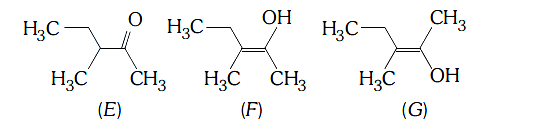 JEE Advanced 2008 Easy
 - Consider the following list of reagents: Acidified , alkaline and . The total number of reagents that can oxidise aqueous iodide to iodine isJEE Advanced 2014 Medium
- The correct statement(s) regarding defects in solids is (are)JEE Advanced 2009 Medium
- Paragraph:
Upon heating \(\mathrm{KClO}_{3}\) in the presence of catalytic amount of \(\mathrm{MnO}_{2}\), a gas \(\mathbf{W}\) is formed. Excess amount of \(\mathbf{W}\) reacts with white phosphorus to give \(\mathbf{X}\). The reaction of \(\mathbf{X}\) with pure \(\mathrm{HNO}_{3}\) gives \(\mathbf{Y}\) and \(\mathbf{Z}\).
Question:
\(\mathbf{W}\) and \(\mathbf{X}\) are, respectivelyJEE Advanced 2017 Medium - Statement I Boron always forms covalent bond
Statement II The small size of \(\mathrm{B}^{3+}\) favours formation of covalent bond.JEE Advanced 2007 Medium
More PYQs from JEE Advanced
- For any matrix , let denote the determinant of . Let be the identity matrix. Let and be two matrices such that is invertible. If , then which of the following statements is (are) TRUE ?JEE Advanced 2021 Medium
- The greatest integer less than or equal to isJEE Advanced 2022 Medium
- The graph between object distance \(u\) and image distance \(v\) for a lens is given below. The focal length of the lens is
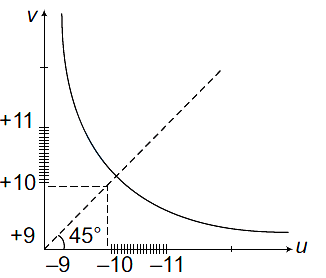 JEE Advanced 2006 Hard
 - Match the thermodynamic processes given under Column I with the expressions given under Column II.
Column I Column II A. Freezing of water at 273 K and 1 atm P. B. Expansion of 1 mol of an ideal gas into a vacuum under isolated conditions Q. C. Mixing of equal volumes of two ideal gases at constant temperature and pressure in an isolated container R. D. Reversible heating of at 1 atm from 300 K to 600 K, followed by reversible cooling to 300 K at 1 atm S. T. JEE Advanced 2015 Hard - Consider a concave mirror and a convex lens (refractive index = ) of focal length each, separated by a distance of in air (refractive index = ), as shown in the figure. An object is placed at a distance of from the mirror. Its erect image, formed by this combination, has magnification . When the set-up is kept in a medium of refractive index , the magnification becomes . The magnitude is
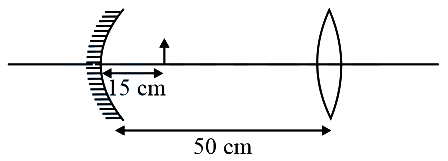 JEE Advanced 2015 Medium
 - Let \(P\left(x_1, y_1\right)\) and \(Q\left(x_2, y_2\right), y_1 < 0, y_2 < 0\), be the end points of the latusrectum of the ellipse \(x^2+4 y^2=4\). The equations of parabolas with latusrectum \(P Q\) areJEE Advanced 2008 Hard