


JEE Advanced · Chemistry · 6. Thermodynamics (C)
Match the thermodynamic processes given under Column I with the expressions given under Column II.
| Column I | Column II | ||
| A. | Freezing of water at 273 K and 1 atm | P. | |
| B. | Expansion of 1 mol of an ideal gas into a vacuum under isolated conditions | Q. | |
| C. | Mixing of equal volumes of two ideal gases at constant temperature and pressure in an isolated container | R. | |
| D. | Reversible heating of at 1 atm from 300 K to 600 K, followed by reversible cooling to 300 K at 1 atm | S. | |
| T. |
- A a-r;b-s,t;c-r,s,t;d-s,t;
- B a-q,r;b-q;c-q;d-s,t;
- C a-r,t;b-p,q,s;c-p,q,s;d-p,q,s,t;
- D a-q,r,s;b-s,t;c-q,r,s;d-t;
Answer & Solution
Correct Answer
(C) a-r,t;b-p,q,s;c-p,q,s;d-p,q,s,t;
Step-by-step Solution
Detailed explanation
A - at 273 K. & 1 atm
(as water expands on freezing),
B - Free expansion of ideal gas.
q = 0
w = 0
C - Mixing of equal volume of ideal gases at constant pressure & temp in an isolated container
q = 0, w = 0, , ,

, ,
(as water expands on freezing),
B - Free expansion of ideal gas.
q = 0
w = 0
C - Mixing of equal volume of ideal gases at constant pressure & temp in an isolated container
q = 0, w = 0, , ,
, ,
See the Complete Solution
Get step-by-step explanations for this and 2.5 Lakh+ more JEE, NEET & CET questions.
- Unlock all solutions
- Practice the full chapter
- Track accuracy across PYQs
4.8 rated on Google Play · 14,000+ reviews
More questions from Chemistry
- Paragraph:
Chemical reactions involve interaction of atoms and molecules. A large number of atoms/molecules (approximately \(6.023 \times 10^{23}\) ) are present in a few grams of any chemical compound varying with their atomic/molecular masses. To handle such large numbers conveniently, the mole concept was introduced. This concept has implications in diverse areas such as analytical chemistry, biochemistry, electrochemistry and radiochemistry. The following example illustrates a typical case, involving chemical/electrochemical reaction, which requires a clear understanding of the mole concept.
A \(4.0\) molar aqueous solution of \(\mathrm{NaCl}\) is prepared and \(500 \mathrm{~mL}\) of this solution is electrolysed. This leads to the evolution of chlorine gas at one of electrodes (atomic mass: \(\mathrm{Na}=23, \mathrm{Hg}=200 ; 1\) faraday \(=96500\) coulombs).
Question:
The total number of moles of chlorine gas evolved isJEE Advanced 2007 Medium - The species having bond order different from that in \(\mathrm{CO}\) isJEE Advanced 2007 Easy
- Match each of the compounds given in Column I with the reaction (s) that they can undergo, given in Column II.
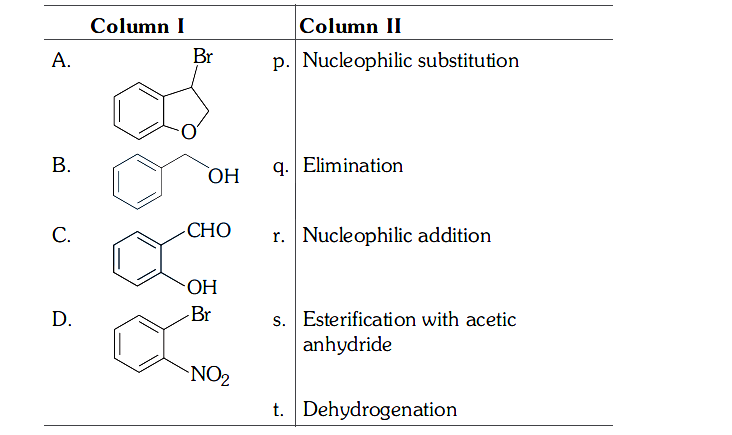 JEE Advanced 2009 Hard
 - Reaction of \(\mathrm{Br}_2\) with \(\mathrm{Na}_2 \mathrm{CO}_3\) in aqueous solution gives sodium bromide and sodium bromate with evolution of \(\mathrm{CO}_2\) gas. The number of sodium bromide molecules involved in the balanced chemical equation isJEE Advanced 2011 Medium
- In an electrochemicalcell, dichromate ions in aqueous acidic medium are reduced to \(\mathrm{Cr}^{3+}\). The current (in amperes) that flows through the cell for 48.25 minutes to produce 1 mole of \(\mathrm{Cr}^{3+}\) is _____ .
Use: 1 Faraday \(=96500 \mathrm{C} \mathrm{mol}^{-1}\)JEE Advanced 2025 Easy - The qualitative sketches I, II and III given below show the variation of surface tension with molar concentration of three different aqueous solutions of KCl, and at room temperature. The correct assignment of the sketches is -
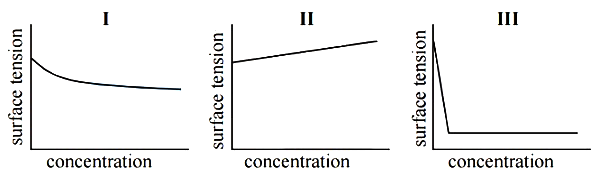 JEE Advanced 2016 Hard
More PYQs from JEE Advanced
- For a complex number , let denote the real part of . Let be the set of all complex numbers satisfying where . Then the minimum possible value of where with and is _______JEE Advanced 2020 Medium
- The figure shows certain wire segments joined together to form a coplanar loop. The loop is placed in a perpendicular
magnetic field in the direction going into the plane of the figure. The magnitude of the field increases with time. \(I_1\) and \(I_2\) are the currents in the segments \(a b\) and \(c d\). Then,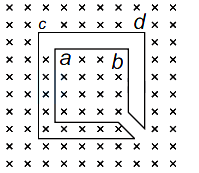 JEE Advanced 2009 Easy
 - When 100 mL of 1.0 M HCl was mixed with 100 mL of 1.0 M NaOH in an insulated beaker at constant pressure, a temperature increase of was measured for the beaker and its contents (Expt.1). Because the enthalpy of neutralization of a strong acid with a strong base is a constant , this experiment could be used to measure the calorimeter constant. In a second experiment (Expt. 2), 100 mL of 2.0 M acetic acid was mixed with 100 mL of 1.0 M NaOH (under identical conditions to Expt. 1) where a temperature rise of was measured. (Consider heat capacity of all solutions as and density of all solutions as )
The pH of the solution after Expt. 2 isJEE Advanced 2015 Medium - Paragraph: When potassium iodide is added to an aqueous solution of potassium ferricyanide, a reversible reaction is observed in which a complex \(\mathrm{P}\) is formed. In a strong acidic medium, the equilibrium shifts completely towards \(\mathrm{P}\). Addition of zinc chloride to \(\mathrm{P}\) in a slightly acidic medium results in a sparingly soluble complex Q.
Question: The number of moles of potassium iodide required to produce two moles of \(\mathbf{P}\) isJEE Advanced 2024 Medium - We have taken a saturated solution of \(\mathrm{AgBr}, K_{\mathrm{sp}}\) is \(12 \times 10^{-14}\). If \(10^{-7}\) mole of \(\mathrm{AgNO}_3\) are added to 1 litre of this solution, find conductivity (specific conductance) of this solution in terms of \(10^{-7} \mathrm{Sm}^{-1}\) units.
\( \text {Given, } \lambda_{\left(\mathrm{Ag}^{+}\right)}^{\circ} =6 \times 10^{-3} \mathrm{Sm}^2 \mathrm{~mol}^{-1},\) \(\lambda_{\left(\mathrm{Br}^{-}\right)}^{\circ}=8 \times 10^{-3} \mathrm{Sm}^2 \mathrm{~mol}^{-1}, \)
\( \lambda_{\left(\mathrm{NO}_3^{-}\right)} =7 \times 10^{-3} \mathrm{Sm}^2 \mathrm{~mol}^{-1},\)JEE Advanced 2006 Hard - Paragraph:
In a mixture of \(\mathrm{H}-\mathrm{H}^{+}\)gas \(\left(\mathrm{He}^{+}\right.\)is singly ionised \(\mathrm{He}\) atom), \(\mathrm{H}\) atoms and \(\mathrm{He}^{+}\)ions are excited to their respective first excited states. Subsequently, \(\mathrm{H}\) atoms transfer their total excitation energy to \(\mathrm{He}^{+}\)ions (by collisions). Assume that the Bohr model of atom is exactly valid.
Question:
The ratio of the kinetic energy of the \(n=2\) electron for the \(\mathrm{H}\) atom to that of \(\mathrm{He}^{+}\) ion isJEE Advanced 2008 Easy