


JEE Advanced · Chemistry · 5. States of Matter
A closed vessel contains \(10 \mathrm{~g}\) of an ideal gas \(\mathbf{X}\) at \(300 \mathrm{~K}\), which exerts 2 atm pressure. At the same temperature, \(80 \mathrm{~g}\) of another ideal gas \(\mathbf{Y}\) is added to it and the pressure becomes \(6 \mathrm{~atm}\). The ratio of root mean square velocities of \(\mathbf{X}\) and \(\mathbf{Y}\) at \(300 \mathrm{~K}\) is
- A \(2 \sqrt{2}: \sqrt{3}\)
- B \(2 \sqrt{2}: 1\)
- C \(1: 2\)
- D \(2: 1\)
Answer & Solution
Correct Answer
(D) \(2: 1\)
Step-by-step Solution
Detailed explanation
For Ideal Gas
\(\mathrm{PV}=\mathrm{nRT}\)
\(\therefore \mathrm{n} \propto \mathrm{P}\) at constant \(\mathrm{T} \& \mathrm{~V}\).
\(\because \quad\) mole \(=\frac{\text { Mass }}{\text { Molar mass }}\)
For gas \(\mathrm{X}: \frac{10}{\mathrm{M}_{\mathrm{X}}} \propto 2 \mathrm{~atm}\) \(\quad\) \(\ldots\)(1)
For gas \(\mathrm{X} \& \mathrm{Y}: \frac{10}{\mathrm{M}_{\mathrm{X}}}+\frac{80}{\mathrm{M}_{\mathrm{Y}}} \propto 6 \mathrm{~atm}\) \(\ldots\)(2)
From \((2)-(1)\)
\(\frac{80}{\mathrm{M}_{\mathrm{y}}} \propto 4\) \(\ldots\)(3)
On dividing (1) by (3)
\(\frac{\mathrm{M}_{\mathrm{Y}}}{8 \mathrm{M}_{\mathrm{X}}}=\frac{1}{2}\)
\(\therefore \quad \frac{\mathrm{M}_{\mathrm{Y}}}{\mathrm{M}_{\mathrm{X}}}=4\) \(\ldots\)(4)
\(\because \mathrm{V}_{\mathrm{rms}}=\sqrt{\frac{3 \mathrm{RT}}{\mathrm{M}}} \Rightarrow \mathrm{v}_{\mathrm{rms}} \propto \frac{1}{\sqrt{\mathrm{M}}}\)
\(\therefore \quad \frac{\left(\mathrm{V}_{\mathrm{ms}}\right)_{\mathrm{X}}}{\left(\mathrm{V}_{\mathrm{ms}}\right)_{\mathrm{Y}}}=\sqrt{\frac{\mathrm{M}_{\mathrm{Y}}}{\mathrm{M}_{\mathrm{x}}}}=\sqrt{\frac{4}{1}}=\frac{2}{1}\)
\(\mathrm{PV}=\mathrm{nRT}\)
\(\therefore \mathrm{n} \propto \mathrm{P}\) at constant \(\mathrm{T} \& \mathrm{~V}\).
\(\because \quad\) mole \(=\frac{\text { Mass }}{\text { Molar mass }}\)
For gas \(\mathrm{X}: \frac{10}{\mathrm{M}_{\mathrm{X}}} \propto 2 \mathrm{~atm}\) \(\quad\) \(\ldots\)(1)
For gas \(\mathrm{X} \& \mathrm{Y}: \frac{10}{\mathrm{M}_{\mathrm{X}}}+\frac{80}{\mathrm{M}_{\mathrm{Y}}} \propto 6 \mathrm{~atm}\) \(\ldots\)(2)
From \((2)-(1)\)
\(\frac{80}{\mathrm{M}_{\mathrm{y}}} \propto 4\) \(\ldots\)(3)
On dividing (1) by (3)
\(\frac{\mathrm{M}_{\mathrm{Y}}}{8 \mathrm{M}_{\mathrm{X}}}=\frac{1}{2}\)
\(\therefore \quad \frac{\mathrm{M}_{\mathrm{Y}}}{\mathrm{M}_{\mathrm{X}}}=4\) \(\ldots\)(4)
\(\because \mathrm{V}_{\mathrm{rms}}=\sqrt{\frac{3 \mathrm{RT}}{\mathrm{M}}} \Rightarrow \mathrm{v}_{\mathrm{rms}} \propto \frac{1}{\sqrt{\mathrm{M}}}\)
\(\therefore \quad \frac{\left(\mathrm{V}_{\mathrm{ms}}\right)_{\mathrm{X}}}{\left(\mathrm{V}_{\mathrm{ms}}\right)_{\mathrm{Y}}}=\sqrt{\frac{\mathrm{M}_{\mathrm{Y}}}{\mathrm{M}_{\mathrm{x}}}}=\sqrt{\frac{4}{1}}=\frac{2}{1}\)
See the Complete Solution
Get step-by-step explanations for this and 2.5 Lakh+ more JEE, NEET & CET questions.
- Unlock all solutions
- Practice the full chapter
- Track accuracy across PYQs
4.8 rated on Google Play · 14,000+ reviews
More questions from Chemistry
- Paragraph:
In hexagonal system of crystals, a frequently encountered arrangement of atoms is described as a hexagonal prism. Here, the top and bottom of the cell are regular hexagons and three atoms are sandwiched in between them. A space-filling model of this structure, called hexagonal close-packed (HCP), is constituted of a sphere on a flat surface surrounded in the same plane by six identical spheres as closely as possible. Three spheres are then placed over the first layer so that they touch each other and represent the second layer. Each one of the three spheres touches three spheres of the bottom layer. Finally, the second layer is covered with a third layer that is identical to the bottom layer in relative position. Assume radius of every sphere to be ' \(r\) '.
Question:
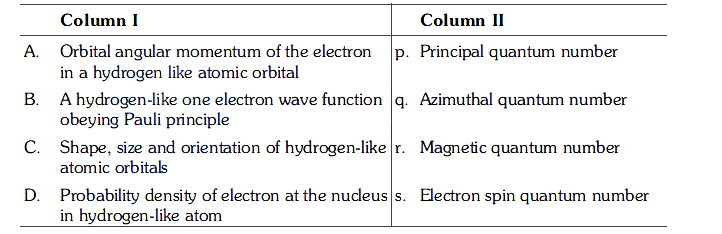
The empty space in this \(\mathrm{HCP}\) unit cell isJEE Advanced 2008 Medium - Match the entries in Column I with the correctly related quantum number(s) in Column II. Indicate your answer by darkening the appropriate bubbles of the \(4 \times 4\) matrix given in the ORS.
 JEE Advanced 2008 Easy
 - Electrolysis of dilute aq. \(\mathrm{NaCl}\) solution was carried out by passing \(10 \mathrm{~mA}\) current. The time required to liberate \(0.01\) mole of \(\mathrm{H}_2\) gas at the cathode is (1 Faraday \(=96500 \mathrm{C} \mathrm{mol}^{-1}\) )JEE Advanced 2008 Hard
- The maximum number of possible isomers (including stereoisomers) which may be formed on mono-bromination of -methylcyclohex- -ene using and light is ___.JEE Advanced 2021 Medium
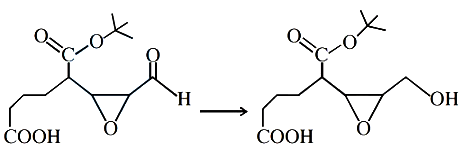
- Reagent(s) which can be used to bring about the following transformation is(are)
 JEE Advanced 2016 Medium
 - The reaction of white phosphorus with aqueous \(\mathrm{NaOH}\) gives phosphine along with another phosphorus containing compound. The reaction type; the oxidation states of phosphorus in phosphine and the other product are respectivelyJEE Advanced 2012 Easy
More PYQs from JEE Advanced
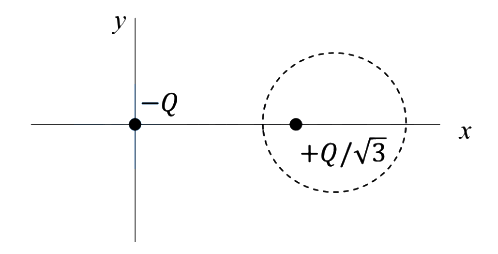
- Two point charges \(-Q\) and \(+Q / \sqrt{3}\) are placed in the \(x y\)-plane at the origin \((0,0)\) and a point \((2,0)\), respectively, as shown in the figure. This results in an equipotential circle of radius \(R\) and potential \(V=0\) in the \(x y\)-plane with its center at \((b, 0)\). All lengths are measured in meters.
The value of is ________ meter.JEE Advanced 2021 Medium - A normal with slope \(\frac{1}{\sqrt{6}}\) is drawn from the point \((0,-\alpha)\) to the parabola \(x^2=-4 a y\), where \(a>0\). Let \(L\) be the line passing through \((0,-\alpha)\) and parallel to the directrix of the parabola. Suppose that \(L\) intersects the parabola at two points \(A\) and \(B\). Let \(r\) denote the length of the latus rectum and \(s\) denote the square of the length of the line segment \(A B\). If \(r: s=1: 16\), then the value of 24ais ________.JEE Advanced 2024 Medium
- The positon vector \(\vec{r}\) of a particle of mass m is given by the following equation \(\vec{r}(t)=\alpha t^3 \hat{i} +\beta t^2 \hat{j}\), where \(\alpha=\frac{10}{3} m s^{-3}, \beta=5 m s^{-2}\) and \(m=0.1 kg\). At \(t=1 s\), which of the following statements (s) is (are) true about the particle?JEE Advanced 2016 Easy
- Extraction for zinc from zinc blende is achieved byJEE Advanced 2007 Medium
- Consider the following reaction,
\(2 \mathrm{H}_2(\mathrm{~g})+2 \mathrm{NO}(\mathrm{g}) \rightarrow \mathrm{N}_2(\mathrm{~g})+2 \mathrm{H}_2 \mathrm{O}(\mathrm{g})\)
which follows the mechanism given below:
\(2 \mathrm{NO}(\mathrm{g}) \stackrel{k_1}{\underset{k_{-1}}{\rightleftharpoons}} \mathrm{N}_2 \mathrm{O}_2(\mathrm{~g})\) \(\quad\) (fast equlibrium)
\(\mathrm{N}_2 \mathrm{O}_2(\mathrm{~g})+\mathrm{H}_2(\mathrm{~g}) \xrightarrow{k_2} \mathrm{~N}_2 \mathrm{O}(\mathrm{g})+\mathrm{H}_2 \mathrm{O}(\mathrm{g})\) \(\quad\)(slow reaction)
\(\mathrm{N}_2 \mathrm{O}(\mathrm{g})+\mathrm{H}_2(\mathrm{~g}) \xrightarrow{k_3} \mathrm{~N}_2(\mathrm{~g})+\mathrm{H}_2 \mathrm{O}(\mathrm{g})\) \(\quad\) (fast reaction)
The order of the reaction is_____JEE Advanced 2024 Medium - Let \(a_{n}\) denote the number of all \(n\)-digit positive integers formed by the digits 0,1 or both such that no consecutive digits in them are 0 . Let \(b_{n}=\) the number of such \(n\)-digit integers ending with digit 1 and \(c_{n}=\) the number of such \(n\)-digit integers ending with digit 0 .
Question:
Which of the following is correct?JEE Advanced 2012 Hard