


JEE Advanced · Chemistry · 12. p Block (G13-14)
Statement I Boron always forms covalent bond
Statement II The small size of \(\mathrm{B}^{3+}\) favours formation of covalent bond.
- A Statement I is true, Statement II is true, Statement II is a correct explanation for Statement I
- B Statement I is true, Statement II is true, Statement II is not a correct explanation for Statement II
- C Statement I is true, Statement II is false
- D Statement I is false, Statement II is true
Answer & Solution
Correct Answer
(A) Statement I is true, Statement II is true, Statement II is a correct explanation for Statement I
Step-by-step Solution
Detailed explanation
Boron always form covalent bond because boron requires very high energy to form \(\mathrm{B}^{3+}\) and again \(\mathrm{B}^{3+}\) due to its very small size having high polarising power thus cause greater polarisation and eventually significant covalent characteristics-Fajans rule.
See the Complete Solution
Get step-by-step explanations for this and 2.5 Lakh+ more JEE, NEET & CET questions.
- Unlock all solutions
- Practice the full chapter
- Track accuracy across PYQs
4.8 rated on Google Play · 14,000+ reviews
More questions from Chemistry
- Total number of cis bond angles (that is, and bonds in cis positions) present in a molecule of cis- complex is _________JEE Advanced 2019 Medium
- For the reaction, \(\mathbf{X}(s) \rightleftharpoons \mathbf{Y}(s)+\mathbf{Z}(g)\), the plot of \(\ln \frac{p_{\mathbf{Z}}}{p^{\theta}}\) versus \(\frac{10^{4}}{T}\) is given below (in solid line), where \(p_{\mathbf{Z}}\) is the pressure (in bar) of the gas \(\mathbf{Z}\) at temperature \(T\) and \(p^{\theta}=1\) bar.
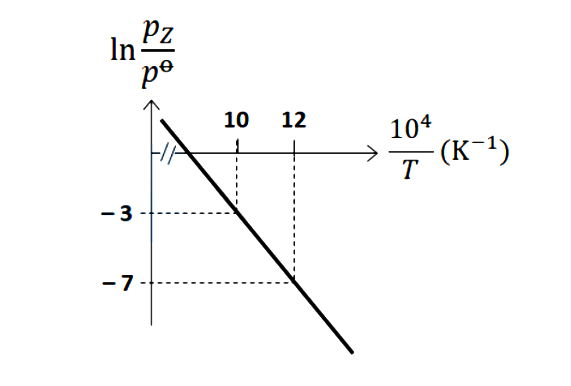
(Given, \(\frac{\mathrm{d}(\ln K)}{\mathrm{d}\left(\frac{1}{T}\right)}=-\frac{\Delta H^{\theta}}{R}\), where the equilibrium constant, \(K=\frac{p_{z}}{p^{\theta}}\) and the gas constant, \(\mathrm{R}=8.314 \mathrm{~J} \mathrm{~K}^{-1} \mathrm{~mol}^{-1}\) )
The value of (in ) for the given reaction, at is ___.JEE Advanced 2021 Hard - For a reaction taking place in a container in equilibrium with its surroundings, the effect of temperature on its equilibrium constant in terms of change in entropy is described by:JEE Advanced 2017 Medium
- For the following reaction, the equilibrium constant at is
When equal volumes of and solutions are mixed, the equilibrium concentration of is found to be The value of is __________JEE Advanced 2019 Medium - The increasing order of atomic radii of the following group elements isJEE Advanced 2016 Easy
- Match the compounds in List-I with the appropriate observations in List-II and choose the correct option.
List - I List - II (P) 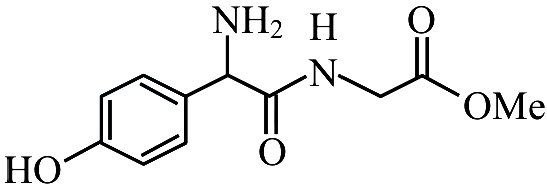
(1) Reaction with phenyl diazonium salt gives #ff0 dye. (Q) 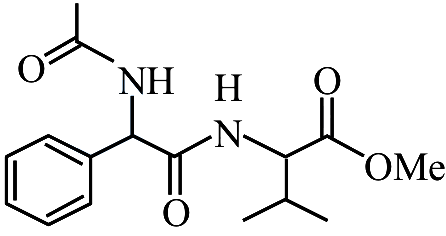
(2) Reaction with ninhydrin gives purple color and it also reacts with \(FeCl _3\) to give violet color. (R) 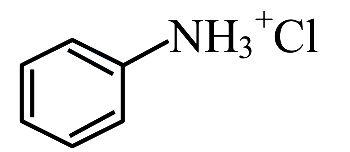
(3) Reaction with glucose will give corresponding hydrazone. (S) 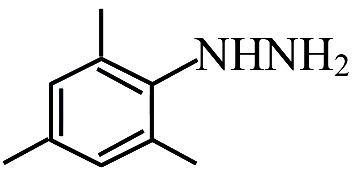
(4) Lassiagne extract of the compound treated with dilute HCl followed by addition of aqueous \(FeCl _3\) gives blood red color. (5) After complete hydrolysis,it will give ninhydrin test and it DOES NOT give positive phthalein dye test. JEE Advanced 2025 Medium
More PYQs from JEE Advanced
- Aqueous solutions of \(\mathrm{HNO}_3, \mathrm{KOH}\), \(\mathrm{CH}_3 \mathrm{COOH}\), and \(\mathrm{CH}_3 \mathrm{COONa}\) of identical concentrations are provided. The pair(s) of solutions which form a buffer upon mixing is(are)JEE Advanced 2010 Medium
- If , then which of the following matrices is equal to ?JEE Advanced 2022 Easy
- Suppose a nucleus at rest and in ground state undergoes -decay to a nucleus in its excited state. The kinetic energy of the emitted particle is found to be nucleus then goes to its ground state by -decay. The energy of the emitted -photon is _______
[Given: atomic mass of atomic mass of atomic mass of particle is speed of the light]JEE Advanced 2019 Medium - In the reaction,
the time taken for reaction of is twice the time taken for reaction of . The concentration of varies with reaction time as shown in the figure.The overall order of the reaction is: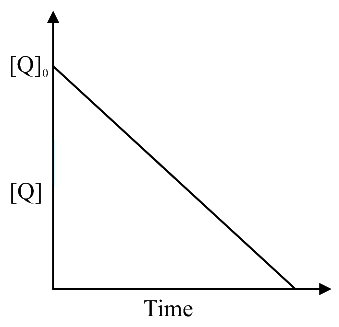 JEE Advanced 2013 Easy
 - A free hydrogen atom after absorbing a photon of wavelength gets excited from the state to the state Immediately after that the electron jumps to state by emitting a photon of wavelength Let the change in momentum of atom due to the absorption and the emission are and respectively. If Which of the option(s) is/are correct?
[Use and are Planck's constant and speed of light, respectively]JEE Advanced 2019 Medium - Let . For let be the number of subsets of , each containing five elements out of which exactly are odd. ThenJEE Advanced 2017 Easy