


JEE Advanced · Physics · 24. Ray Optics
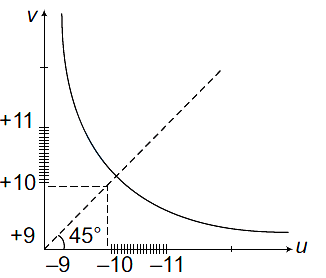
The graph between object distance \(u\) and image distance \(v\) for a lens is given below. The focal length of the lens is
- A \(5 \pm 0.1\)
- B \(5 \pm 0.05\)
- C \(0.5 \pm 0.1\)
- D \(0.5 \pm 0.05\)
Answer & Solution
Correct Answer
(B) \(5 \pm 0.05\)
Step-by-step Solution
Detailed explanation
From the lens formula:
\(\frac{1}{f}=\frac{1}{v}-\frac{1}{u}\) we have, \(\frac{1}{f}=\frac{1}{10}-\frac{1}{-10}\) or \(f=+5\)
Further, \(\Delta u=0.1\) and \(\Delta v=0.1\)
(from the graph)
Now, differentiating the lens formula we have,
\(
\frac{\Delta f}{f^2}=\frac{\Delta v}{v^2}+\frac{\Delta u}{u^2} \text { or } \Delta f=\left(\frac{\Delta v}{v^2}+\frac{\Delta u}{u^2}\right) f^2
\)
Substituting the values we have,
\(
\Delta f=\left(\frac{0.1}{10^2}+\frac{0.1}{10^2}\right)(5)^2 \Rightarrow f \pm \Delta f\) \(=5 \pm 0.05
\)
\(\frac{1}{f}=\frac{1}{v}-\frac{1}{u}\) we have, \(\frac{1}{f}=\frac{1}{10}-\frac{1}{-10}\) or \(f=+5\)
Further, \(\Delta u=0.1\) and \(\Delta v=0.1\)
(from the graph)
Now, differentiating the lens formula we have,
\(
\frac{\Delta f}{f^2}=\frac{\Delta v}{v^2}+\frac{\Delta u}{u^2} \text { or } \Delta f=\left(\frac{\Delta v}{v^2}+\frac{\Delta u}{u^2}\right) f^2
\)
Substituting the values we have,
\(
\Delta f=\left(\frac{0.1}{10^2}+\frac{0.1}{10^2}\right)(5)^2 \Rightarrow f \pm \Delta f\) \(=5 \pm 0.05
\)
See the Complete Solution
Get step-by-step explanations for this and 2.5 Lakh+ more JEE, NEET & CET questions.
- Unlock all solutions
- Practice the full chapter
- Track accuracy across PYQs
4.8 rated on Google Play · 14,000+ reviews
More questions from Physics
- A flat plate is moving normal to its plane through a gas under the action of a constant force F. The gas is kept at a very low pressure. The speed of the plate v I much less than the average speed u of the gas molecules. Which of the following options is true?JEE Advanced 2017 Medium
- A ray of light travelling in water is incident on its surface open to air. The angle of incidence is \(\theta\), which is less than the critical angle. Then there will beJEE Advanced 2007 Medium
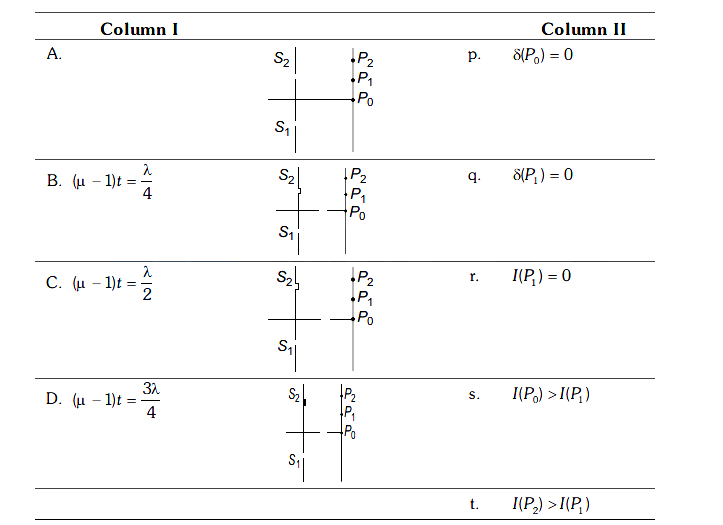
- Column I shows four situations of standard Young's double slit arrangement with the screen placed far away from the slits \(S_1\) and \(S_2\). In each of these cases \(S_1 P_0=S_2 P_0\), \(S_1 P_1-S_2 P_1=\frac{\lambda}{4}\) and \(S_1 P_2-S_2 P_2=\frac{\lambda}{3}\), where \(\lambda\) is the wavelength of the light used. In the cases \(\mathrm{B}, \mathrm{C}\) and \(\mathrm{D}\), a transparent sheet of refractive index \(\mu\) and thickness \(t\) is pasted on slit \(S_2\). The thickness of the sheets are different in different cases. The phase difference between the light waves reaching a point \(P\) on the screen from the two slits is denoted by \(\delta(P)\) and the intensity by \(I(P)\). Match each situation given in Column-I with the statement(s) in Column-II valid for that situation.
 JEE Advanced 2009 Hard
 - A dimensionless quantity is constructed in terms of electronic charge \(e\), permittivity of free space \(\varepsilon_0\), Planck's constant \(h\) and speed of light \(c\). If the dimensionless quantity is written as \(e^\alpha \varepsilon_0^\beta h^\gamma c^\delta\) and \(n\) is a non-zero integer, then \((\alpha, \beta, \gamma, \delta)\) is given byJEE Advanced 2024 Easy
- A moving coil galvanometer has 50 turns and each turn has an area . The magnetic field produced by the magnet inside the galvanometer is . The torsional constant of the suspension wire is . When a current flows through the galvanometer, a full scale deflection occurs if the coil rotates by . The resistance of the coil of the galvanometer is . This galvanometer is to be converted into an ammeter capable of measuring current in the range . For this purpose, a shunt resistance is to be added in parallel to the galvanometer. The value of this shunt resistance, in ohms, is __________.JEE Advanced 2018 Hard
- A student performed the experiment to measure the speed of sound in air using resonance air-column method. Two resonances in the air-column were obtained by lowering the water level. The resonance with the shorter air-column is the first resonance and that with the longer air column is the second resonance. Then,JEE Advanced 2009 Medium
More PYQs from JEE Advanced
- A solid sphere of radius \(R\) has a charge \(Q\) distributed in its volume with a charge density \(\rho=k r^a\), where \(k\) and \(a\) are constants and \(r\) is the distance from its centre. If the electric field at \(r=\frac{R}{2}\) is \(\frac{1}{8}\) times that at \(r=R\), find the value of \(a\).JEE Advanced 2009 Medium
-
Column I Column II In a triangle let and be the lengths of the angles and , respectively. If and then possible values of for which is are In a triangle let and be the lengths of the sides opposite to the angles and , respectively. If , then possible value(s) of is (are) In let and be the position vectors of and with respect to the origin , respectively. If the distance of from the bisector of the acute angle of with is , then possible value (s) of is (are) Suppose that denotes the area of the region bounded by and where Then the value (s) of when and , is (are) JEE Advanced 2015 Hard - If where the inverse trigonometric functions take only the principal values, then the correct options(s) is(are)JEE Advanced 2015 Medium
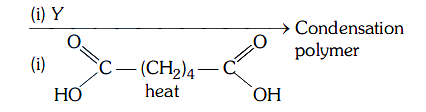
- The correct functional group \(X\) and the reagent/reaction conditions \(Y\) in the following schemes are \(\mathrm{X}-\left(\mathrm{CH}_2\right)_4-X\)
 JEE Advanced 2011 Hard
 - Complete reaction of acetaldehyde with excess formaldehyde, upon heating with conc. \(\mathrm{NaOH}\) solution, gives \(\mathbf{P}\) and \(\mathbf{Q}\). Compound \(\mathbf{P}\) does not give Tollens' test, whereas \(\mathbf{Q}\) on acidification gives positive Tollens' test. Treatment of \(\mathbf{P}\) with excess cyclohexanone in the presence of catalytic amount of \(p\)-toluenesulfonic acid (PTSA) gives product \(\mathbf{R}\).
Sum of the number of methylene groups \(\left(-\mathrm{CH}_2-\right)\) and oxygen atoms in \(\mathbf{R}\) is ________.JEE Advanced 2024 Medium - Consider the following cell reaction,
\(2 \mathrm{Fe}(\mathrm{s})+\mathrm{O}_2(g)+4 \mathrm{H}^{+}(a q) \longrightarrow \)
\( 2 \mathrm{Fe}^{2+}(a q)+2 \mathrm{H}_2 \mathrm{O}(l), E^{\circ}=1.67 \mathrm{~V} \)
\( \text {At } {\left[\mathrm{Fe}^{2+}\right]=10^{-3} \mathrm{M}, \mathrm{P}\left(\mathrm{O}_2\right)=0.1 \mathrm{~atm}}\)
and \(\mathrm{pH}=3\), the cell potential at \(25^{\circ} \mathrm{C}\) isJEE Advanced 2011 Easy