


JEE Advanced · Physics · 24. Ray Optics
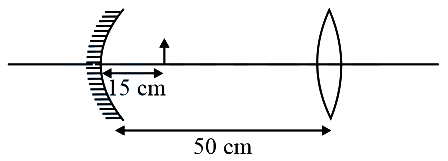
Consider a concave mirror and a convex lens (refractive index = ) of focal length each, separated by a distance of in air (refractive index = ), as shown in the figure. An object is placed at a distance of from the mirror. Its erect image, formed by this combination, has magnification . When the set-up is kept in a medium of refractive index , the magnification becomes . The magnitude is
- A 5
- B 7
- C 9
- D 11
Answer & Solution
Correct Answer
(B) 7
Step-by-step Solution
Detailed explanation
For reflection from a concave mirror,
Magnification
Now for refraction from lens,
Magnification
Now when the set-up is immersed in liquid, no effect for the image formed by mirror.
We have
When lens is immersed in liquid,
Magnification
Magnification
Now for refraction from lens,
Magnification
Now when the set-up is immersed in liquid, no effect for the image formed by mirror.
We have
When lens is immersed in liquid,
Magnification
See the Complete Solution
Get step-by-step explanations for this and 2.5 Lakh+ more JEE, NEET & CET questions.
- Unlock all solutions
- Practice the full chapter
- Track accuracy across PYQs
4.8 rated on Google Play · 14,000+ reviews
More questions from Physics
- The electric field E is measured at a point , generated due to various charge distributions and the dependence of E on d is found to be different for different charge distributions. List-I contains different relations between E and d. List-II describes different electric charge distributions, along with their locations. Match the functions in List-I with the related charge distributions in List-II.
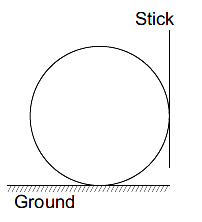
LIST -I LIST -II A) is independent of d P) A point charge at the origin B) \(E \propto \frac{1}{d}\) Q) A small dipole with point charges \(Q\) at \((0,0, l)\) and \(-\operatorname{Qat}(0,0, l)\). Take \(2 l \ll d\) C) \(E \propto \frac{1}{d^2}\) R) An infinite line charge coincident with the \(x\)-axis, with uniform linear charge density \(\lambda\) D) \(E \propto \frac{1}{d^3}\) S) Two infinite wires carrying uniform linear charge density parallel to the \(x\) - axis. The one along \((y-0, z=l)\) has a charge density \(+\lambda\) and the one along \((y=0, z=-l)\) has a charge density \(-\lambda\). Take \(2 l \ll d\) T) Infinite plane charge coincident with the \(x y\) - plane with uniform surface charge density JEE Advanced 2018 Medium - A boy is pushing a ring of mass \(2 \mathrm{~kg}\) and radius \(0.5 \mathrm{~m}\) with a stick as shown in the figure. The stick applies a force of \(2 \mathrm{~N}\) on the ring and rolls it without slipping with an acceleration of \(0.3 \mathrm{~m} / \mathrm{s}^2\). The coefficient of friction between the ground and the ring is large enough that rolling always occurs and the coefficient of friction between the stick and the ring is \(\frac{P}{10}\). The value of \(P\) is
 JEE Advanced 2011 Hard
 - A train is moving along a straight line with a constant acceleration a. A boy standing in the train throws a ball forward with a speed of \(10 \mathrm{~m} / \mathrm{s}\), at an angle of \(60^{\circ}\) to the horizontal. The boy has to move forward by \(1.15 \mathrm{~m}\) inside the train to catch the ball back at the initial height. The acceleration of the train in \(\mathrm{m} / \mathrm{s}^2\), isJEE Advanced 2011 Medium
- A large glass slab \(\left(\mu=\frac{5}{3}\right)\) of thickness 8 \(\mathrm{cm}\) is placed over a point source of light on a plane surface. It is seen that light emerges out of the top surface of the slab from a circular area of radius \(R \mathrm{~cm}\). What is the value of \(R\) ?JEE Advanced 2010 Medium
- A particle of mass is initially at rest in the -plane at a point , where and . The particle is accelerated at time with a constant acceleration along the positive -direction. Its angular momentum and torque with respect to the origin, in SI units, are represented by and , respectively. and are unit vectors along the positive and -directions, respectively. If then which of the following statement(s) is (are) correct?JEE Advanced 2021 Medium
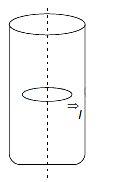
- A long circular tube of length \(10 \mathrm{~m}\) and radius \(0.3 \mathrm{~m}\) carries a current I along its curved surface as shown. A wire loop of resistance \(0.005 \Omega\) and of radius \(0.1 \mathrm{~m}\) is placed inside the tube with its axis coinciding with the axis of the tube. The current varies as \(I=I_0 \cos 300 t\), where \(I_0\) is constant. If the magnetic moment of the loop is \(N \mu_0 I_0 \sin 300 t\), then \(N\) is
 JEE Advanced 2011 Hard
More PYQs from JEE Advanced
- The value of
\(6+\log _{\frac{3}{2}}\)\(\left(\frac{1}{3 \sqrt{2}} \sqrt{4-\frac{1}{3 \sqrt{2}} \sqrt{4-\frac{1}{3 \sqrt{2}} \sqrt{4-\frac{1}{3 \sqrt{2}}} \cdots}}\right)\) isJEE Advanced 2012 Medium - One mole of an ideal monoatomic gas undergoes two reversible processes and as shown in the given figure:
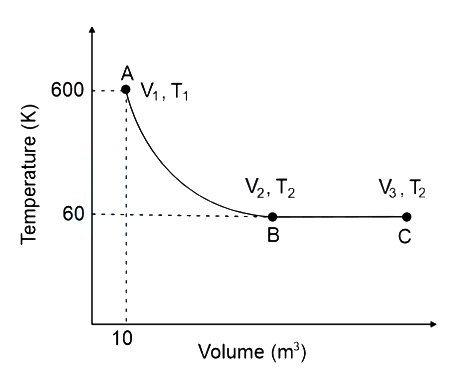
is an adiabatic process. If the total heat absorbed in the entire process and is , the value of is
[Use molar heat capacity of the gas at constant pressure, ]JEE Advanced 2023 Medium - Let be a positive real number. Let and be the functions defined by and .
Then the value of is ______.JEE Advanced 2022 Medium - Paragraph :
Two plane harmonic sound waves are expressed by the equations.
\(
\begin{aligned}
& y_1(x, t)=A \cos (0.5 \pi x-100 \pi t) \\
& y_2(x, t)=A \cos (0.46 \pi x-92 \pi t)
\end{aligned}
\)
(All parameters are in MKS)
Question :
What is the speed of the sound?JEE Advanced 2006 Easy - Paragraph:
Let \(p\) be an odd prime number and \(T_p\) be the following set of \(2 \times 2\) matrices
\[
T_p=\left\{A=\left[\begin{array}{ll}
a & b \\
c & a
\end{array}\right] ; a, b, c \in\{0,1,2, \ldots, p-1\}\right\}
\]Question:
The number of \(A\) in \(T_p\) such that the trace of \(A\) is not divisible by \(p\) but det \((A)\) is divisible by \(p\) is
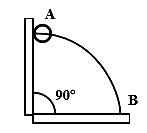
[Note : The trace of a matrix is the sum of its diagonal entries.]JEE Advanced 2010 Medium - A wire, which passes through the hole in a small bead, is bent in the form of quarter of a circle. The wire is fixed vertically on ground as shown in the figure. The bead is released from near the top of the wire and it slides along the wire without friction. As the bead moves from A to B, the force it applies on the wire is
 JEE Advanced 2014 Easy