


JEE Advanced · Chemistry · 5. States of Matter
Paragraph:
\(\mathbf{X}\) and \(\mathbf{Y}\) are two volatile liquids with molar weights of \(10 \mathrm{~g} \mathrm{~mol}^{-1}\) and \(40 \mathrm{~g} \mathrm{~mol}^{-1}\) respectively. Two cotton plugs, one soaked in \(\mathbf{X}\) and the other soaked in \(\mathbf{Y}\), are simultaneously placed at the ends of a tube of length \(L=24 \mathrm{~cm}\), as shown in the figure. The tube is filled with an inert gas at \(1\) atmosphere pressure and a temperature of \(300 \mathrm{~K}\). Vapours of \(\mathbf{X}\) and \(\mathbf{Y}\) react to form a product which is first observed at a distance \(\mathbf{d} \mathrm{~cm}\) from the plug soaked in \(\mathbf{X}\). Take \(\mathbf{X}\) and \(\mathbf{Y}\) to have equal molecular diameters and assume ideal behaviour for the inert gas and the two vapours.
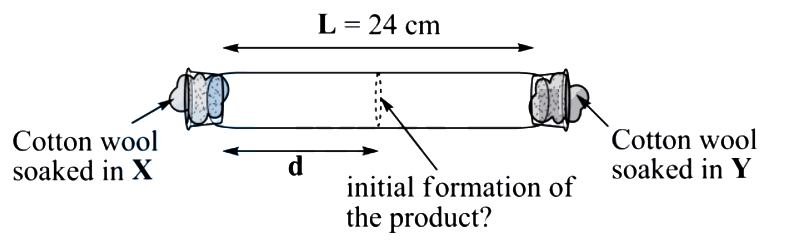
Question:
The experimental value of \(\mathbf{d}\) is found to be smaller than the estimate obtained using Graham's law. This is due to
- A Larger mean free path for X as compared to that of Y.
- B Larger mean free path for Y as compared to that of X.
- C Increased collision frequency of Y with the inert gas as compared to that of X with the inert gas.
- D Increased collision frequency of X with the inert gas as compared to that of Y with the inert gas.
Answer & Solution
Correct Answer
(D) Increased collision frequency of X with the inert gas as compared to that of Y with the inert gas.
Step-by-step Solution
Detailed explanation
As the collision frequency increases then molecular speed decreases than the expected.
See the Complete Solution
Get step-by-step explanations for this and 2.5 Lakh+ more JEE, NEET & CET questions.
- Unlock all solutions
- Practice the full chapter
- Track accuracy across PYQs
4.8 rated on Google Play · 14,000+ reviews
More questions from Chemistry
- Paragraph:
Properties such as boiling point, freezing point and vapour pressure of a pure solvent change when solute molecules are added to get homogeneous solution. These are called colligative properties. Applications of colligative properties are very useful in day-to-day life. One of its examples is the use of ethylene glycol and water mixture as anti-freezing liquid in the radiator automobiles.
A solution \(M\) is prepared by mixing ethanol and water. The mole fraction of ethanol in the mixtrue is \(0.9\)
Given Freezing point depression constant of water \(\left(k^{\text {water }}\right)=1.86 \mathrm{~K} \mathrm{~kg} \mathrm{~mol}^{-1}\)
Freezing point depression constant of ethanol \(\left(k_f^{\text {ethanol }}\right)=2.0 \mathrm{Kkg} \mathrm{mol}^{-1}\)
Boiling point elevation constant of water \(\left(k_b^{\text {water }}\right)=0.52 \mathrm{Kkg} \mathrm{mol}^{-1}\)
Boiling point elevation constant of ethanol \(\left(k_b^{\text {ethanol }}\right)=1.2 \mathrm{Kkg} \mathrm{mol}^{-1}\)
Standard freezing point of water \(=273 \mathrm{~K}\)
Standard freezing point of ethanol \(=155.7 \mathrm{~K}\)
Standard boiling point of water \(=373 \mathrm{~K}\)
Standard boiling point of ethanol \(=351.5 \mathrm{~K}\)
Vapour pressure of pure water \(=328 \mathrm{~mm}\) of \(\mathrm{Hg}\)
Vapour pressure of pure ethanol \(=40 \mathrm{~mm}\) of \(\mathrm{Hg}\)
Molecular weight of water \(=18 \mathrm{~g} \mathrm{~mol}^{-1}\)
Molecular weight of ethanol \(=46 \mathrm{~g} \mathrm{~mol}^{-1}\)
In answering the following questions, consider the solutions to be ideal dilute solutions and solutes to be non-volatile and non-dissociative.
Question:
The freezing point of the solution \(M\) isJEE Advanced 2008 Medium - The entropy versus temperature plot for phases and at bar pressure is given. and are entropies of the phases at temperatures and , respectively.
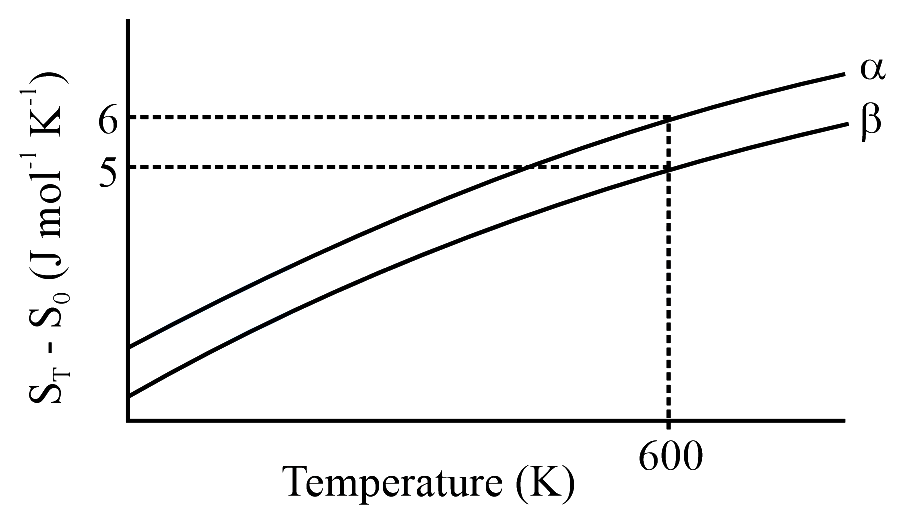 The transition temperature for to phase change is and . Assume is independent of temperature in the range of to and are heat capacities of and phases, respectively. The value of enthalpy change, (in ), at isJEE Advanced 2023 Medium
 - In allene \(\left(\mathrm{C}_{3} \mathrm{H}_{4}\right)\), the type(s) of hybridisation of the carbon atoms is (are):JEE Advanced 2012 Medium
- A trinitro compound, -tris-(-nitrophenyl) benzene, on complete reaction with an excess of gives a major product, which on treatment with an excess of at provides as the product. , upon treatment with excess of at room temperature, gives the product . Bromination of in aqueous medium furnishes the product . The compound upon treatment with an excess of phenol under basic conditions gives the product . The molar mass difference between compounds and is and between compounds and is .
The total number of carbon atoms and heteroatoms present in one molecule of \(S\) is
[Use: Molar mass (in \(\text{gmol} ^{-1}\) ): \(\text H =1,\text C =12,\text N=14,\text O =16,\) \(\text{Br} =80, \text{Cl} =35.5\) Atoms other than C and H are considered as heteroatoms]JEE Advanced 2023 Easy - Liquids and form ideal solution for all compositions of and at . Two such solutions with and mole fractions of have the total vapor pressures of and bar, respectively. What is the vapor pressure of pure liquid in bar?JEE Advanced 2020 Medium
- The following carbohydrate is
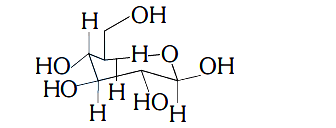 JEE Advanced 2011 Medium
More PYQs from JEE Advanced
- One mole of a monatomic ideal gas undergoes the cyclic process \(\mathrm{J} \rightarrow \mathrm{K} \rightarrow \mathrm{L} \rightarrow \mathrm{M} \rightarrow \mathrm{J}\), as shown in the P-T diagram.
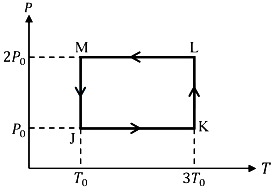
Match the quantities mentioned in List-I with their values in List-II and choose the correct option.
[\(\mathcal{R}\) is the gas constant.]List-I List-II (P) Work done in the complete cyclic process (1) \(R T_0-4 R T_0 \ln 2\) (Q) Change in the internal energy of the gas in the process JK (2) \(0\) (R) Heat given to the gas in the process KL (3) \(3 K T_0\) (S) Change in the internal energy of the gas in the process MJ (4) \(-2 R T_0 \ln 2\) \((5)-3 R T_0 \ln 2\) JEE Advanced 2024 Medium - A binary star consists of two stars \(A\) (mass \(2.2 M_S\) ) and \(B\) (mass \(11 M_s\) ), where \(M_S\) is the mass of the sun. They are separated by distance \(d\) and are rotating about their centre of mass, which is stationary. The ratio of the total angular momentum of the binary star to the angular momentum of \(\operatorname{star} B\) about the centre of mass isJEE Advanced 2010 Medium
- Let \(S=\{a+b \sqrt{2}: a, b \in \mathbb{Z}\}, T_1=\)\(\left\{(-1+\sqrt{2})^n: n \in \mathbb{N}\right\}\), and \(T_2=\left\{(1+\sqrt{2})^n: n \in \mathbb{N}\right\}\). Then which of the following statements is (are) TRUE?JEE Advanced 2024 Medium
- Let a solution \(y=y(x)\) of the differential equation \(x \sqrt{x^2-1} d y-y \sqrt{y^2-1} d x=0\) satisfy \(y(2)=\frac{2}{\sqrt{3}}\)
Statement \(1 y(x)=\sec \left(\sec ^{-1} x-\frac{\pi}{6}\right)\)
Statement \(2 y(x)\) is given by \(\frac{1}{y}=\frac{2 \sqrt{3}}{x}-\sqrt{1-\frac{1}{x^2}}\)JEE Advanced 2008 Medium - A particle of mass is attached to one end of a massless spring of force constant , lying on a frictionless horizontal plane. The other end of the spring is fixed. The particle starts moving horizontally from its equilibrium position at time with an initial velocity . When the speed of the particle is , it collides elastically with a rigid wall. After this collision :JEE Advanced 2013 Medium
- Paragraph
The key feature of Bohr's theory of spectrum of hydrogen atom is the quantization of angular momentum when an electron is revolving around a proton. We will extend this to a general rotational motion to find quantized rotational energy of a diatomic molecule assuming it to be rigid. The rule to be applied is Bohr's quantization condition.
Question:
It is found that the excitation frequency from ground to the first excited state of rotation for the \(\mathrm{CO}\) molecule is close to \(\frac{4}{\pi} \times 10^{11} \mathrm{~Hz}\). Then the moment of inertia of CO molecule about its centre of mass is close to (Take \(h=2 \pi \times 10^{-34} J-s\) )JEE Advanced 2010 Hard