


JEE Advanced · Mathematics · 29. Differential Eqns
Let a solution \(y=y(x)\) of the differential equation \(x \sqrt{x^2-1} d y-y \sqrt{y^2-1} d x=0\) satisfy \(y(2)=\frac{2}{\sqrt{3}}\)
Statement \(1 y(x)=\sec \left(\sec ^{-1} x-\frac{\pi}{6}\right)\)
Statement \(2 y(x)\) is given by \(\frac{1}{y}=\frac{2 \sqrt{3}}{x}-\sqrt{1-\frac{1}{x^2}}\)
- A
Statement 1 is true, Statement 2 is true, Statement 2 is a correct explanation for Statement 1.
- B
Statement 1 is true, Statement 2 is true, Statement 2 is not a correct explanation for Statement 1.
- C
Statement 1 is true, Statement 2 is false.
- D
Statement 1 is false, Statement 2 is true
Answer & Solution
Correct Answer
(C)
Statement 1 is true, Statement 2 is false.
Step-by-step Solution
Detailed explanation
\(\because \frac{d y}{d x}=\frac{y \sqrt{y^2-1}}{x \sqrt{x^2-1}} \Rightarrow \int \frac{d y}{y \sqrt{y^2-1}}=\int \frac{d x}{x \sqrt{x^2-1}}\) \(\Rightarrow \quad \sec ^{-1} y=\sec ^{-1} x+C\) At \(\quad x=2, y=\frac{2}{\sqrt{3}}\) \[ \frac{\pi}{6}=\frac{\pi}{3}+C \Rightarrow C=-\frac{\pi}{6} \]
Now, \(y=\sec \left(\sec ^{-1} x-\frac{\pi}{6}\right)\)
$$
\begin{aligned}
& =\cos \left[\cos ^{-1} \frac{1}{x}-\cos ^{-1} \frac{\sqrt{3}}{2}\right] \\
& =\cos \left[\cos ^{-1}\left(\frac{\sqrt{3}}{2 x}+\sqrt{1-\frac{1}{x^2}} \sqrt{1-\frac{3}{4}}\right)\right] \\
\Rightarrow \quad \frac{1}{y} & =\frac{\sqrt{3}}{2 x}+\frac{1}{2} \sqrt{1-\frac{1}{x^2}} \\
Now, \(y=\sec \left(\sec ^{-1} x-\frac{\pi}{6}\right)\)
$$
\begin{aligned}
& =\cos \left[\cos ^{-1} \frac{1}{x}-\cos ^{-1} \frac{\sqrt{3}}{2}\right] \\
& =\cos \left[\cos ^{-1}\left(\frac{\sqrt{3}}{2 x}+\sqrt{1-\frac{1}{x^2}} \sqrt{1-\frac{3}{4}}\right)\right] \\
\Rightarrow \quad \frac{1}{y} & =\frac{\sqrt{3}}{2 x}+\frac{1}{2} \sqrt{1-\frac{1}{x^2}} \\
See the Complete Solution
Get step-by-step explanations for this and 2.5 Lakh+ more JEE, NEET & CET questions.
- Unlock all solutions
- Practice the full chapter
- Track accuracy across PYQs
4.8 rated on Google Play · 14,000+ reviews
More questions from Mathematics
- Let \(\mathbb{R}\) denote the set of all real numbers. Let \(f: \mathbb{R} \rightarrow \mathbb{R}\) be a function such that \(f(x)>0\) for all \(x \in \mathbb{R}\), and \(f(x+y)=f(x) f(y)\) for all \(x, y \in \mathbb{R}\).
Let the real numbers \(\mathrm{a}_1, \mathrm{a}_2 \ldots, \mathrm{a}_{50}\) be in an arithmetic progression. If \(f\left(\mathrm{a}_{31}\right)=64 f\left(\mathrm{a}_{25}\right)\), and \(\sum_{i=1}^{50} f\left(a_i\right)=3\left(2^{25}+1\right)\) then the value of \(\sum_{i=6}^{30} f\left(a_i\right)\) is ________JEE Advanced 2025 Easy - \[
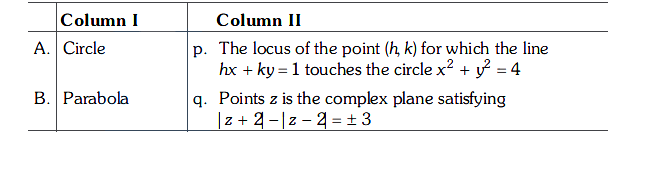
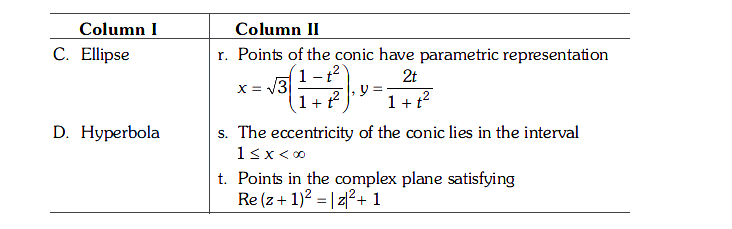
\text { Match the conics in Column I with the statements/expressions in Column II. }
\]
 JEE Advanced 2009 Easy
 - Consider the matrix, \(P=\left(\begin{array}{lll}2 & 0 & 0 \\ 0 & 2 & 0 \\ 0 & 0 & 3\end{array}\right)\)
Let the transpose of a matrix \(X\) be denoted by \(\mathrm{X}^T\). Then the number of \(3 \times 3\) invertible matrices Q with integer entries, such that \(Q^{-1}=Q^T\) and \(P Q=Q P\) isJEE Advanced 2025 Easy - Let and .Further and , where C is the set of all complex numbers. If and O represents the origin, thenJEE Advanced 2013 Hard
- Paragraph:
Let \(V_r\) denotes the sum of the first \(r\) terms of an arithmetic progression \((A P)\) whose first term is \(r\) and the common difference is \((2 r-1)\). Let \(T_r=V_{r+1}-V_r-2\) and \(Q_r=T_{r+1}-T_r\) for \(r=1,2, \ldots\)
Question:
\(T_r\) is alwaysJEE Advanced 2007 Hard - Let m and n be two positive integers greater than 1. If then the value of isJEE Advanced 2015 Medium
More PYQs from JEE Advanced
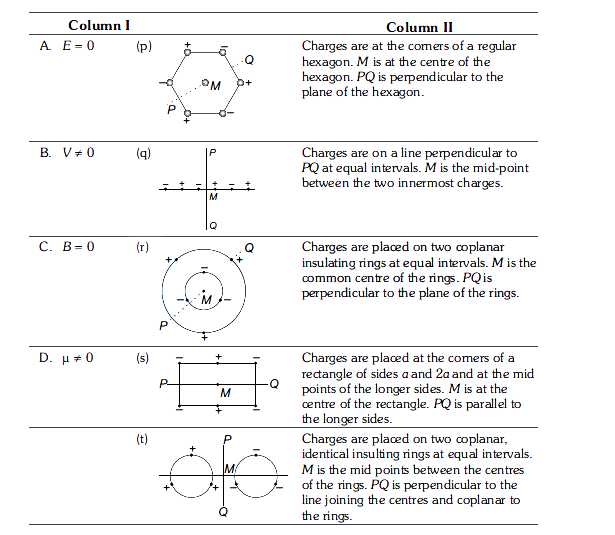
- Six point charges, each of the same magnitude \(q\), are arranged in different manners as shown in Column-II. In each case, a point \(M\) and a line \(P Q\) passing through \(M\) are shown. Let \(E\) be the electric field and \(V\) be the electric potential at \(M\) (potential at infinity is zero) due to the given charge distribution when it is at rest. Now, the whole system is set into rotation with a constant angular velocity about the line \(P Q\). Let \(B\) the magnetic field at \(M\) and \(\mu\) be the magnetic moment of the system in this condition. Assume each rotating charge to be equivalent to a steady current.
 JEE Advanced 2009 Hard
 - Consider an experiment of tossing a coin repeatedly until the outcomes of two consecutive tosses are same. If the probability of a random toss resulting in head is , then the probability that the experiment stops with head isJEE Advanced 2023 Medium
- The correct order of the wavelength maxima of the absorption band in the ultraviolet-visible region for the given complexes isJEE Advanced 2025 Medium
- Let \(S=\left\{A=\left(\begin{array}{lll}0 & 1 & c \\ 1 & a & d \\ 1 & b & e\end{array}\right): a, b, c, d, e \in\{0,1\}\right.\) and \(\left.|A| \in\{-1,1\}\right\}\), where \(|A|\) denotes the determinant of \(A\). Then the number of elements in \(S\) isJEE Advanced 2024 Medium
- For , the number of real roots of the equation isJEE Advanced 2021 Easy
- At 300 K , an ideal dilute solution of a macromolecule exerts osmotic pressure that is expressed in terms of the height ( h ) of the solution (density \(=1.00 \mathrm{~g} \mathrm{~cm}^{-3}\) ) where h is equal to 2.00 cm . If the concentration of the dilute solution of the macromolecule is \(2.00 \mathrm{~g} \mathrm{dm}^{-3}\), the molar mass of the macromolecule is calculated to be \(\boldsymbol{X} \times 10^4 \mathrm{~g} \mathrm{~mol}^{-1}\). The value of \(\boldsymbol{X}\) is \(\qquad\) .
Use : Universal gas constant \((\mathrm{R})=8.3 \mathrm{~J} \mathrm{~K}^{-1} \mathrm{~mol}^{-1}\) and acceleration due to gravity \((\mathrm{g})=10 \mathrm{~m} \mathrm{~s}^{-2}\)JEE Advanced 2025 Easy