


JEE Advanced · Physics · 15. Oscillations
A particle of mass is attached to one end of a massless spring of force constant , lying on a frictionless horizontal plane. The other end of the spring is fixed. The particle starts moving horizontally from its equilibrium position at time with an initial velocity . When the speed of the particle is , it collides elastically with a rigid wall. After this collision :
- A The speed of the particle when it returns to its equilibrium position is u0
- B The time at which the particle passes through the equilibrium position for the first time is
- C The time at which the maximum compression of the spring occurs is
- D The time at which the particle passes through the equilibrium position for the second time is
Answer & Solution
Correct Answer
(D) The time at which the particle passes through the equilibrium position for the second time is
Step-by-step Solution
Detailed explanation
Let the equation of be,
See the Complete Solution
Get step-by-step explanations for this and 2.5 Lakh+ more JEE, NEET & CET questions.
- Unlock all solutions
- Practice the full chapter
- Track accuracy across PYQs
4.8 rated on Google Play · 14,000+ reviews
More questions from Physics
- Function \(x=A \sin ^2 \omega t+B \cos ^2 \omega t+C\) \(\sin \omega t \cos \omega t\) represents SHM.JEE Advanced 2006 Hard
- Length, breadth and thickness of a strip having a uniform cross section are measured to be 10.5 cm , 0.05 mm , and \(6.0 \mu \mathrm{~m}\), respectively. Which of the following option(s) give(s) the volume of the strip in \(\mathrm{cm}^3\) with correct significant figures:JEE Advanced 2025 Easy
- One mole of a monatomic ideal gas undergoes the cyclic process \(\mathrm{J} \rightarrow \mathrm{K} \rightarrow \mathrm{L} \rightarrow \mathrm{M} \rightarrow \mathrm{J}\), as shown in the P-T diagram.
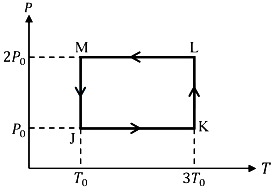
Match the quantities mentioned in List-I with their values in List-II and choose the correct option.
[\(\mathcal{R}\) is the gas constant.]List-I List-II (P) Work done in the complete cyclic process (1) \(R T_0-4 R T_0 \ln 2\) (Q) Change in the internal energy of the gas in the process JK (2) \(0\) (R) Heat given to the gas in the process KL (3) \(3 K T_0\) (S) Change in the internal energy of the gas in the process MJ (4) \(-2 R T_0 \ln 2\) \((5)-3 R T_0 \ln 2\) JEE Advanced 2024 Medium - Paragraph :
A special metal \(S\) conducts electricity without any resistance. A closed wire loop, made of \(S\), does not allow any change in flux through itself by inducing a suitable current to generate a compensating flux. The induced current in the loop cannot decay due to its zero resistance. This current gives rise to a magnetic moment which in turn repels the source of magnetic field or flux. Consider such a loop, of radius \(a\), with its center at the origin. A magnetic dipole of moment \(m\) is brought along the axis of this loop from infinity to a point at distance \(r(\gg a)\) from the center of the loop with its north pole always facing the loop, as shown in the figure below.
The magnitude of magnetic field of a dipole \(m\), at a point on its axis at distance \(r\), is \(\frac{\mu_{0}}{2 \pi} \frac{m}{r^{3}}\), where \(\mu_{0}\) is the permeability of free space. The magnitude of the force between two magnetic dipoles with moments, \(m_{1}\) and \(m_{2}\), separated by a distance \(r\) on the common axis, with their north poles facing each other, is \(\frac{k m_{1} m_{2}}{r^{4}}\), where \(k\) is a constant of appropriate dimensions. The direction of this force is along the line joining the two dipoles.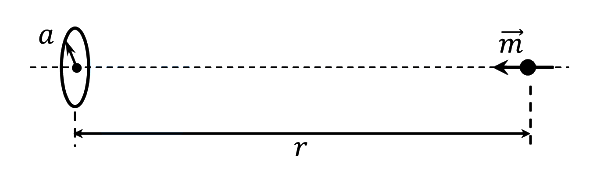
Question :
When the dipole m is placed at a distance r from the centre of the loop (as shown in the figure), the current induced in the loop will be proportional to:JEE Advanced 2021 Medium - A medium having dielectric constant fills the space between the plates of a parallel plate capacitor. The plates have large area, and the distance between them is . The capacitor is connected to a battery of voltage . as shown in Figure (a). Now, both the plates are moved by a distance of from their original positions, as shown in Figure (b).
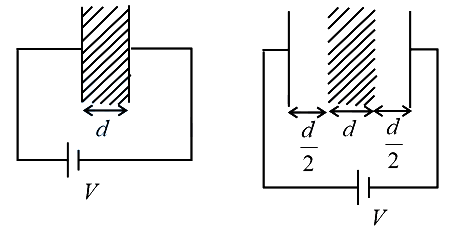
In the process of going from the configuration depicted in Figure (a) to that in Figure (b), which of the following statement(s) is(are) correct?JEE Advanced 2022 Medium - A particle of mass is moving in the -plane such that its velocity at a point is given as where is a non-zero constant. What is the force acting on the particle?JEE Advanced 2023 Hard
More PYQs from JEE Advanced
- The entropy versus temperature plot for phases and at bar pressure is given. and are entropies of the phases at temperatures and , respectively.
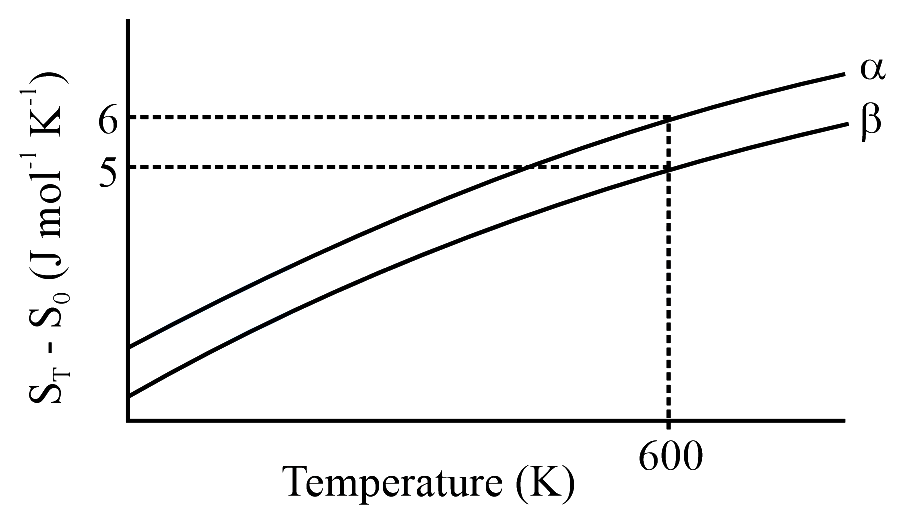 The transition temperature for to phase change is and . Assume is independent of temperature in the range of to and are heat capacities of and phases, respectively.
The value of entropy change, (in ), at is [Use: 0. Given: at ]JEE Advanced 2023 Medium - Paragraph:
The coordination number of \(\mathrm{Ni}^{2+}\) is 4 .
\(\mathrm{NiCl}_2+\mathrm{KCN}\) (excess) \(\rightarrow A\) (cyano complex)
\(\mathrm{NiCl}_2+\) conc. \(\mathrm{HCl}\) (excess) \(\rightarrow B\) (chloro complex)
Question:
The IUPAC name of \(A\) and \(B\) areJEE Advanced 2006 Medium - Assuming that Hund's rule is violated, the bond order and magnetic nature of the diatomic molecule \(\mathrm{B}_2\) isJEE Advanced 2010 Medium
- The order of the oxidation state of the phosphorus atom in and isJEE Advanced 2017 Easy
- Paragraph:
A small spherical monoatomic ideal gas bubble \(\left(\gamma=\frac{5}{3}\right)\) is trapped inside a liquid of density \(\rho_1\) (see figure). Assume that the bubble does not exchange any heat with the liquid. The bubble contains \(n\) moles of gas. The temperature of the gas when the bubble is at the bottom is \(T_0\), the height of the liquid is \(H\) and the atmospheric pressure is \(p_0\) (Neglect surface tension).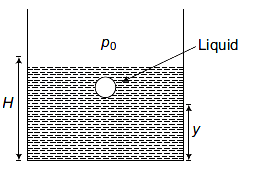
Question:
The buoyancy force acting on the gas bubble is (Assume \(R\) is the universal gas constant)JEE Advanced 2008 Hard - Let thenJEE Advanced 2017 Easy