


JEE Advanced · Chemistry · 29. Biomolecules
The following carbohydrate is
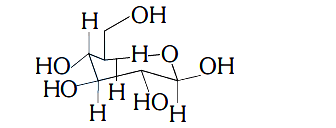
- A a ketohexose
- B an aldohexose
- C an \(\alpha\)-furanose
- D an \(\alpha\)-pyranose
Answer & Solution
Correct Answer
(B) an aldohexose
Step-by-step Solution
Detailed explanation
Here, the- \(\mathrm{OH}\) of hemiacetal group is equatorial therefore, it is a \(\beta\)-pyranose of an aldohexose.
See the Complete Solution
Get step-by-step explanations for this and 2.5 Lakh+ more JEE, NEET & CET questions.
- Unlock all solutions
- Practice the full chapter
- Track accuracy across PYQs
4.8 rated on Google Play · 14,000+ reviews
More questions from Chemistry
- Choose the correct option(s) from the followingJEE Advanced 2019 Medium
- At the reaction of with produces a xenon compound The total number of lone pair(s) of electrons present on the whole molecule of is __________JEE Advanced 2019 Medium
- List-I contains various reaction sequences and List-II contains different phenolic compounds.
Match each entry in List-I with the appropriate entry in List-II and choose the correct option.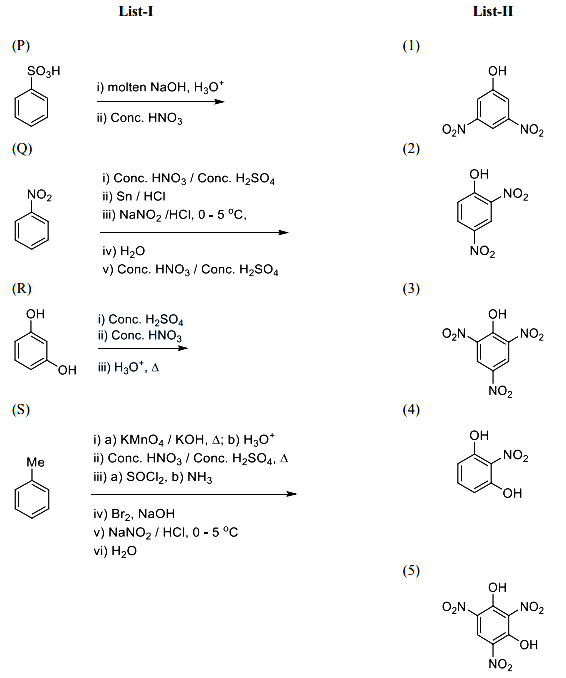 JEE Advanced 2024 Medium
 - The compound(s) with two lone pairs of electrons on the central atom is (are)JEE Advanced 2016 Medium
- Paragraph:
An aqueous solution of a mixture of two inorganic salts, when treated with dilute \(H C\) ?, gave a precipitate \((\boldsymbol{P})\) and a filtrate \((\boldsymbol{Q})\). The precipitate \(\boldsymbol{P}\) was found to dissolve in hot water. The filtrate \((\boldsymbol{Q})\) remained unchanged, when treated with \(\mathrm{H}_{2} \mathrm{~S}\) in a dilute mineral acid medium. However, it gave a precipitate \((\boldsymbol{R})\) with \(H_{2} S\) in an ammoniacal medium. The precipitate \(\boldsymbol{R}\) gave a coloured solution \((\boldsymbol{S})\), when treated with \(\mathrm{H}_{2} \mathrm{O}_{2}\) in an aqueous \(\mathrm{NaOH}\) medium.
Question:
The precipitate \(\boldsymbol{P}\) containsJEE Advanced 2013 Medium - The total number of compounds having at least one bridging oxo group among the molecules given below is
\(\text N _2\text O _5,\)\(\text P _4\text O _6,\)\(\text P _4\text O _8,\)\(\text H _4\text P _2\text O _5,\)\(\text H _5\text P _3\text O _{10},\) \(\text H _2\text S_2\text O _3,\text H _2\text S_2\text O _5\)JEE Advanced 2018 Medium
More PYQs from JEE Advanced
- Two beams of red and violet colours are made to pass separately through a prism (angle of the prism is \(60^{\circ}\) ). In the position of minimum deviation, the angle of refraction will beJEE Advanced 2008 Easy
- Paragraph:
Let \(a\), b and \(c\) be three real numbers satisfying \(\left[\begin{array}{lll}a & b & c\end{array}\right]\left[\begin{array}{lll}1 & 9 & 7 \\ 8 & 2 & 7 \\ 7 & 3 & 7\end{array}\right]=\left[\begin{array}{lll}0 & 0 & 0\end{array}\right]\)Question:
If the point \(P(a, b, c)\), with reference to Eq. (E), lies on the plane \(2 x+y+z=1\), then the value of \(7 a+b+c\) isJEE Advanced 2011 Easy - The distance between two stars of masses and is . Here is the mean distance between the centres of the Earth and the Sun, and is the mass of the Sun. Two stars orbit around their common centre of mass in circular orbits with period , where is the period of Earth's revolution around the Sun. The value of is _____.JEE Advanced 2021 Medium
- List-I shows four configurations, each consisting of a pair of ideal electric dipoles. Each dipole has a dipole moment of magnitude \(p\), oriented as marked by arrows in the figures. In all the configurations the dipoles are fixed such that they are at a distance \(2 r\) apart along the \(x\) direction. The midpoint of the line joining the two dipoles is \(X\). The possible resultant electric fields \(\vec{E}\) at \(X\) are given in List-II. Choose the option that describes the correct match between the entries in List-I to those in List-II.
List-I List-II \((P)\) 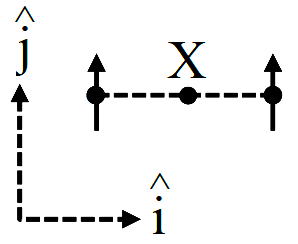
\((1)\) \(\vec{E}=0\) \((Q)\) 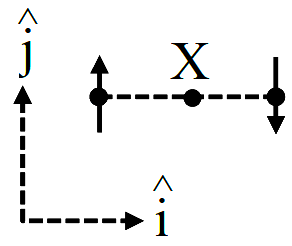
\((2)\) \(\vec{E}=-\frac{p}{2 \pi \epsilon_0 \mathrm{r}^3} \hat{\mathrm{j}}\) \((R)\) 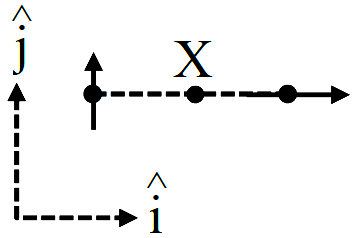
\((3)\) \(\vec{E}=-\frac{p}{4 \pi \epsilon_0 \mathrm{r}^3}(\hat{\mathrm{i}}-\hat{\mathrm{j}})\) \((S)\) 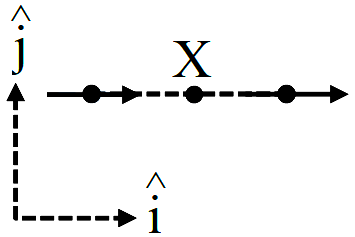
\((4)\) \(\vec{E}=\frac{p}{4 \pi \epsilon_0 \mathrm{r}^3}(2 \hat{\mathrm{i}}-\hat{\mathrm{j}})\) \((5)\) \(\vec{E}=\frac{p}{\pi \epsilon_0 \mathrm{r}^3} \hat{\mathrm{i}}\) JEE Advanced 2025 Hard - Let \(\omega \neq 1\) be a cube root of unity and \(S\) be the set of all non-singular matrices of the form \(\left[\begin{array}{ccc}1 & a & b \\ \omega & 1 & c \\ \omega^2 & \omega & 1\end{array}\right]\), where each of \(a, b\) and \(c\) is either \(\omega\) or \(\omega^2\). Then, the number of distinct matrices in the set \(S\) isJEE Advanced 2011 Easy
- Answer the following by appropriately matching the lists based on the information given in the paragraph.
In a thermodynamics process on an ideal monatomic gas, the infinitesimal heat absorbed by the gas is given by where is temperature of the system and is the infinitesimal change in a thermodynamic quantity of the system. For a mole of monatomic ideal gas Here, is gas constant, is volume of gas, and are constants.
The List-I below gives some quantities involved in a process and List-II gives some possible values of these quantities.Column - I Column - II (a) Work done by the system in process (p) (b) Change in internal energy in process (q) (c) Heat absorbed by the system in process (r) (d) Heat absorbed by the system in process (s) (t) (u)
If the process on one mole of monatomic ideal gas is as shown in the -diagram with the correct match is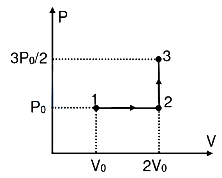 JEE Advanced 2019 Medium