


JEE Advanced · Chemistry · 14. Hydrocarbons
In allene \(\left(\mathrm{C}_{3} \mathrm{H}_{4}\right)\), the type(s) of hybridisation of the carbon atoms is (are):
- A \(s p\) and \(s p^{3}\)
- B \(s p\) and \(s p^{2}\)
- C only \(s p^{3}\)
- D \(s p^{2}\) and \(s p^{3}\)
Answer & Solution
Correct Answer
(B) \(s p\) and \(s p^{2}\)
Step-by-step Solution
Detailed explanation
Allene \(\left(\mathbf{C}_{3} \mathbf{H}_{4}\right)\) is \(\stackrel{s p^{2}}{\mathrm{H}_{2}} \mathrm{C}=\stackrel{s p}{\mathrm{C}}=\stackrel{s p^{2}}{\mathrm{CH}_{2}}\)
See the Complete Solution
Get step-by-step explanations for this and 2.5 Lakh+ more JEE, NEET & CET questions.
- Unlock all solutions
- Practice the full chapter
- Track accuracy across PYQs
4.8 rated on Google Play · 14,000+ reviews
More questions from Chemistry
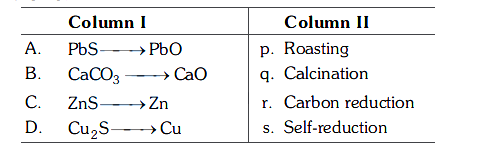
- Match the conversions in Column I with the type(s) given in Column II. Indicate your answer by darkening the appropriate bubbles of the \(4 \times 4\) matrix given in the ORS.
 JEE Advanced 2008 Medium
 - Consider the kinetic data given in the following table for the reaction Product.
The rate of the reaction for and is found to be The value of is __________Ex
peri
ment No.\([\text A]\) \((\text{mol}\) \(\text{dm} ^{-3})\) \([\text B]\) \((\text{mol}\) \(\text{dm} ^{-3})\) \([\text C]\) \((\text{mol}\) \(\text{dm} ^{-3})\) Rate
of
reaction \((\text{mol}\) \(\text{dm} ^{-3}\) \(\text s^{-1})\)1 0.2 0.1 0.1 \(6.0 \times\) \(10^{-5}\) 2 0.2 0.2 0.1 \(6.0 \times \) \(10^{-5}\) 3 0.2 0.1 0.2 \(1.2 \times \) \(10^{-4}\) 4 0.3 0.1 0.1 \(9.0 \times \) \(10^{-5}\) JEE Advanced 2019 Medium - (I) 1, 2-dihydroxy benzene
(II) 1, 3-dihydroxy benzene
(III) 1, 4-dihydroxy benzene
(IV) Hydroxy benzene
The increasing order of boiling points of above mentioned alcohols isJEE Advanced 2006 Medium - The figure below is the plot of potential energy versus internuclear distance of molecule in the electronic ground state. What is the value of the net potential energy (as indicated in the figure) in for at which the electron-electron repulsion and the nucleus-nucleus repulsion energies are absent? As reference, the potential energy of atom is taken as zero when its electron and the nucleus are infinitely far apart.
Use Avogadro constant as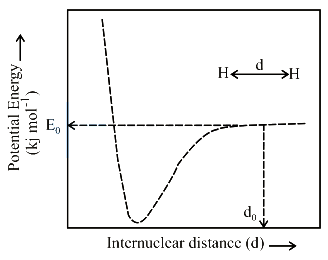
Mark total potential energy for 2 H-atom (per mole) as answer.JEE Advanced 2020 Medium - The desired product X can be prepared by reacting the major product of the reactions in LIST-I with one or more appropriate reagents in LIST-II.
(given, order of migratory aptitude: aryl > alkyl hydrogen)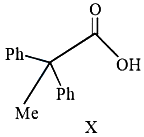
LIST-I LIST -II A) 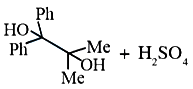
P) B) 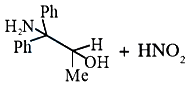
Q) C) 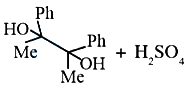
R) Fehling solution D) 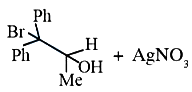
S) T) JEE Advanced 2018 Medium - Match the extraction processes listed in column I with metals listed in column II.
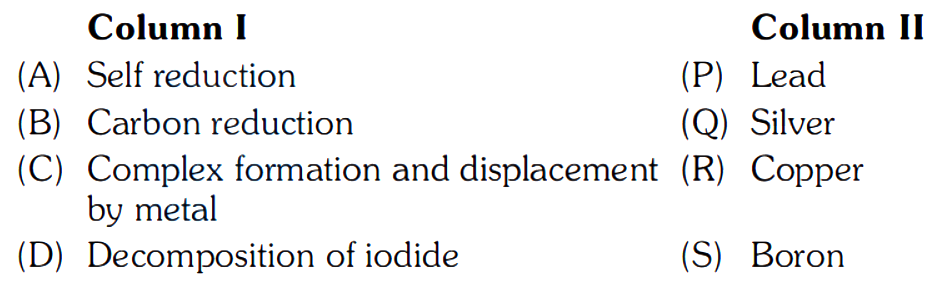 JEE Advanced 2006 Medium
More PYQs from JEE Advanced
- An infinitely long wire, located on the \(z\)-axis, carries a current \(I\) along the \(+z\)-direction and produces the magnetic field \(\vec{B}\). The magnitude of the line integral \(\int \vec{B} \cdot \overrightarrow{d l}\) along a straight line from the point \((-\sqrt{3} a, a, 0)\) to \((a, a, 0)\) is given by
[ \(\mu_0\) is the magnetic permeability of free space.]JEE Advanced 2024 Hard - Upon treatment with ammoniacal , the metal ion that precipitates as a sulphide isJEE Advanced 2013 Easy
- Paragraph :
Treatment of compound \(\mathbf{O}\) with \(\mathrm{KMnO}_{4} / \mathrm{H}^{+}\)gave \(\mathbf{P}\), which on heating with ammonia gave \(\mathbf{Q}\). The compound \(\mathbf{Q}\) on treatment with \(\mathrm{Br}_{2} / \mathrm{NaOH}\) produced \(\mathbf{R}\). On strong heating, \(\mathbf{Q}\) gave \(\mathbf{S}\), which on further treatment with ethyl \(2-\)bromopropanoate in the presence of \(\mathrm{KOH}\) followed by acidification, gave a compound \(\mathbf{T}\).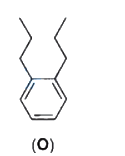
Question :
The compound \(\mathbf{T}\) isJEE Advanced 2016 Medium - Half-life of a radio active substance ' \(A\) ' is 4 days. The probability that a nucleus will decay in two half-lives isJEE Advanced 2006 Easy
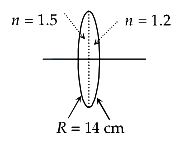
- A bi-convex lens is formed with two thin plano-convex lenses as shown in the figure. Refractive index \(n\) of the first lens is \(1.5\) and that of the second lens is \(1.2\). Both the curved surface are of the same radius of curvature \(R=14\) \(\mathrm{cm}\). For this bi-convex lens, for an object distance of 40 \(\mathrm{cm}\), the image distance will be
 JEE Advanced 2012 Medium
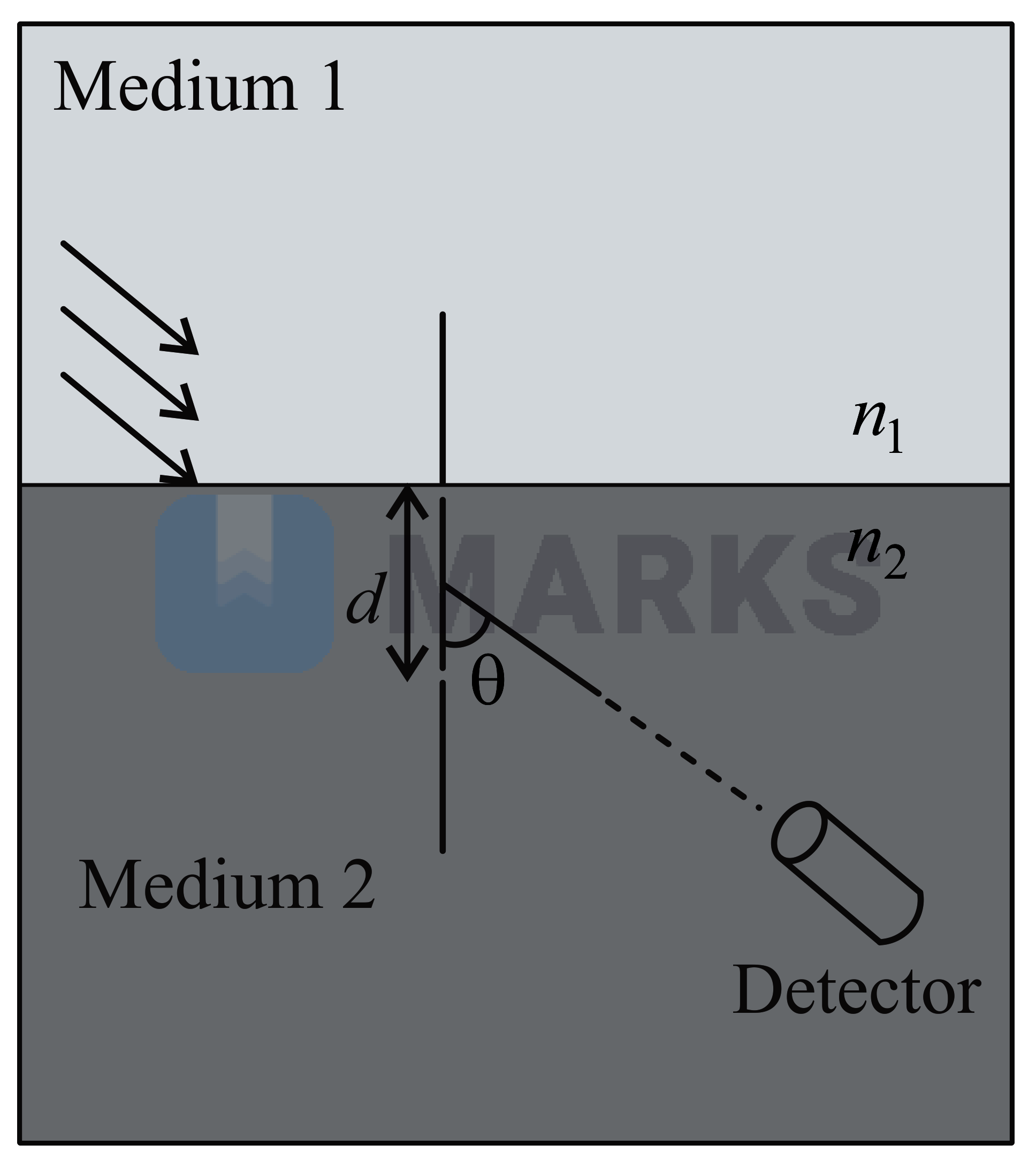
 - A double slit setup is shown in the figure. One of the slits is in medium of refractive index . The other slit is at the interface of this medium with another medium of refractive index . The line joining the slits is perpendicular to the interface and the distance between the slits is . The slit widths are much smaller than . A monochromatic parallel beam of light is incident on the slits from medium . A detector is placed in medium at a large distance from the slits, and at an angle from the line joining them, so that equals the angle of refraction of the beam. Consider two approximately parallel rays from the slits received by the detector.
Which of the following statement(s) is(are) correct?JEE Advanced 2022 Easy