


JEE Advanced · Physics · 13. Thermodynamics
One mole of a monatomic ideal gas undergoes the cyclic process \(\mathrm{J} \rightarrow \mathrm{K} \rightarrow \mathrm{L} \rightarrow \mathrm{M} \rightarrow \mathrm{J}\), as shown in the P-T diagram.
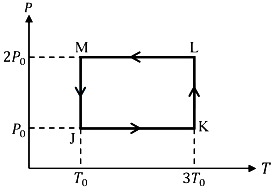
Match the quantities mentioned in List-I with their values in List-II and choose the correct option.
[\(\mathcal{R}\) is the gas constant.]
| List-I | List-II |
| (P) Work done in the complete cyclic process | (1) \(R T_0-4 R T_0 \ln 2\) |
| (Q) Change in the internal energy of the gas in the process JK | (2) \(0\) |
| (R) Heat given to the gas in the process KL | (3) \(3 K T_0\) |
| (S) Change in the internal energy of the gas in the process MJ | (4) \(-2 R T_0 \ln 2\) |
| \((5)-3 R T_0 \ln 2\) |
- A \(\mathrm{P} \rightarrow 1 ; \mathrm{Q} \rightarrow 3 ; \mathrm{R} \rightarrow 5 ; \mathrm{S} \rightarrow 4\)
- B \(\mathrm{P} \rightarrow 4 ; \mathrm{Q} \rightarrow 3 ; \mathrm{R} \rightarrow 5 ; \mathrm{S} \rightarrow 2\)
- C \(\mathrm{P} \rightarrow 4\); \(\mathrm{Q} \rightarrow 1 ; \mathrm{R} \rightarrow 2 ; \mathrm{S} \rightarrow 2\)
- D \(\mathrm{P} \rightarrow 2 ; \mathrm{Q} \rightarrow 5 ; \mathrm{R} \rightarrow 3 ; \mathrm{S} \rightarrow 4\)
Answer & Solution
Correct Answer
(B) \(\mathrm{P} \rightarrow 4 ; \mathrm{Q} \rightarrow 3 ; \mathrm{R} \rightarrow 5 ; \mathrm{S} \rightarrow 2\)
Step-by-step Solution
Detailed explanation
\(\mathrm{J}\left(\mathrm{P}_0, \mathrm{~V}_0, \mathrm{~T}_0\right) \)
\( \mathrm{K}\left(\mathrm{P}_0, 3 \mathrm{~V}_0, 3 \mathrm{~T}_0\right) \)
\( \mathrm{M}\left(2 \mathrm{P}_0, \frac{\mathrm{V}_0}{2}, \mathrm{~T}_0\right) \)
\( \mathrm{L}\left(2 \mathrm{P}_0, \frac{3 \mathrm{~V}_0}{2}, 3 \mathrm{~T}_0\right) \)
\( \mathrm{P}_0 \mathrm{~V}_0=\mathrm{nRT}_0 \)
\( \mathrm{JK} \rightarrow \text { isobaric } \Rightarrow \mathrm{W}=\mathrm{P}_0\left(2 \mathrm{~V}_0\right)=2 \mathrm{nRT}_0 \)
\( \Delta \mathrm{U}=\frac{3}{2} \mathrm{nR}\left(2 \mathrm{~T}_0\right)=3 \mathrm{nRT}_0 \)
\( \mathrm{KL} \rightarrow \text { isothermal } \rightarrow \mathrm{W}=\mathrm{nR}(3 \mathrm{~T}) \ln \left(\frac{1}{2}\right)\) \(=-3 \mathrm{nRT}_0 \ell \mathrm{n} 2 \)
\( \Delta \mathrm{U}=0 \Rightarrow \mathrm{Q}=-3 \mathrm{nRT}{ }_0 \ln 2 \)
\( \mathrm{LM} \rightarrow \text { isobaric }=2 \mathrm{P}_0\left(-\mathrm{V}_0\right)=-2 \mathrm{nRT} \mathrm{e}_0 \)
\( \mathrm{MJ} \rightarrow \text { isothermal } \Rightarrow \mathrm{nRT} \mathrm{n}_0 \ln 2 ; \Delta \mathrm{U}=0 \)
\( \mathrm{WD} \text { net }=-2 \mathrm{nRT} \mathrm{e}_0 \ln 2 \)
\( \mathrm{P} \rightarrow 4, \mathrm{Q} \rightarrow 3, \mathrm{R} \rightarrow 5, \mathrm{~S} \rightarrow 2\)
\( \mathrm{K}\left(\mathrm{P}_0, 3 \mathrm{~V}_0, 3 \mathrm{~T}_0\right) \)
\( \mathrm{M}\left(2 \mathrm{P}_0, \frac{\mathrm{V}_0}{2}, \mathrm{~T}_0\right) \)
\( \mathrm{L}\left(2 \mathrm{P}_0, \frac{3 \mathrm{~V}_0}{2}, 3 \mathrm{~T}_0\right) \)
\( \mathrm{P}_0 \mathrm{~V}_0=\mathrm{nRT}_0 \)
\( \mathrm{JK} \rightarrow \text { isobaric } \Rightarrow \mathrm{W}=\mathrm{P}_0\left(2 \mathrm{~V}_0\right)=2 \mathrm{nRT}_0 \)
\( \Delta \mathrm{U}=\frac{3}{2} \mathrm{nR}\left(2 \mathrm{~T}_0\right)=3 \mathrm{nRT}_0 \)
\( \mathrm{KL} \rightarrow \text { isothermal } \rightarrow \mathrm{W}=\mathrm{nR}(3 \mathrm{~T}) \ln \left(\frac{1}{2}\right)\) \(=-3 \mathrm{nRT}_0 \ell \mathrm{n} 2 \)
\( \Delta \mathrm{U}=0 \Rightarrow \mathrm{Q}=-3 \mathrm{nRT}{ }_0 \ln 2 \)
\( \mathrm{LM} \rightarrow \text { isobaric }=2 \mathrm{P}_0\left(-\mathrm{V}_0\right)=-2 \mathrm{nRT} \mathrm{e}_0 \)
\( \mathrm{MJ} \rightarrow \text { isothermal } \Rightarrow \mathrm{nRT} \mathrm{n}_0 \ln 2 ; \Delta \mathrm{U}=0 \)
\( \mathrm{WD} \text { net }=-2 \mathrm{nRT} \mathrm{e}_0 \ln 2 \)
\( \mathrm{P} \rightarrow 4, \mathrm{Q} \rightarrow 3, \mathrm{R} \rightarrow 5, \mathrm{~S} \rightarrow 2\)
See the Complete Solution
Get step-by-step explanations for this and 2.5 Lakh+ more JEE, NEET & CET questions.
- Unlock all solutions
- Practice the full chapter
- Track accuracy across PYQs
4.8 rated on Google Play · 14,000+ reviews
More questions from Physics
- One mole of a monatomic ideal gas undergoes four thermodynamic processes as shown schematically in the PV - diagram below. Among these four processes, one is isobaric, one is isochoric, one is isothermal and one is adiabatic. Match the processes mentioned in List-1 with the corresponding statements in List-II.

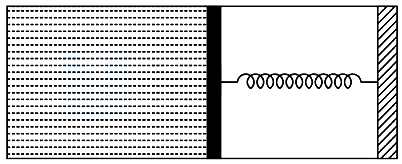
LIST -I LIST -II A) In process P) Work done by the gas is zero B) In process Q) Temperature of the gas remains unchanged C) In process R) No heat is exchanged between the gas and its surroundings D) In process S) Work done by the gas is JEE Advanced 2018 Medium - An ideal monoatomic gas is confined in a horizontal cylinder by a spring loaded piston (as shown in the figure).Initially the gas is at temperature , pressure and volume and the spring is in its relaxed state. The gas is then heated very slowly to temperature , pressure and volume . During this process the piston moves out by a distance . Ignoring the friction between the piston the cylinder, the correct statement(s) is (are)
 JEE Advanced 2015 Medium
 - A perfectly reflecting mirror of mass mounted on a spring constitutes a spring-mass system of angular frequency such that with as Planck's constant. photons of wavelength strike the mirror simultaneously at normal incidence such that the mirror gets displaced by If the value of is then the value of is________.
[Consider the spring as massless]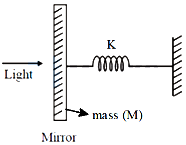 JEE Advanced 2019 Medium
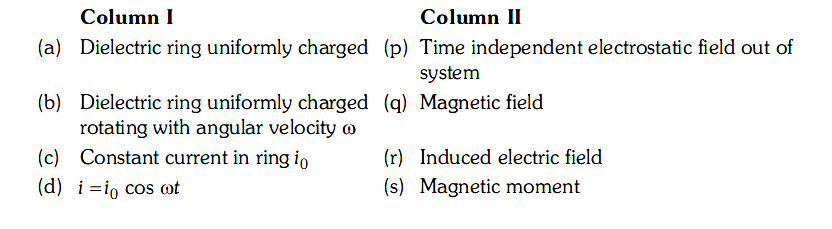
 - Match the following columns
 JEE Advanced 2006 Hard
 - A monochromatic light is travelling in a medium of refractive index . It enters a stack of glass layers from the bottom side at an angle The interfaces of the glass layers are parallel to each other. The refractive indices of different glass layers are monotonically decreasing as where is the refractive index of the slab and (see the figure). The ray is refracted out parallel to the interface between the and slabs from the right side of the stack. What is the value of m?
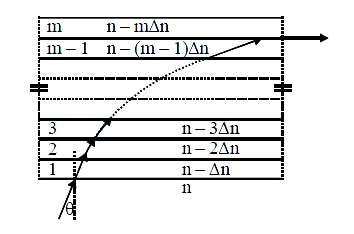 JEE Advanced 2017 Hard
 - A projectile is fired from horizontal ground with speed and projection angle . When the acceleration due to gravity is , the range of the projectile is . If at the highest point in its trajectory, the projectile enters a different region where the effective acceleration due to gravity is , then the new range is The value of isJEE Advanced 2022 Easy
More PYQs from JEE Advanced
- Consider three points \(P=(-\sin (\beta-\alpha),-\cos \beta), Q=(\cos (\beta-\alpha), \sin \beta)\) and \(R=(\cos (\beta-\alpha+\theta), \sin (\beta-\theta)\), where \(0 < \alpha, \beta, \theta < \frac{\pi}{4}\). Then,JEE Advanced 2008 Easy
- A Young's double slit interference arrangement with slits and is immersed in water (refractive index ) as shown in the figure. The positions of maxima on the surface of water are given by , where is the wavelength of light in air (refractive index = 1), is the separation between the slits and m is an integer. The value of p is
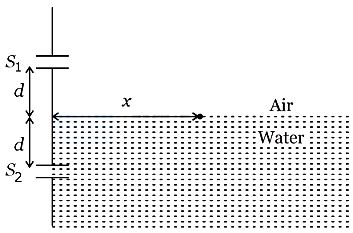 JEE Advanced 2015 Hard
 - A right-angled prism of refractive index is placed in a rectangular block of refractive index , which is surrounded by a medium of refractive index , as shown in the figure. A ray of light enters the rectangular block at normal incidence. Depending upon the relationships between and , it takes one of the four possible paths or .
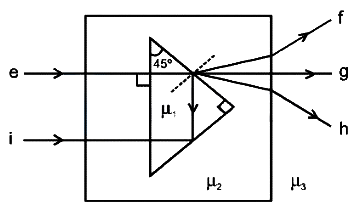
Match the paths in List with conditions of refractive indices in List and select the correct answer using the codes given below the lists:List I List II A. P. B. Q. C. R. D. S. JEE Advanced 2013 Medium - The colour of light absorbed by an aqueous solution of \(\mathrm{CuSO}_{4}\) is:JEE Advanced 2012 Medium
- Paragraph:
Consider the functions defined implicitly by the equation \(y^3-3 y+x=0\) on various intervals in the real line. If \(x \in(-\infty,-2) \cup(2, \infty)\), the equation implicitly defines a unique real valued differentiable function \(y=f(x)\). If \(x \in(-2,2)\), the equation implicitly defines a unique real valued differentiable function \(y=g(x)\), satisfying \(g(0)=0\).Question:
If \(f(-10 \sqrt{2})=2 \sqrt{2}\), then \(f^{\prime \prime}(-10 \sqrt{2})\) is equal toJEE Advanced 2008 Medium -

Which is correct statement if \(\mathrm{N}_2\) is added at equilibrium condition?JEE Advanced 2006 Easy