


JEE Advanced · Chemistry · 9. Redox Reactions
Match the complexes in Column I with their properties listed in Column II. Indicate your answer by darkening the appropriate bubbles of the \(4 \times 4\) matrix given in the ORS.
| Column I | Column II |
| A. \(\text O _2^{-} \longrightarrow \text{O} _2\) \(+~\text O _2^{2-}\) | P. Redox reaction |
| B. \(\text{CrO} _4^{2-}+\text H ^{+} \longrightarrow\) | Q. One of the products has trigonal planar structure |
| C. \(\text{MnO} _4^{-}+ \text{NO} _2^{-}\) \(+~ \text H ^{+} \longrightarrow\) | R. Dimeric bridged tetrahedral metal ion |
| D. \(\text{NO} _3^{-}+ \text H _2 \text{SO} _4\) \(+~ \text{Fe} ^{2+} \longrightarrow\) | S. Disproportionation |
- A A-p; B-q; C-p; D-q, r
- B A-p, s; B-q, r; C-p, r; D-r, s
- C A-s; B-p; C-p; D-q
- D A-p, s; B-r; C-p, q; D-p, s
Answer & Solution
Correct Answer
(D) A-p, s; B-r; C-p, q; D-p, s
Step-by-step Solution
Detailed explanation
A-p,s B-r, C-p,q, D-p,s,
\(2 \mathrm{CrO}_4^{2-} \longrightarrow \mathrm{Cr}_2 \mathrm{O}_7^{2-} \)
\( \mathrm{MnO}_4^{-}+\mathrm{NO}_2^{-}+\mathrm{H}^{+} \longrightarrow \mathrm{Mn}^{2+}+\) \(\mathrm{NO}_3^{-}+\mathrm{H}_2 \mathrm{O} \)
\( \mathrm{NO}_3^{-}+\mathrm{H}_2 \mathrm{SO}_4+\mathrm{Fe}^{2+} \longrightarrow \mathrm{Fe}^{3+}+\) \(\mathrm{NO}+\mathrm{SO}_4^{2-}+\mathrm{H}_2 \mathrm{O}\)
\(2 \mathrm{CrO}_4^{2-} \longrightarrow \mathrm{Cr}_2 \mathrm{O}_7^{2-} \)
\( \mathrm{MnO}_4^{-}+\mathrm{NO}_2^{-}+\mathrm{H}^{+} \longrightarrow \mathrm{Mn}^{2+}+\) \(\mathrm{NO}_3^{-}+\mathrm{H}_2 \mathrm{O} \)
\( \mathrm{NO}_3^{-}+\mathrm{H}_2 \mathrm{SO}_4+\mathrm{Fe}^{2+} \longrightarrow \mathrm{Fe}^{3+}+\) \(\mathrm{NO}+\mathrm{SO}_4^{2-}+\mathrm{H}_2 \mathrm{O}\)
See the Complete Solution
Get step-by-step explanations for this and 2.5 Lakh+ more JEE, NEET & CET questions.
- Unlock all solutions
- Practice the full chapter
- Track accuracy across PYQs
4.8 rated on Google Play · 14,000+ reviews
More questions from Chemistry
- Hyperconjugation involves overlap of the following orbitalsJEE Advanced 2008 Easy
- The colour of the molecules of group 17 elements changes gradually from yellow to violet down the group. This is due to -JEE Advanced 2017 Medium
- A solution of colourless salt \(\mathrm{H}\) on boiling with excess \(\mathrm{NaOH}\) produces a non-flammable gas. The gas evolution ceases after sometime. Upon addition of \(\mathrm{Zn}\) dust to the same solution, the gas evolution restarts. The colourless salt (s) \(\mathrm{H}\) is (are)JEE Advanced 2008 Medium
- Reduction of the metal centre in aqueous permanganate ion involvesJEE Advanced 2011 Hard
- A plot of the number of neutrons against the number of protons of the stable nuclei exhibits upwards deviation from linearity for atomic number, . For an unstable nucleus having ratio less than , the possible mode(s) of decay is (are):JEE Advanced 2016 Medium
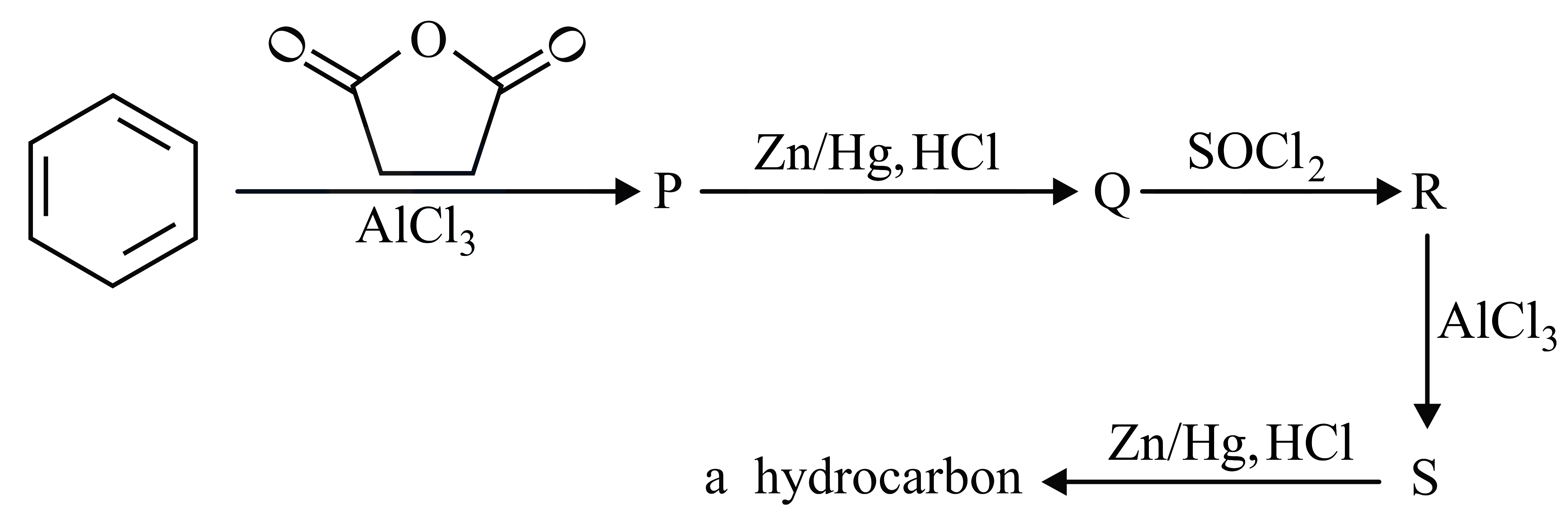
- Considering the following reaction sequence, the correct statement(s) is(are)
 JEE Advanced 2022 Hard
More PYQs from JEE Advanced
- Paragraph:
Box \(1\) contains three cards bearing numbers \(1,2,3\); box \(2\) contains five cards bearing numbers \(1,2,3,4,5\); and box \(3\) contains seven cards bearing numbers \(1,2,3,4,5,6,7\). A card is drawn from each of the boxes. Let \(x_{i}\) be the number on the card drawn from the \(i^{t h}\) box, \(i=1,2,3\).
Question:
The probability that \(x_{1}+x_{2}+x_{3}\) is odd, isJEE Advanced 2014 Medium - Consider the following statements related to colloids.
(I) Lyophobic colloids are not formed by simple mixing of dispersed phase and dispersion medium.
(II) For emulsions, both the dispersed phase and the dispersion medium are liquid.
(III) Micelles are produced by dissolving a surfactant in any solvent at any temperature.
(IV) Tyndall effect can be observed from a colloidal solution with dispersed phase having the same refractive index as that of the dispersion medium.
The option with the correct set of statements isJEE Advanced 2023 Medium - A metal rod of length \(L\) and mass \(m\) is pivoted at one end. A thin disc of mass \(M\) and radius \(R( < L)\) is attached at its centre to the free end of the rod. Consider two ways the disc is attached. Case A-the disc is not free to rotate about its centre and case \(B\)-the disc is free to rotate about its centre. The rod-disc system performs
SHM in vertical plane after being released from the same displaced position. Which of the following statement(s) is/are true?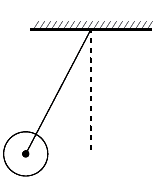 JEE Advanced 2011 Medium
 - Paragraph :
Consider an evacuated cylindrical chamber of height \(h\) having rigid conducting plates at the ends and an insulating curved surface as shown in the figure. A number of spherical balls made of a light weight and soft material and coated with a conducting material are placed on the bottom plate. The balls have a radius \(r \ll h\). Now a high voltage source \((HV)\) is connected across the conducting plates such that the bottom plate is at \(+V_{0}\) and the top plate at \(-V_{0} .\) Due to their conducting surface, the balls will get charged, will become equipotential with the plate and are repelled by it. The balls will eventually collide with the top plate, where the coefficient of restitution can be taken to be zero due to the soft nature of the material of the balls. The electric field in the chamber can be considered to be that of a parallel plate capacitor. Assume that there are no collisions between the balls and the interaction between them is negligible. (Ignore gravity)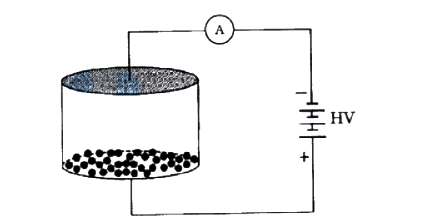
Question :
Which one of the following statements is correct?JEE Advanced 2016 Medium - Let \(H_1, H_2, \ldots, H_n\) be mutually exclusive events with \(P\left(H_i\right)>0, i=1,2, \ldots, n\). Let \(E\) be any other event with \(0 < P(E) < 1\).
Statement I \(P\left(H_i / E\right)>P\left(E / H_i\right) P\left(H_i\right)\) for \(i=1,2, \ldots, n\).
Statement II \(\sum_{i=1}^n P\left(H_i\right)=1\)JEE Advanced 2007 Hard - Paragraph:
Let \(f:[0,1] \rightarrow \mathbb{R}\) (the set of all real numbers) be a function. Suppose the function \(f\) is twice differentiable, \(f(0)=f(1)=0\) and satisfies \(f^{\prime \prime}(x)-2 f^{\prime}(x)+f(x) \geq e^{x}, x \in[0,1] .\)
Question:
Which of the following is true for \(f(x)\) ?JEE Advanced 2013 Hard