


JEE Advanced · Physics · 19. Current Electricity
Paragraph :
Consider an evacuated cylindrical chamber of height \(h\) having rigid conducting plates at the ends and an insulating curved surface as shown in the figure. A number of spherical balls made of a light weight and soft material and coated with a conducting material are placed on the bottom plate. The balls have a radius \(r \ll h\). Now a high voltage source \((HV)\) is connected across the conducting plates such that the bottom plate is at \(+V_{0}\) and the top plate at \(-V_{0} .\) Due to their conducting surface, the balls will get charged, will become equipotential with the plate and are repelled by it. The balls will eventually collide with the top plate, where the coefficient of restitution can be taken to be zero due to the soft nature of the material of the balls. The electric field in the chamber can be considered to be that of a parallel plate capacitor. Assume that there are no collisions between the balls and the interaction between them is negligible. (Ignore gravity)
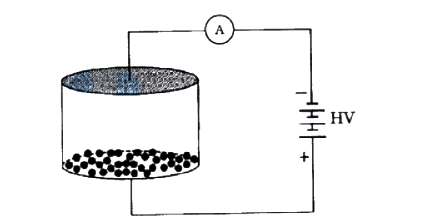
Question :
Which one of the following statements is correct?
- A The balls will bounce back to the bottom plate carrying the opposite charge they went up with
- B The balls will execute simple harmonic motion between the two plates
- C The balls will bounce back to the bottom plate carrying the same charge they went up with
- D The balls will stick to the top plate and remain there
Answer & Solution
Correct Answer
(A) The balls will bounce back to the bottom plate carrying the opposite charge they went up with
Step-by-step Solution
Detailed explanation
Balls placed on +ve plate become positive charge and move upward due to electric field. These balls on colliding with negative plate become negatively charged and move opposite to the direction of electric field.
Balls placed on +ve plate become positive charge and move upward due to electric field.
These balls on colliding with negative plate become negatively charged and move opposite to the direction of electric field.
Balls placed on +ve plate become positive charge and move upward due to electric field.
These balls on colliding with negative plate become negatively charged and move opposite to the direction of electric field.
See the Complete Solution
Get step-by-step explanations for this and 2.5 Lakh+ more JEE, NEET & CET questions.
- Unlock all solutions
- Practice the full chapter
- Track accuracy across PYQs
4.8 rated on Google Play · 14,000+ reviews
More questions from Physics
- An infinitely long thin wire, having a uniform charge density per unit length of \(5 \mathrm{nC} / \mathrm{m}\), is passing through a spherical shell of radius \(1 \mathrm{~m}\), as shown in the figure. A \(10 \mathrm{nC}\) charge is distributed uniformly over the spherical shell. If the configuration of the charges remains static, the magnitude of the potential difference between points \(\mathrm{P}\) and \(\mathrm{R}\), in Volt, is _______ .
[Given: In SI units \(\frac{1}{4 \pi \epsilon_0}=9 \times 10^9, \ln 2=0.7\). Ignore the area pierced by the wire.]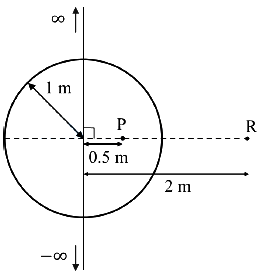 JEE Advanced 2024 Medium
 - Consider regular polygons with number of sides as shown in the figure. The center of mass of all the polygons is at height from the ground. They roll on a horizontal surface about the leading vertex without slipping and sliding as depicted. The maximum increase in height of the locus of the center of mass for each polygon is . Then, depends on and as
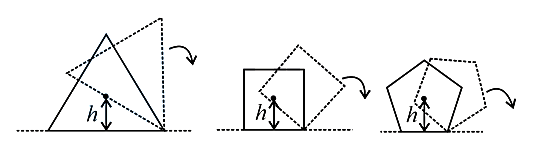 JEE Advanced 2017 Medium
 - A person sitting inside an elevator performs a weighing experiment with an object of mass 50 kg . Suppose that the variation of the height \(y\) (in m ) of the elevator, from the ground, with time \(t\) (in s ) is given by \(y=8\left[1+\sin \left(\frac{2 \pi t}{T}\right)\right]\), where \(T=40 \pi \mathrm{~s}\). Taking acceleration due to gravity, \(g=10 \mathrm{~m} / \mathrm{s}^2\), the maximum variation of the object's weight (in N ) as observed in the experiment is _______ .JEE Advanced 2025 Medium
- List I describes four systems, each with two particles and in relative motion as shown in figure. List II gives possible magnitudes of their relative velocities (in ) at time .
Which one of the following options is correct?List-I List-II (I) and are moving on a horizontal circle of radius with uniform angular speed . The initial angular positions of and at time are and respectively. 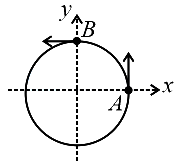
(P) (II) Projectiles and are fired (in the same vertical plane) at and respectively, with the same speed and at from the horizontal plane. The initial separation between and is large enough so that they do not collide, . 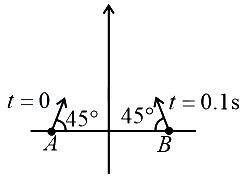
(Q) (III) Two harmonic oscillators and moving in the direction according to and respectively, starting from . Take . 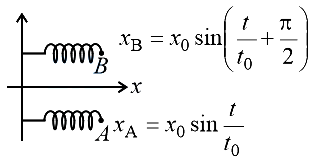
(R) (IV) Particle is rotating in a horizontal circular path of radius on the plane, with constant angular speed . Particle is moving up at a constant speed in the vertical direction as shown in the figure. (Ignore gravity.) 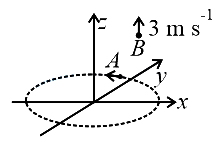
(S) (T) JEE Advanced 2022 Medium - An ideal gas is undergoing a cyclic thermodynamic process in different ways as shown in the corresponding P-V diagrams in column 3 of the table. Consider only the path from state 1 to state 2. W denotes the corresponding work done on the system. The equations and plots in the table have standard notations as used in thermodynamic process. Here is the ratio of heat capacities at constant pressure and constant volume. The number of moles in the gas in n.
Which one of the following options correctly represents a thermodynamic process that is used as a correction in the determination of the speed of sound in ideal gas?Column – 1 Column – 2 Column – 3 (I) \(W_{1 \rightarrow 2}=\) \(\frac{1}{\gamma-1}\left(P_2 V_2-P_1 V_1\right)\) (i) Isothermal (P) 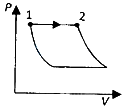
(II) \(W_{1 \rightarrow 2}=\) \(-P V_2+P V_1\) (ii) Isochoric (Q) 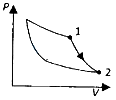
(III) \(W_{1 \rightarrow 2}=0\) (iii) Isobaric (R) 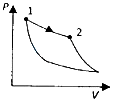
(IV) \(W_{1 \rightarrow 2}=\)\(-n R T \ln \left(\frac{V_2}{V_1}\right)\) (iv) Adiabatic (S) 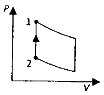 JEE Advanced 2017 Medium
 - The isotope having a mass 12.014 u undergoes - decay to has an excited state of the nucleus at 4.041 MeV above its ground state. If decays to the maximum kinetic energy of the - particle in units of MeV is ( where c is the speed of light in vacuum).JEE Advanced 2016 Medium
More PYQs from JEE Advanced
- The smallest value of \(k\), for which both the roots of the equation \(x^2-8 k x+16\left(k^2-k+1\right)=0\) are real, distinct and have values atleast 4 , isJEE Advanced 2009 Easy
- Paragraph:
A frame of reference that is accelerated with respect to an inertial frame of reference is called a non-inertial frame of reference. A coordinate system fixed on a circular disc rotating about a fixed axis with a constant angular velocity \(\omega\) is an example of a non-inertial frame of reference.
The relationship between the force \(\vec{F}_{\text {rot }}\) experienced by a particle of mass \(m\) moving on the rotating disc and the force \(\vec{F}_{\text {in }}\) experienced by the particle in an inertial frame of reference is
\(\vec{F}_{\mathrm{rot}}=\vec{F}_{\mathrm{in}}+2 m\left(\vec{v}_{\mathrm{rot}} \times \vec{\omega}\right)+m(\vec{\omega} \times \vec{r}) \times \vec{\omega}\),
where \(\vec{v}_{\text {rot }}\) is the velocity of the particle in the rotating frame of reference and \(\vec{r}\) is the position vector of the particle with respect to the centre of the disc.
Now consider a smooth slot along a diameter of a disc of radius \(R\) rotating counter-clockwise with a constant angular speed \(\omega\) about its vertical axis through its center. We assign a coordinate system with the origin at the center of the disc, the \(x\)-axis along the slot, the \(y\)-axis perpendicular to the slot and the \(z\)-axis along the rotation axis \((\vec{\omega}=\omega \hat{k}) .\) A small block of mass \(m\) is gently placed in the slot at \(\vec{r}=(R / 2) \hat{i}\) at \(t=0\) and is constrained to move only along the slot.
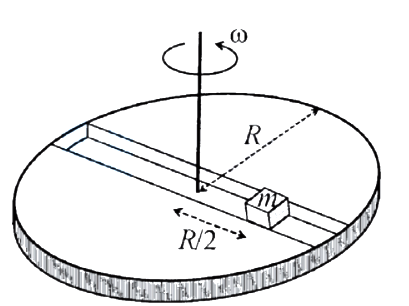
Question:
The distance \(r\) of the block at time \(t\) isJEE Advanced 2016 Easy - Paragraph:
\(\mathbf{X}\) and \(\mathbf{Y}\) are two volatile liquids with molar weights of \(10 \mathrm{~g} \mathrm{~mol}^{-1}\) and \(40 \mathrm{~g} \mathrm{~mol}^{-1}\) respectively. Two cotton plugs, one soaked in \(\mathbf{X}\) and the other soaked in \(\mathbf{Y}\), are simultaneously placed at the ends of a tube of length \(L=24 \mathrm{~cm}\), as shown in the figure. The tube is filled with an inert gas at \(1\) atmosphere pressure and a temperature of \(300 \mathrm{~K}\). Vapours of \(\mathbf{X}\) and \(\mathbf{Y}\) react to form a product which is first observed at a distance \(\mathbf{d} \mathrm{~cm}\) from the plug soaked in \(\mathbf{X}\). Take \(\mathbf{X}\) and \(\mathbf{Y}\) to have equal molecular diameters and assume ideal behaviour for the inert gas and the two vapours.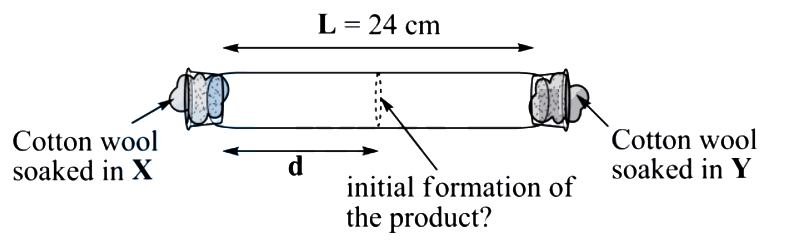
Question:
The experimental value of \(\mathbf{d}\) is found to be smaller than the estimate obtained using Graham's law. This is due toJEE Advanced 2014 Medium - \(\lim _{x \rightarrow \frac{\pi}{4}} \frac{\int_2^{\sec ^2 x} f(t) d t}{x^2-\frac{\pi^2}{16}}\) equalsJEE Advanced 2007 Easy
- A diatomic ideal gas is compressed adiabatically to \(\frac{1}{32}\) of its initial volume. If the initial temperature of the gas is \(T_i\) \(T_i\) (in kelvin) and the final temperature is \(a T_i\), the value of \(a\) isJEE Advanced 2010 Easy
- If the distance between the plane \(A x-2 y+z=d\) and the plane containing the lines \(\frac{x-1}{2}=\frac{y-2}{3}=\frac{z-3}{4} \quad\) and \(\frac{x-2}{3}=\frac{y-3}{4}=\frac{z-4}{5}\) is \(\sqrt{6}\), then \(|d|\) isJEE Advanced 2010 Easy