


JEE Advanced · Mathematics · 32. Probability
Let \(H_1, H_2, \ldots, H_n\) be mutually exclusive events with \(P\left(H_i\right)>0, i=1,2, \ldots, n\). Let \(E\) be any other event with \(0 < P(E) < 1\).
Statement I \(P\left(H_i / E\right)>P\left(E / H_i\right) P\left(H_i\right)\) for \(i=1,2, \ldots, n\).
Statement II \(\sum_{i=1}^n P\left(H_i\right)=1\)
- A Statement I is true, Statement II is true; Statement II is a correct explanation for Statement I
- B Statement I is true, Statement II is true; Statement II is not a correct explanation for Statement II
- C Statement I is true, Statement II is false
- D Statement I is false, Statement II is true
Answer & Solution
Correct Answer
(D) Statement I is false, Statement II is true
Step-by-step Solution
Detailed explanation
Statement : I If \(P\left(H_i \cap E\right)=0\) for some \(i\), then
\[
P\left(\frac{H_i}{E}\right)=P\left(\frac{E}{H_i}\right)=0
\]
If \(P\left(H_i \cap E\right) \neq 0\) for \(\forall i=1,2, \ldots . n\), then
\[
\begin{aligned}
P\left(\frac{H_i}{E}\right) & =\frac{P\left(H_i \cap E\right)}{P\left(H_i\right)} \times \frac{P\left(H_i\right)}{P(E)} \\
& \left.=\frac{P\left(\frac{E}{H_i}\right) \times P\left(H_i\right)}{P(E)}>P\left(\frac{E}{H_i}\right) \cdot P\left(H_i\right) \quad \text { [as } 0 < P(E) < 1\right]
\end{aligned}
\]
Hence, Statement I may not always be true.
Statement II
Clearly, \(H_1 \cup H_2 \cup \ldots . \cup H_n=S\) (sample space)
\[
\Rightarrow \quad P\left(H_1\right)+P\left(H_2\right)+\ldots+P\left(H_n\right)=1 .
\]
Hence, Statement II is true.
\[
P\left(\frac{H_i}{E}\right)=P\left(\frac{E}{H_i}\right)=0
\]
If \(P\left(H_i \cap E\right) \neq 0\) for \(\forall i=1,2, \ldots . n\), then
\[
\begin{aligned}
P\left(\frac{H_i}{E}\right) & =\frac{P\left(H_i \cap E\right)}{P\left(H_i\right)} \times \frac{P\left(H_i\right)}{P(E)} \\
& \left.=\frac{P\left(\frac{E}{H_i}\right) \times P\left(H_i\right)}{P(E)}>P\left(\frac{E}{H_i}\right) \cdot P\left(H_i\right) \quad \text { [as } 0 < P(E) < 1\right]
\end{aligned}
\]
Hence, Statement I may not always be true.
Statement II
Clearly, \(H_1 \cup H_2 \cup \ldots . \cup H_n=S\) (sample space)
\[
\Rightarrow \quad P\left(H_1\right)+P\left(H_2\right)+\ldots+P\left(H_n\right)=1 .
\]
Hence, Statement II is true.
See the Complete Solution
Get step-by-step explanations for this and 2.5 Lakh+ more JEE, NEET & CET questions.
- Unlock all solutions
- Practice the full chapter
- Track accuracy across PYQs
4.8 rated on Google Play · 14,000+ reviews
More questions from Mathematics
- Consider the lines given by
\[
L_1: x+3 y-5=0, L_2: 3 x-k y-1=0, L_3: 5 x+2 y-12=0
\]
Match the Statements/Expressions in Column I with the Statements/Expressions in Column II.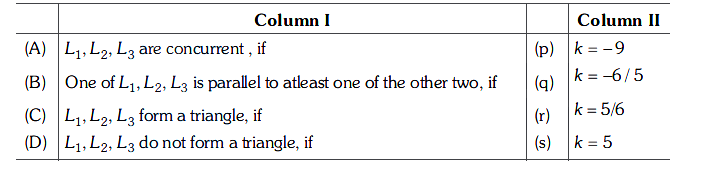 JEE Advanced 2008 Medium
 - If \(\mathbf{a}, \mathbf{b}, \mathbf{c}\) and \(\mathbf{d}\) are the unit vectors such that \((\mathbf{a} \times \mathbf{b}) \cdot(\mathbf{c} \times \mathbf{d})=1\) and \(\mathbf{a} \cdot \mathbf{c}=\frac{1}{2}\), thenJEE Advanced 2009 Hard
- The line \(2 x+y=1\) is tangent to the hyperbola \(\frac{x^2}{a^2}-\frac{y^2}{b^2}=1\). If this line passes through the point of intersection of the nearest directrix and the \(x\)-axis, then the eccentricity of the hyperbola isJEE Advanced 2010 Medium
- Let \(\mathbb{R}\) denote the set of all real numbers. Define the function \(f: \mathbb{R \rightarrow \mathbb { R }}\) by
\(f(\mathrm{x})=\left\{\begin{array}{cc}2-2 x^2-x^2 \sin \frac{1}{x} & \text { if } x \neq 0 \\ 2 & \text { if } x=0\end{array}\right.\)
Then which one of the following statements is TRUE ?JEE Advanced 2025 Hard - Let and be two ellipse whose centers are at the origin. The major axes of lie along the x - axis and the y - axis, respectively. Let S be the circle The straight line touches the curves and at and respectively. Suppose that If and are the eccentricities of and respectively, then the correct expression(s) is(are)JEE Advanced 2015 Medium
- Let denote the parabola Let , and let and be two distinct points on such that the lines and are tangents to . Let be the focus of . Then which of the following statements is (are) TRUE?JEE Advanced 2021 Medium
More PYQs from JEE Advanced
- The of is at . The solubility (in ) of in a solution isJEE Advanced 2013 Hard
- A bar of mass and length is lying on a horizontal frictionless surface. One end of the bar is pivoted at a point about which it is free to rotate. A small mass is moving on the same horizontal surface with speed on a path perpendicular to the bar. It hits the bar at a distance from the pivoted end and returns back on the same path with speed . After this elastic collision, the bar rotates with an angular velocity . Which of the following statement is correct?JEE Advanced 2023 Hard
- Match List I with List II and select the correct answer using the code given below the lists :
List - I List - II A.
P. B.
If cosx + cosy + cosz = 0 = sinx + siny + sinz then possible value of cosQ. C.
If cos cos2x + sinx sin 2x secx = cosx sin2x secx + cos cos2x then possible value of secx isR. D.
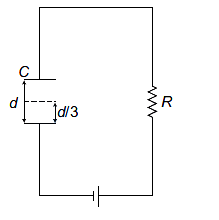
If cot then possible value of x isS. 1 JEE Advanced 2013 Medium - A parallel plate capacitor \(C\) with plates of unit area and separation \(d\) is filled with a liquid of dielectric constant \(K=2\). The level of liquid is \(\frac{d}{3}\) initially. Suppose the liquid level decreases at a constant speed \(v\), the time constant as a function of time \(t\) is
 JEE Advanced 2008 Hard
 - Let be given by Define Then which of the following options is/are correct?JEE Advanced 2019 Medium
- The carbon-based reduction method is NOT used for the extraction ofJEE Advanced 2013 Easy