


JEE Advanced · Chemistry · 19. Surface Chemistry
Consider the following statements related to colloids.
(I) Lyophobic colloids are not formed by simple mixing of dispersed phase and dispersion medium.
(II) For emulsions, both the dispersed phase and the dispersion medium are liquid.
(III) Micelles are produced by dissolving a surfactant in any solvent at any temperature.
(IV) Tyndall effect can be observed from a colloidal solution with dispersed phase having the same refractive index as that of the dispersion medium.
The option with the correct set of statements is
- A (I) and (II)
- B (II) and (III)
- C (III) and (IV)
- D (II) and (IV)
Answer & Solution
Correct Answer
(A) (I) and (II)
Step-by-step Solution
Detailed explanation
As in Lyophobic colloids there is no interaction between dispersed phase and dispersion medium, special methods are used for preparation, simple mixing will not form colloid.
Emulsion are colloids of liquid dispersed phase and liquid dispersion medium.
Micelles formation occurs when temperature is above a particular temperature called Kraft temperature and concentration above a particular value know as critical micelle concentration (CMC).
Tyndall's effect can be observed when the refractive indices of the dispersed phase and the dispersion medium differ greatly in magnitude.
Emulsion are colloids of liquid dispersed phase and liquid dispersion medium.
Micelles formation occurs when temperature is above a particular temperature called Kraft temperature and concentration above a particular value know as critical micelle concentration (CMC).
Tyndall's effect can be observed when the refractive indices of the dispersed phase and the dispersion medium differ greatly in magnitude.
See the Complete Solution
Get step-by-step explanations for this and 2.5 Lakh+ more JEE, NEET & CET questions.
- Unlock all solutions
- Practice the full chapter
- Track accuracy across PYQs
4.8 rated on Google Play · 14,000+ reviews
More questions from Chemistry
- Match the anionic species given in Column I that are present in the ores(s) given in Column II.
Column I Column II A. Carbonate P. Siderite B. Sulphide Q. Malachite C. Hydroxide R. Bauxite D. Oxide S. Calamine T. Argentite JEE Advanced 2015 Easy - \(\mathrm{MgSO}_4\) on reaction with \(\mathrm{NH}_4 \mathrm{OH}\) and \(\mathrm{Na}_2 \mathrm{HPO}_4\) forms a white crystalline precipitate. What is its formula?JEE Advanced 2006 Medium
- Match each of the compounds given in Column I with the reaction (s) that they can undergo, given in Column II.
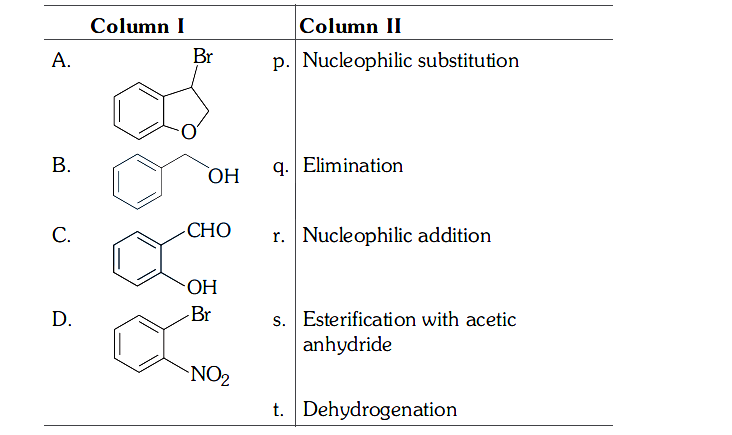 JEE Advanced 2009 Hard
 - The compound (s) having peroxide linkage is(are) :JEE Advanced 2024 Easy
- Bleaching powder and bleach solution are produced on a large scale and used in several household products. The effectiveness of bleach solution is often measured by iodometry.
Question:
\(25 \mathrm{~mL}\) of household solution was mixed with \(30 \mathrm{~mL}\) of \(0.50\) M KI and \(10 \mathrm{~mL}\) of \(4 \mathrm{~N}\) acetic acid. In the titration of the liberated iodine, \(48 \mathrm{~mL}\) of \(0.25 \mathrm{~N~} \mathrm{Na}_{2} \mathrm{~S}_{2} \mathrm{O}_{3}\) was used to reach the end point. The molarity of the household bleach solution isJEE Advanced 2012 Hard - A compound with molar weight of 80g is dissolved in a solvent having density of . Assuming no change in volume upon dissolution, the molality of a 3.2 molar solution isJEE Advanced 2014 Medium
More PYQs from JEE Advanced
- We have taken a saturated solution of \(\mathrm{AgBr}, K_{\mathrm{sp}}\) is \(12 \times 10^{-14}\). If \(10^{-7}\) mole of \(\mathrm{AgNO}_3\) are added to 1 litre of this solution, find conductivity (specific conductance) of this solution in terms of \(10^{-7} \mathrm{Sm}^{-1}\) units.
\( \text {Given, } \lambda_{\left(\mathrm{Ag}^{+}\right)}^{\circ} =6 \times 10^{-3} \mathrm{Sm}^2 \mathrm{~mol}^{-1},\) \(\lambda_{\left(\mathrm{Br}^{-}\right)}^{\circ}=8 \times 10^{-3} \mathrm{Sm}^2 \mathrm{~mol}^{-1}, \)
\( \lambda_{\left(\mathrm{NO}_3^{-}\right)} =7 \times 10^{-3} \mathrm{Sm}^2 \mathrm{~mol}^{-1},\)JEE Advanced 2006 Hard - In the circuit shown below, the key is pressed at time t = 0. Which of the following statement(s) is(are) true?
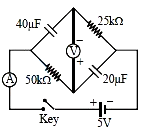 JEE Advanced 2016 Hard
 - Paragraph:
The reaction of compound \(\mathbf{P}\) with \(\mathrm{CH}_{3} \mathrm{MgBr}\) (excess) in \(\left(\mathrm{C}_{2} \mathrm{H}_{5}\right)_{2} \mathrm{O}\) followed by addition of \(\mathrm{H}_{2} \mathrm{O}\) gives \(\mathbf{Q}\). The compound \(\mathbf{Q}\) on treatment with \(\mathrm{H}_{2} \mathrm{SO}_{4}\) at \(0^{\circ} \mathrm{C}\) gives \(\mathbf{R}\). The reaction of \(\mathbf{R}\) with \(\mathrm{CH}_{3} \mathrm{COCl}\) in the presence of anhydrous \(\mathrm{AlCl}_{3}\) in \(\mathrm{CH}_{2} \mathrm{Cl}_{2}\) followed by treatment with \(\mathrm{H}_{2} \mathrm{O}\) produces compound \(\mathbf{S}\). [Et in compound \(\mathbf{P}\) is ethyl group]
Question :
The reactions, \(\mathbf{Q}\) to \(\mathbf{R}\) and \(\mathbf{R}\) to \(\mathbf{S}\), areJEE Advanced 2017 Hard - Match the extraction processes listed in column I with metals listed in column II.
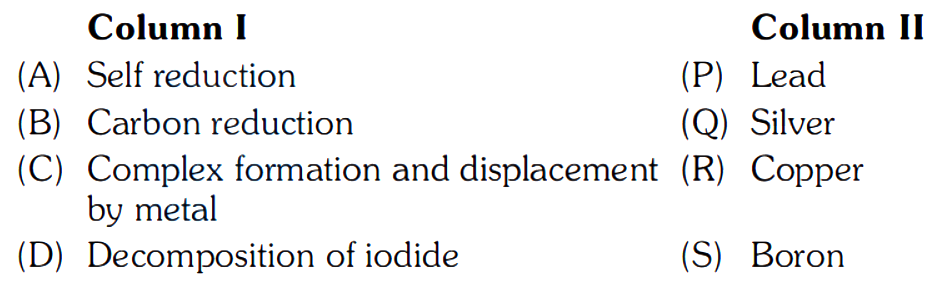 JEE Advanced 2006 Medium
 - Let for all be a continuous function. For if is the area of the region bounded by then isJEE Advanced 2015 Medium
- A large spherical mass is fixed at one position and two identical point masses are kept on a line passing through the centre of (see figure). The point masses are connected by a rigid massless rod of length and this assembly is free to move along the line connecting them. All three masses interact only through their mutual gravitational interaction. When the point mass nearer to is at a distance from , the tension in the rod is zero for . The value of is
 JEE Advanced 2015 Medium