


WBJEE · Chemistry · Chemical Kinetics
For a reaction \(2 \mathrm{~A}+\mathrm{B} \rightarrow \mathrm{P}\), when concentration of \(\mathrm{B}\) alone is doubled, rate does not change and when concentrations of both \(\mathrm{A}\) and \(\mathrm{B}\) is doubled, rate increases by a factor of 4 . The unit of rate constant is,
- A \(\mathrm{s}^{-1}\)
- B \(\mathrm{L} \mathrm{mol}^{-1} \mathrm{~s}^{-1}\)
- C \(\mathrm{mol} \mathrm{L}^{-1} \mathrm{~s}^{-1}\)
- D \(\mathrm{L}^{2} \mathrm{~mol}^{-2} \mathrm{~s}^{-1}\)
Answer & Solution
Correct Answer
(B) \(\mathrm{L} \mathrm{mol}^{-1} \mathrm{~s}^{-1}\)
Step-by-step Solution
Detailed explanation
Hint : Rate law: \(\mathrm{r}=\mathrm{k}[\mathrm{A}]^{\alpha}[\mathrm{B}]^{\beta} \quad \mathrm{B}\) follows first order kinetics. \(\therefore \beta=1\) \(\frac{r_{2}}{r_{1}}=\frac{[2 A]^{\alpha}[2 B]^{p}}{[A]^{\alpha}[B]^{\beta}}\) or, \(4=2^{a+\beta}\) or, \(\alpha+\beta=2\)…
See the Complete Solution
Get step-by-step explanations for this and 2.5 Lakh+ more JEE, NEET & CET questions.
- Unlock all solutions
- Practice the full chapter
- Track accuracy across PYQs
4.8 rated on Google Play · 14,000+ reviews
More questions from Chemistry
- The second law of thermodynamics says that in a cyclic process :WBJEE 2009 Easy
- If the given four electronic configurations.
(i) \(n=4, l=1\)
(ii) \(n=4, l=0\)
(iii) \(n=3, l=2\)
(iv) \(n=3, l=1\)
are arranged in order of increasing energy, then the order will beWBJEE 2017 Easy - The major product \((\mathrm{F})\) in the following reaction is
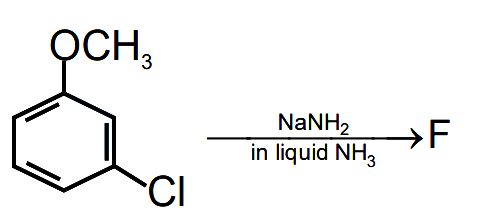 WBJEE 2025 Medium
 - \(\mathrm{Na}_2 \mathrm{CO}_3\) is prepared by Solvay process but \(\mathrm{K}_2 \mathrm{CO}_3\) cannot be prepared by the same becauseWBJEE 2023 Easy
- Which one is not a constituent of nucleic acid?WBJEE 2011 Easy
- Identify the incorrect statement among the following:WBJEE 2024 Hard
More PYQs from WBJEE
- For a chemical reaction at \(27^{\circ} \mathrm{C},\) the activation energy is \(600 \mathrm{R}\). The ratio of the rate constants at \(327^{\circ} \mathrm{C}\) to that of at \(27^{\circ} \mathrm{C}\)
will beWBJEE 2013 Medium - The ground state magnetic property of \(\mathrm{B}_{2}\) and
\(\mathrm{C}_{2}\) molecules will beWBJEE 2017 Easy - The ratio of magnetic field and magnetic moment at the centre of a current carrying circular loop is \(x\). When both the current and radius is doubled the ratio will beWBJEE 2010 Medium
- A particle of mass ' \(m\) ' moves in one dimension under the action of a conservative force whose potential energy has the form of \(U(x)=-\frac{\alpha x}{x^2+\beta^2}\) where \(\alpha\) and \(\beta\) are dimensional parameters. The angular frequency of the oscillation is proportional toWBJEE 2024 Easy
- Among the following chlorides the compounds which will be hydrolysed most easily and most slowly in aqueous \(\mathrm{NaOH}\) solution are respectively.
1.Methoxymethyl chloride
2.Benzyl chloride
3.Neopentyl chloride
4.Propyl chlorideWBJEE 2021 Medium - The equation of the plane through the point \((2,-1,-3)\) and parallel to the lines \(\frac{x-1}{3}=\frac{y+2}{2}=\frac{z}{-4}\) and \(\frac{x}{2}=\frac{y-1}{-3}=\frac{z-2}{2}\) isWBJEE 2020 Medium