


WBJEE · Chemistry · Haloalkanes and Haloarenes
The major product \((\mathrm{F})\) in the following reaction is
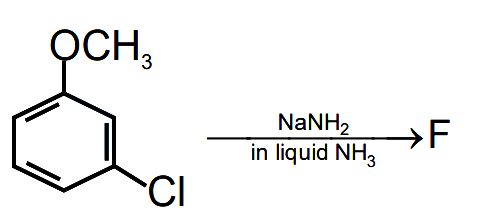
- A o-Anisidine
- B m-Anisidine
- C p-Anisidine
- D p-Chloro aniline
Answer & Solution
Correct Answer
(B) m-Anisidine
Step-by-step Solution
Detailed explanation
See the Complete Solution
Get step-by-step explanations for this and 2.5 Lakh+ more JEE, NEET & CET questions.
- Unlock all solutions
- Practice the full chapter
- Track accuracy across PYQs
4.8 rated on Google Play · 14,000+ reviews
More questions from Chemistry
- Which atomic species cannot be used as a nuclear fuel?WBJEE 2019 Easy
- Metal ion responsible for the Minimata disease isWBJEE 2014 Easy
- The mole fraction of ethanol in water is \(0.08\). Its molality isWBJEE 2020 Medium
- Among the following, the one which is not a "green house gas", isWBJEE 2014 Easy
- An electric current is passed through an aqueous solution of a mixture of alanine (isoelectric point 6.0) glutamic acid (3.2) and arginine (10.7) buffered at \(\mathrm{pH}\) 6. What is the fate of the three acids?WBJEE 2011 Hard
- Ribose and 2 -deoxyribose can be differentiated byWBJEE 2013 Medium
More PYQs from WBJEE
-
Structure of \(M\) is,WBJEE 2023 Medium - Which of the following orders regarding ionization energy is correct?WBJEE 2010 Easy
- Consider the real valued function \(\mathrm{h}:\{0,1,2 \ldots \ldots 100\} \rightarrow \mathrm{R}\) such that \(\mathrm{h}(0)=5, \mathrm{~h}(100)=20\) and satisfying \(h(p)=\frac{1}{2}\{h(p+1)+h(p-1)\}\) for every \(p=1,2 \ldots .99 .\) Then the value of \(h(1)\) isWBJEE 2021 Medium
- The number of atoms of a radioactive substance of half-life \(T\) is \(N_{0}\) at \(t=0 .\) The time necessary to decay from \(N_{0} / 2\) atoms to \(N_{0} / 10\) atoms will beWBJEE 2013 Medium
- If \(P, Q\) and \(R\) are angles of \(\Delta P Q R\), then the value of \(\left|\begin{array}{ccc}-1 & \cos R & \cos Q \\ \cos R & -1 & \cos P \\ \cos Q & \cos P & -1\end{array}\right|\) is equal toWBJEE 2012 Medium
- Let \(f:[a, b] \rightarrow \mathbb{R}\) be continuous in \([a, b]\), differentiable in \((a, b)\) and \(f(a)=0=f(b)\). ThenWBJEE 2022 Medium