


WBJEE · Chemistry · Thermodynamics (C)
The second law of thermodynamics says that in a cyclic process :
- A work cannot be converted into heat
- B heat cannot be converted into work
- C work cannot be completely converted into heat
- D heat cannot be completely converted into work
Answer & Solution
Correct Answer
(D) heat cannot be completely converted into work
Step-by-step Solution
Detailed explanation
Because \(0 \mathrm{~K}\) temperature is unattainable.
See the Complete Solution
Get step-by-step explanations for this and 2.5 Lakh+ more JEE, NEET & CET questions.
- Unlock all solutions
- Practice the full chapter
- Track accuracy across PYQs
4.8 rated on Google Play · 14,000+ reviews
More questions from Chemistry
- The change of entropy \((d S)\) is defined asWBJEE 2013 Easy
- 1,4 -dimethylbenzene on heating with anhydrous \(\mathrm{AlCl}_{3}\) and HCl producesWBJEE 2015 Medium
- The correct order of relative stability for the given free radicals is
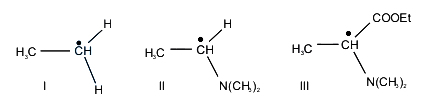 WBJEE 2022 Medium
 - How and why does the density of liquid water change on prolonged electrolysis?WBJEE 2020 Easy
- Amongst the following compounds, the one that will not respond to Cannizzaro reaction upon treatment with alkali isWBJEE 2016 Medium
- A compound is formed by substitution of two chlorine for two hydrogens in propane. The number of possible isomeric compounds isWBJEE 2009 Hard
More PYQs from WBJEE
- In a right-angled triangle, the sides are \(a, b\) and \(c\), with \(c\) as hypotenuse, and \(c-b \neq 1, c+b \neq 1\). Then the value of \(\left(\log _{c+b} a+\log _{c-b} a\right) /\left(2 \log _{c+b} a \times \log _{c-b} a\right)\) will beWBJEE 2010 Medium
- The distance between an object and a divergent lens is \(\mathrm{m}\) times the focal length of the lens. The linear magnification produced by the lens isWBJEE 2009 Medium
- For the reaction \(A+2 B \longrightarrow C\), the reaction rate is doubled, if the concentration of \(A\) is doubled. The rate is increased by four times When concentrations of both \(A\) and \(B\) are increased by four limes. The order of the reaction isWBJEE 2015 Easy
- In Young's double slit experiment, the fringe width is \(\beta\). If the entire arrangement is placed in a liquid of refractive index \(n\), the fringe width becomes :WBJEE 2010 Easy
- A line passing through the point of intersection of \(x+y=4\) and \(x-y=2\) makes an angle \(\tan ^{-1}\left(\frac{3}{4}\right)\) with the \(x\) -axis. It intersects the parabola \(y^{2}=4(x-3)\) at points \(\left(x_{1}, y_{1}\right)\) and \(\left(x_{2}, y_{2}\right)\) respectively. Then, \(\left|x_{1}-x_{2}\right|\) is equal toWBJEE 2013 Hard
- Let \(A\) be the point \((0,4)\) and \(B\) be a moving point on \(x\)-axis. Let \(M\) be the midpoint of \(A B\) and let the perpendicular bisector of \(A B\) meets the \(y\)-axis at \(R\). The locus of the midpoint \(P\) of \(M R\) isWBJEE 2021 Medium