


JEE Advanced · Physics · 2. Units & Dimensions
Paragraph : In electromagnetic theory, the electric and magnetic phenomena are related to each other. Therefore, the dimensions of electric and magnetic quantities must also be related to each other. In the questions below, stand for dimensions of electric and magnetic fields respectively, while and stand for dimensions of the permittivity and permeability of free space respectively. are dimensions of length and time respectively. All the quantities are given in units
Question :The relation between and is
- A
- B
- C
- D
Answer & Solution
Correct Answer
(C)
Step-by-step Solution
Detailed explanation
We have
See the Complete Solution
Get step-by-step explanations for this and 2.5 Lakh+ more JEE, NEET & CET questions.
- Unlock all solutions
- Practice the full chapter
- Track accuracy across PYQs
4.8 rated on Google Play · 14,000+ reviews
More questions from Physics
- A planar structure of length and width is made of two different optical media of refractive indices and as shown in figure. If a ray entering from end will emerge from end only if the total internal reflection condition is met inside the structure. For if the incident angle is varied, the maximum time taken by a ray to exit the plane is where is ____.
[Speed of light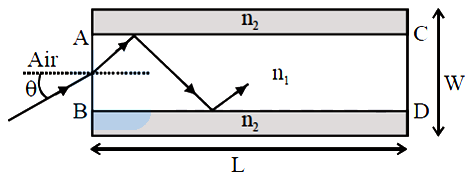 JEE Advanced 2019 Medium
 - An ideal gas is undergoing a cyclic thermodynamic process in different ways as shown in the corresponding P-V diagrams in column 3 of the table. Consider only the path from state 1 to state 2. W denotes the corresponding work done on the system. The equations and plots in the table have standard notations as used in thermodynamic process. Here is the ratio of heat capacities at constant pressure and constant volume. The number of moles in the gas is n.
Which one of the following options is the correct combination?Column – 1 Column – 2 Column – 3 (I) \(W_{1 \rightarrow 2}=\frac{1}{\gamma-1}\) \(\left(P_2 V_2-P_1 V_1\right)\) (i) Isothermal (P) 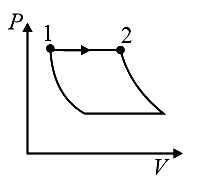
(II) \(W_{1 \rightarrow 2}=\) \(-P V_2+P V_1\) (ii) Isochoric (Q) 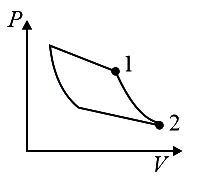
(III) \(W_{1 \rightarrow 2}=0\) (iii) Isobaric (R) 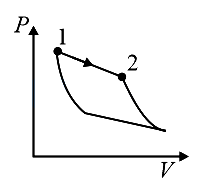
(IV) \(W_{1 \rightarrow 2}=\) \(-n R T \ln \left(\frac{V_2}{V_1}\right)\) (iv) Adiabatic (S) 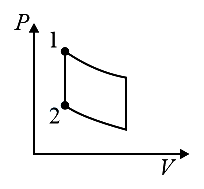 JEE Advanced 2017 Medium
 - List-I shows various functional dependencies of energy \((E)\) on the atomic number \((Z)\). Energies associated with certain phenomena are given in List-II. Choose the option that describes the correct match between the entries in List-I to those in List-II.
List - I List - II (P) \(E\text { propto } Z^2\) (1) energy of characteristic x-rays (Q) \(E\text { propto } (Z-1)^2\) (2) electrostatic part of the nuclear binding energy for stable nuclei with mass numbers in the range 30 to 170 (R) \(E \text { propto } Z(Z-1)\) (3) energy of continuous x-rays (S) E is practically independent of Z (4) average nuclear binding energy per nucleon for stable nuclei with mass number in the range 30 to 170 (5) energy of radiation due to electronic transitions from hydrogen-like atoms JEE Advanced 2025 Hard - Paragraph:
A small spherical monoatomic ideal gas bubble \(\left(\gamma=\frac{5}{3}\right)\) is trapped inside a liquid of density \(\rho_1\) (see figure). Assume that the bubble does not exchange any heat with the liquid. The bubble contains \(n\) moles of gas. The temperature of the gas when the bubble is at the bottom is \(T_0\), the height of the liquid is \(H\) and the atmospheric pressure is \(p_0\) (Neglect surface tension).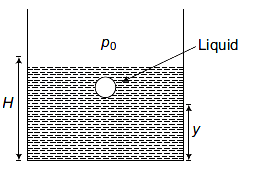
Question:
When the gas bubble is at height \(y\) from the bottom, its temperature isJEE Advanced 2008 Hard - Paragraph:
The mass of a nucleus \({ }_{Z}^{A} X\) is less than the sum of the masses of \((A-Z)\) number of neutrons and \(Z\) number of protons in the nucleus. The energy equivalent to the corresponding mass difference is known as the binding energy of the nucleus. A heavy nucleus of mass \(M\) can break into two light nuclei of masses \(m_{1}\) and \(m_{2}\) only if \(\left(m_{1}+m_{2}\right) \lt M\). Also two light nuclei of masses \(m_{3}\) and \(m_{4}\) can undergo complete fusion and form a heavy nucleus of mass \(M^{\prime}\) only if \(\left(m_{3}+m_{4}\right) \gt M^{\prime}\). The masses of some neutral atoms are given in the table below:
\(\left(1 u=932 M e V / c^{2}\right)\)
Question:
The correct statement isJEE Advanced 2013 Easy - Paragraph:
The key feature of Bohr's theory of spectrum of hydrogen atom is the quantization of angular momentum when an electron is revolving around a proton. We will extend this to a general rotational motion to find quantized rotational energy of a diatomic molecule assuming it to be rigid. The rule to be applied is Bohr's quantization condition.
Question:
In a CO molecule, the distance between \(\mathrm{C}\) (mass \(=12 \mathrm{amu}\) ) and \(\mathrm{O}\) (mass = \(16 \mathrm{amu}\) ), where \(1 \mathrm{amu}=\frac{5}{3} \times 10^{-27} \mathrm{~kg}\), is close toJEE Advanced 2010 Medium
More PYQs from JEE Advanced
- Paragraph:
An aqueous solution of metal ion \(\mathbf{M} 1\) reacts separately with reagents \(\mathbf{Q}\) and \(\mathbf{R}\) in excess to give tetrahedral and square planar complexes, respectively. An aqueous solution of another metal ion M2 always forms tetrahedral complexes with these reagents. Aqueous solution of \(\mathbf{M} 2\) on reaction with reagent \(\mathbf{S}\) gives white precipitate which dissolves in excess of \(\mathbf{S}\). The reactions are summarized in the scheme given below: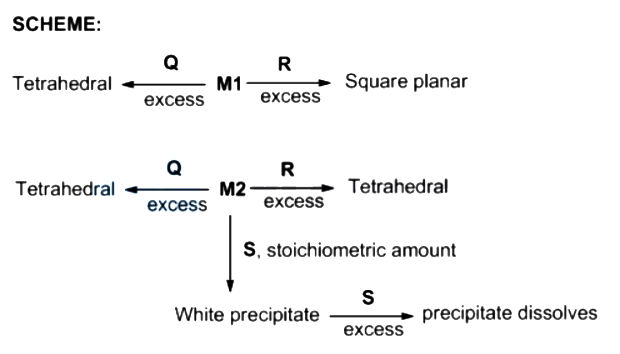
Question:
\(\mathbf{M} 1, \mathbf{Q}\) and \(\mathbf{R}\), respectively areJEE Advanced 2014 Easy - Paragraph:
The key feature of Bohr's theory of spectrum of hydrogen atom is the quantization of angular momentum when an electron is revolving around a proton. We will extend this to a general rotational motion to find quantized rotational energy of a diatomic molecule assuming it to be rigid. The rule to be applied is Bohr's quantization condition.
Question:
A diatomic molecule has moment of inertia I. By Bohr's quantization condition its rotational energy in the \(n\)th level ( \(n=0\) is not allowed) isJEE Advanced 2010 Medium - Four persons independently solve a certain problem correctly with probabilities . Then the probability that the problem is solved correctly by at least one of them isJEE Advanced 2013 Medium
- A pendulum consists of a bob of mass \(m=0.1 \mathrm{~kg}\) and a massless inextensible string of length \(L=1.0 \mathrm{~m}\). It is suspended from a fixed point at height \(H=0.9 \mathrm{~m}\) above a frictionless horizontal floor. Initially, the bob of the pendulum is lying on the floor at rest vertically below the point of suspension. A horizontal impulse \(P=0.2 \mathrm{~kg}-\mathrm{m} / \mathrm{s}\) is imparted to the bob at some instant. After the bob slides for some distance, the string becomes taut and the bob lifts off the floor. The magnitude of the angular momentum of the pendulum about the point of suspension just before the bob lifts off is \(J \mathrm{~kg}-\mathrm{m}^{2} / \mathrm{s}\). The kinetic energy of the pendulum just after the liftoff is \(K\) Joules.
The value of is ____.JEE Advanced 2021 Hard - Three students \(S_1, S_2\) and \(S_1\) are given a problem to solve. Consider the following events :
\(U:\) At least one of \(S_1, S_2\) and \(S_3\) can solve the problem,
\(V: S_1\) can solve the problem, given that neither \(\mathrm{S}_2\) nor \(\mathrm{S}_3\) can solve the problem,
\(W: S_2\) can solve the problem and \(S_3\) cannot solve the problem,
\(T: S_3\) can solve the problem.
For any event \(E\), let \(P(E)\) denote the probability of \(E\).
If \(P(U)=\frac{1}{2}, P(V)=\frac{1}{10}\) and \(P(W)=\frac{1}{12}\), then \(P(T)\) is equal toJEE Advanced 2025 Medium - A linear octasaccharide (molar mass \(=1024 \mathrm{~g} \mathrm{~mol}^{-1}\) ) on complete hydrolysis produces three monosaccharides: ribose, 2-deoxyribose and glucose. The amount of 2-deoxyribose formed is \(58.26 \%(\mathrm{w} / \mathrm{w})\) of the total amount of the monosaccharides produced in the hydrolyzed products. The number of ribose unit(s) present in one molecule of octasaccharide is \(\qquad\)
Use : Molar mass \(\left(\right.\) in \(\left.\mathrm{g} \mathrm{mol}^{-1}\right)\) : ribose \(=150,2\)-deoxyribose \(=134\), glucose \(=180\); Atomic mass (in amu): \(\mathrm{H}=1, \mathrm{O}=16\)JEE Advanced 2025 Hard