


JEE Advanced · Physics · 27. Atomic Physics
List-I shows various functional dependencies of energy \((E)\) on the atomic number \((Z)\). Energies associated with certain phenomena are given in List-II. Choose the option that describes the correct match between the entries in List-I to those in List-II.
| List - I | List - II |
| (P) \(E\text { propto } Z^2\) | (1) energy of characteristic x-rays |
| (Q) \(E\text { propto } (Z-1)^2\) | (2) electrostatic part of the nuclear binding energy for stable nuclei with mass numbers in the range 30 to 170 |
| (R) \(E \text { propto } Z(Z-1)\) | (3) energy of continuous x-rays |
| (S) E is practically independent of Z | (4) average nuclear binding energy per nucleon for stable nuclei with mass number in the range 30 to 170 |
| (5) energy of radiation due to electronic transitions from hydrogen-like atoms |
- A \(\mathrm{P} \rightarrow 4, \mathrm{Q} \rightarrow 3, \mathrm{R} \rightarrow 1, \mathrm{~S} \rightarrow 2\)
- B \(\mathrm{P} \rightarrow 5, \mathrm{Q} \rightarrow 2, \mathrm{R} \rightarrow 1, \mathrm{~S} \rightarrow 4\)
- C \(\mathrm{P} \rightarrow 5, \mathrm{Q} \rightarrow 1, \mathrm{R} \rightarrow 2, \mathrm{~S} \rightarrow 4\)
- D \(\mathrm{P} \rightarrow 3, \mathrm{Q} \rightarrow 2, \mathrm{R} \rightarrow 1, \mathrm{~S} \rightarrow 5\)
Answer & Solution
Correct Answer
(C) \(\mathrm{P} \rightarrow 5, \mathrm{Q} \rightarrow 1, \mathrm{R} \rightarrow 2, \mathrm{~S} \rightarrow 4\)
Step-by-step Solution
Detailed explanation
(P) Energy of H -like atom is
\(\begin{aligned} & \mathrm{E}=-13.6 \frac{\mathrm{Z}^2}{\mathrm{n}^2} \text { So } \\ & \mathrm{E} \propto \mathrm{Z}^2 \\ & \mathrm{P} \rightarrow(5)\end{aligned}\)
(Q) Energy of characteristic X-ray by moseley's correction
\(\begin{aligned} & E=-13.6(Z-1)^2\left[\frac{1}{n_1^2}-\frac{1}{n_2^2}\right] \text { So } \\ & E \propto(Z-1)^2 \\ & Q \rightarrow(1)\end{aligned}\)
(R) Electrostatics binding energy is proportional to \(Z(Z-1)\)
\(R \rightarrow(2)\)
(S) For stable nuclei with mass no. in range 30 to 170 . Binding energy per nucleon is constant \& graph is straight line
\(S \rightarrow(4)\)
Ans. (C) is correct
\(\begin{aligned} & \mathrm{E}=-13.6 \frac{\mathrm{Z}^2}{\mathrm{n}^2} \text { So } \\ & \mathrm{E} \propto \mathrm{Z}^2 \\ & \mathrm{P} \rightarrow(5)\end{aligned}\)
(Q) Energy of characteristic X-ray by moseley's correction
\(\begin{aligned} & E=-13.6(Z-1)^2\left[\frac{1}{n_1^2}-\frac{1}{n_2^2}\right] \text { So } \\ & E \propto(Z-1)^2 \\ & Q \rightarrow(1)\end{aligned}\)
(R) Electrostatics binding energy is proportional to \(Z(Z-1)\)
\(R \rightarrow(2)\)
(S) For stable nuclei with mass no. in range 30 to 170 . Binding energy per nucleon is constant \& graph is straight line
\(S \rightarrow(4)\)
Ans. (C) is correct
See the Complete Solution
Get step-by-step explanations for this and 2.5 Lakh+ more JEE, NEET & CET questions.
- Unlock all solutions
- Practice the full chapter
- Track accuracy across PYQs
4.8 rated on Google Play · 14,000+ reviews
More questions from Physics
- A ball is thrown from the location \(\left(x_0, y_0\right)=(0,0)\) of a horizontal playground with an initial speed \(v_0\) at an angle \(\theta_0\) from the \(+x\)-direction. The ball is to be hit by a stone, which is thrown at the same time from the location \(\left(x_1, y_1\right)=(L, 0)\). The stone is thrown at an angle \(\left(180-\theta_1\right)\) from the \(+x\)-direction with a suitable initial speed. For a fixed \(v_0\), when \(\left(\theta_0, \theta_1\right)=\left(45^{\circ}, 45^{\circ}\right)\), the stone hits the ball after time \(T_1\), and when \(\left(\theta_0, \theta_1\right)=\left(60^{\circ}, 30^{\circ}\right)\), it hits the ball after time \(T_2\). In such a case, \(\left(T_1 / T_2\right)^2\) is _______ .JEE Advanced 2024 Hard
- A freshly prepared sample of a radioisotope of half-life 1386 s has activity \({10}^{3}\) disintegrations per second. Given that In 2 = 0.693, the fraction of the initial number of nuclei (expressed in nearest integer percentage) that will decay in the first 80 s after preparation of the sample isJEE Advanced 2013 Medium
- A moving coil galvanometer has 50 turns and each turn has an area . The magnetic field produced by the magnet inside the galvanometer is . The torsional constant of the suspension wire is . When a current flows through the galvanometer, a full scale deflection occurs if the coil rotates by . The resistance of the coil of the galvanometer is . This galvanometer is to be converted into an ammeter capable of measuring current in the range . For this purpose, a shunt resistance is to be added in parallel to the galvanometer. The value of this shunt resistance, in ohms, is __________.JEE Advanced 2018 Hard
- A cylindrical cavity of diameter a exists inside a cylinder of diameter \(2 a\) as shown in the figure. Both the cylinder and the cavity are infinity long. A uniform current density \(J\) flows along the length. If the magnitude of the magnetic field at the point \(P\) is given by \(\frac{N}{12} \mu_{0} a J\), then the value of \(N\) is
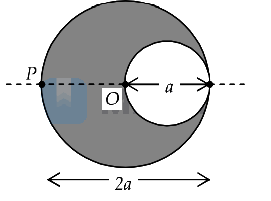 JEE Advanced 2012 Medium
 - To find the distance d over which a signal can be seen clearly in foggy conditions, a railways engineer uses dimensional analysis and assumes that the distance depends on the mass density of the fog, intensity (power/area) S of the light from the signal and its frequency f. The engineer finds that d is proportional to . The value of n isJEE Advanced 2014 Easy
- Paragraph II: Two particles, 1 and 2 , each of mass \(m\), are connected by a massless spring, and are on a horizontal frictionless plane, as shown in the figure. Initially, the two particles, with their center of mass at \(x_0\), are oscillating with amplitude \(a\) and angular frequency \(\omega\). Thus, their positions at time \(t\) are given by \(x_1(t)=\left(x_0+d\right)+a \sin \omega t\) and \(x_2(t)=\left(x_0-d\right)-a \sin \omega t\), respectively, where \(d>2 a\). Particle 3 of mass \(m\) moves towards this system with speed \(u_0=a \omega / 2\), and undergoes instantaneous elastic collision with particle 2 , at time \(t_0\). Finally, particles 1 and 2 acquire a center of mass speed \(v_{\mathrm{cm}}\) and oscillate with amplitude \(b\) and the same angular frequency \(\omega\).

If the collision occurs at time \(t_0=0\), the value of \(v_{\mathrm{cm}} /(a \omega)\) will be ________ .JEE Advanced 2024 Medium
More PYQs from JEE Advanced
- Identify the binary mixture(s) that can be separated into individual compounds, by differential extraction as shown in the given scheme.
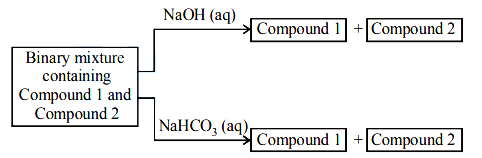 JEE Advanced 2012 Medium
 - Statement I Glucose gives a reddish-brown precipitate with Fehling's solution.
Statement II Reaction of glucose with Fehling's solution gives \(\mathrm{CuO}\) and gluconic acid.JEE Advanced 2007 Medium - List I contains four combinations of two lenses ( 1 and 2 ) whose focal lengths (in cm ) are indicated in the figures. In all cases, the object is placed 20 cm from the first lens on the left, and the distance between the two lenses is 5 cm . List II contains the positions of the final images.
Which one of the following options is correct?List - I List - II (I) 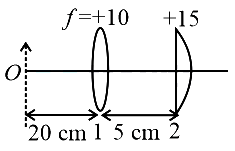
(P) Final image is formed at 7.5 cm on the right side of lens 2. (II) 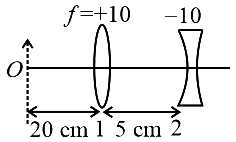
(Q) Final image is formed at 60.0 cm on the right side of lens 2. (III) 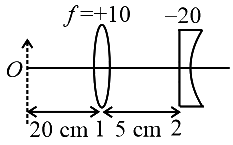
(R) Final image is formed at 30.0 cm on the left side of lens 2. (IV) 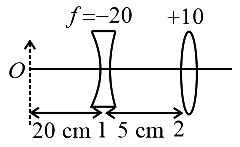
(S) Final image is formed at
6.0 cm on the right side of lens 2.(T) Final image is formed at 30.0 cm on the right side of lens 2. JEE Advanced 2022 Hard - Consider a efficient hydrogen-oxygen fuel cell working under standard conditions at bar and . Its cell reaction is The work derived from the cell on the consumption of of is used to compress of a monoatomic ideal gas in a thermally insulated container. What is the change in the temperature (in ) of the ideal gas? The standard reduction potentials for the two half-cells are given below. \(O _2(g)+4 H ^{+}( aq )+4 e ^{-} \rightarrow 2 H _2 O ( l ),\) \(E ^0=1.23 V\) Use .JEE Advanced 2020 Hard
- A sample \((5.6 \mathrm{~g})\) containing iron is completely dissolved in cold dilute \(\mathrm{HCl}\) to prepare a \(250 \mathrm{~mL}\) of solution. Titration of \(25.0 \mathrm{~mL}\) of this solution requires \(12.5 \mathrm{~mL}\) of \(0.03 \mathrm{M} \mathrm{KMnO}_{4}\) solution to reach the end point. Number of moles of \(\mathrm{Fe}^{2+}\) present in \(250 \mathrm{~mL}\) solution is \(\mathbf{x} \times 10^{-2}\) (consider complete dissolution of \(\mathrm{FeCl}_{2}\) ). The amount of iron present in the sample is \(\mathbf{y} \%\) by weight.
(Assume: \(\mathrm{KMnO}_{4}\) reacts only with \(\mathrm{Fe}^{2+}\) in the solution Use: Molar mass of iron as \(56 \mathrm{~g} \mathrm{~mol}^{-1}\) )
The value of is________ .JEE Advanced 2021 Medium - The straight line \(2 x-3 y=1\) divides the circular region \(x^2+y^2 \leq 6\) into two parts. If \(S=\left\{\left(2, \frac{3}{4}\right),\left(\frac{5}{2}, \frac{3}{4}\right),\left(\frac{1}{4},-\frac{1}{4}\right),\left(\frac{1}{8}, \frac{1}{4}\right)\right\}\), then the number of point(s) in \(S\) lying inside the smaller part isJEE Advanced 2011 Medium