


JEE Advanced · Chemistry · 31. Practical Chemistry
Paragraph:
An aqueous solution of metal ion \(\mathbf{M} 1\) reacts separately with reagents \(\mathbf{Q}\) and \(\mathbf{R}\) in excess to give tetrahedral and square planar complexes, respectively. An aqueous solution of another metal ion M2 always forms tetrahedral complexes with these reagents. Aqueous solution of \(\mathbf{M} 2\) on reaction with reagent \(\mathbf{S}\) gives white precipitate which dissolves in excess of \(\mathbf{S}\). The reactions are summarized in the scheme given below:
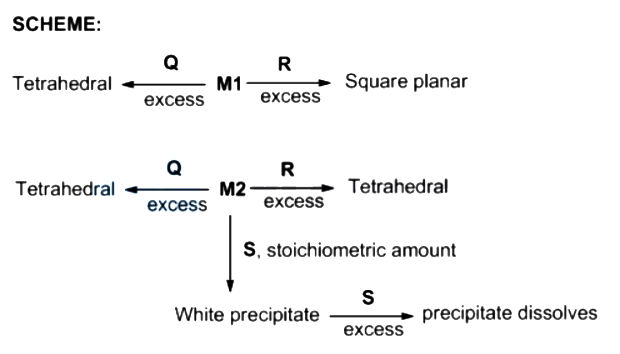
Question:
\(\mathbf{M} 1, \mathbf{Q}\) and \(\mathbf{R}\), respectively are
- A
- B
- C
- D
Answer & Solution
Correct Answer
(B)
Step-by-step Solution
Detailed explanation
See the Complete Solution
Get step-by-step explanations for this and 2.5 Lakh+ more JEE, NEET & CET questions.
- Unlock all solutions
- Practice the full chapter
- Track accuracy across PYQs
4.8 rated on Google Play · 14,000+ reviews
More questions from Chemistry
- dissociates in and ions in an aqueous solution, with a degree of dissociation of 0.5. The ratio of the observed depression of freezing point of the aqueous solution to the value of the depression of freezing point in the absence of ionic dissociation isJEE Advanced 2014 Medium
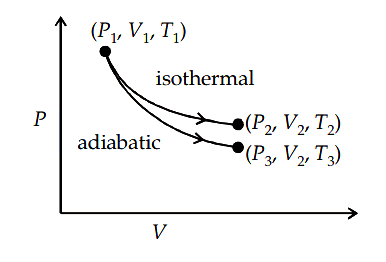
- The reversible expansion of an ideal gas under adiabatic and isothermal conditions is shown in the figure. Which of the following statement(s) is (are) correct?
 JEE Advanced 2012 Medium
 - Based on VSEPR theory, the number of 90 degree \(\mathrm{F}-\mathrm{Br}-\mathrm{F}\) angles in \(\mathrm{BrF}_5\) isJEE Advanced 2010 Hard
- For the reaction, \(2 \mathrm{CO}+\mathrm{O}_2 \rightarrow 2 \mathrm{CO}_2 ; \Delta H=-560 \mathrm{~kJ}\). Two moles of \(\mathrm{CO}\) and one mole of \(\mathrm{O}_2\) are taken in a container of volume \(1 \mathrm{~L}\). They completely form two moles of \(\mathrm{CO}_2\), the gases deviate appreciably from ideal behaviour. If the pressure in the vessel changes from 70 to \(40 \mathrm{~atm}\), find the magnitude (absolute value) of \(\Delta U\) at \(500 \mathrm{~K} .(1 \mathrm{~L}-\mathrm{atm}=0.1 \mathrm{~kJ})\)JEE Advanced 2006 Easy
- The pair(s) of coordination complexes/ions exhibiting the same kind of isomerism is (are)JEE Advanced 2013 Medium
- Match the compounds in List-I with the appropriate observations in List-II and choose the correct option.
List - I List - II (P) 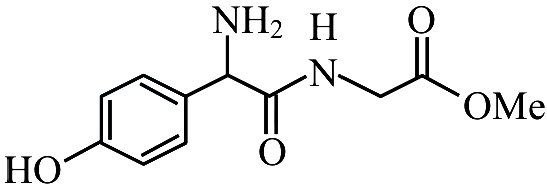
(1) Reaction with phenyl diazonium salt gives #ff0 dye. (Q) 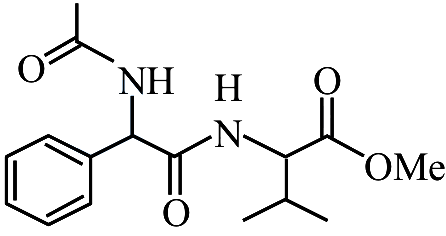
(2) Reaction with ninhydrin gives purple color and it also reacts with \(FeCl _3\) to give violet color. (R) 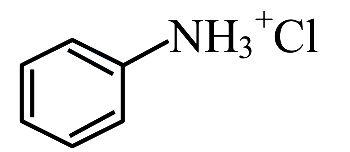
(3) Reaction with glucose will give corresponding hydrazone. (S) 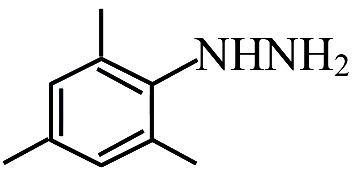
(4) Lassiagne extract of the compound treated with dilute HCl followed by addition of aqueous \(FeCl _3\) gives blood red color. (5) After complete hydrolysis,it will give ninhydrin test and it DOES NOT give positive phthalein dye test. JEE Advanced 2025 Medium
More PYQs from JEE Advanced
- A drop of liquid of radius having surface tension divides itself into K identical drops. In the process the total change in the surface energy . If then the value of isJEE Advanced 2017 Medium
- Let be a positive real number. Let and be the functions defined by and .
Then the value of is ______.JEE Advanced 2022 Medium - Let and be positive real numbers. Suppose and are adjacent sides of a parallelogram Let and be the projection vectors of along and , respectively. If and if the area of the parallelogram is then which of the following statements is/are TRUE?JEE Advanced 2020 Medium
- In a non-right-angled triangle let denote the lengths of the sides opposite to the angles at respectively. The median from meets the side at the perpendicular from meets the side at , and and intersect at If and the radius of the circumcircle of the equals then which of the following options is/are correct?JEE Advanced 2019 Hard
- A line passing through the origin is perpendicular to the lines
Then, the coordinate(s) of the point(s) on at a distance of from the point of intersection of and is (are)JEE Advanced 2013 Medium - Paragraph:
Let \(U_1\) and \(U_2\) be two urns such that \(U_1\) contains 3 white and 2 red balls and \(U_2\) contains only 1 white ball. A fair coin is tossed. If head appears then 1 ball is drawn at random from \(U_1\) and put into \(U_2\). However, if tail appears then 2 balls are drawn at random from \(U_1\) and put into \(U_2\). Now, 1 ball is drawn at random from \(U_2\).Question:
Given that the drawn ball from \(U_2\) is white, the probability that head appeared on the coin isJEE Advanced 2011 Medium