


JEE Advanced · Chemistry · 29. Biomolecules
A linear octasaccharide (molar mass \(=1024 \mathrm{~g} \mathrm{~mol}^{-1}\) ) on complete hydrolysis produces three monosaccharides: ribose, 2-deoxyribose and glucose. The amount of 2-deoxyribose formed is \(58.26 \%(\mathrm{w} / \mathrm{w})\) of the total amount of the monosaccharides produced in the hydrolyzed products. The number of ribose unit(s) present in one molecule of octasaccharide is \(\qquad\)
Use : Molar mass \(\left(\right.\) in \(\left.\mathrm{g} \mathrm{mol}^{-1}\right)\) : ribose \(=150,2\)-deoxyribose \(=134\), glucose \(=180\); Atomic mass (in amu): \(\mathrm{H}=1, \mathrm{O}=16\)
- A 1
- B 2
- C 3
- D 8
Answer & Solution
Correct Answer
(B) 2
Step-by-step Solution
Detailed explanation
\(\underset{\mathrm{M} . \mathrm{M} .=1024}{\text {Octasaccharide }}+\underset{\mathrm{M} . \mathrm{M} .=126}{7 \mathrm{H}_2 \mathrm{O}} \longrightarrow \text { Ribose }\)\(+\text { 2deoxyribose }+ \text { glucose } \)
\( \text {Total mass }=1024+126=1150\)
\(\begin{aligned}
& 58.26=\frac{134 \times n}{1150} \times 100 \\
& \frac{66.999}{100}=134 n \quad n=4.99=5
\end{aligned}\)
5 units of 2-Deoxyribose
\(1150=(5 \times 150)+(\mathrm{x} \times 150)+(\mathrm{y} \times 180)\)
\(\begin{aligned} & 1150=\underbrace{750}_{5 \text { unit }}+\underbrace{150 x}_{300}+\underbrace{180 y}_{180} \\
& \qquad \quad \qquad \quad \text{2 unit} \quad \text{1 unit}\end{aligned}\)
n = 2.00
\( \text {Total mass }=1024+126=1150\)
\(\begin{aligned}
& 58.26=\frac{134 \times n}{1150} \times 100 \\
& \frac{66.999}{100}=134 n \quad n=4.99=5
\end{aligned}\)
5 units of 2-Deoxyribose
\(1150=(5 \times 150)+(\mathrm{x} \times 150)+(\mathrm{y} \times 180)\)
\(\begin{aligned} & 1150=\underbrace{750}_{5 \text { unit }}+\underbrace{150 x}_{300}+\underbrace{180 y}_{180} \\
& \qquad \quad \qquad \quad \text{2 unit} \quad \text{1 unit}\end{aligned}\)
n = 2.00
See the Complete Solution
Get step-by-step explanations for this and 2.5 Lakh+ more JEE, NEET & CET questions.
- Unlock all solutions
- Practice the full chapter
- Track accuracy across PYQs
4.8 rated on Google Play · 14,000+ reviews
More questions from Chemistry
- The solubility of barium iodate in an aqueous solution prepared by mixing 200 mL of 0.010 M barium nitrate with 100 mL of 0.10 M sodium iodate is \(\boldsymbol{X} \times 10^{-6} \mathrm{~mol} \mathrm{dm}^{-3}\). The value of \(\boldsymbol{X}\) is \(\qquad\) .
Use: Solubility product constant \(\left(K_{\mathrm{sp}}\right)\) of barium iodate \(=1.58 \times 10^{-9}\)JEE Advanced 2025 Hard - The boiling point of water in a \(0.1\) molal silver nitrate solution (solution \(\mathbf{A}\) ) is \(\mathbf{x}^{\circ} \mathrm{C}\). To this solution \(\mathbf{A}\), an equal volume of \(0.1\) molal aqueous barium chloride solution is added to make a new solution B. The difference in the boiling points of water in the two solutions \(\mathbf{A}\) and \(\mathbf{B}\) is \(\mathbf{y} \times 10^{-2}{ }^{\circ} \mathrm{C}\).
(Assume: Densities of the solutions \(\mathbf{A}\) and \(\mathbf{B}\) are the same as that of water and the soluble salts dissociate completely.
Use: Molal elevation constant (Ebullioscopic Constant), \(K_{b}=0.5 \mathrm{~K} \mathrm{~kg} \mathrm{~mol}^{-1}\); Boiling point of pure water as \(100^{\circ} \mathrm{C}\).)
The value of is ___.JEE Advanced 2021 Hard - Based on VSEPR model, match the xenon compounds given in List-I with the corresponding geometries and the number of lone pairs on xenon given in List-II and choose the correct option.
List - I List - II (P) \(XeF _2\) (1) Trigonal bipyramidal and two lone pair of electrons (Q) \(XeF _4\) (2) Tetrahedral and one lone pair of electrons (R) \(XeO _3\) (3) Octahedral and two lone pair of electrons (S) \(XeO _3 F_2\) (4) Trigonal bipyramidal and no lone pair of electrons (5) Trigonal bipyramidal and three lone pair of electrons JEE Advanced 2024 Medium - In the following monobromination reaction, the number of possible chiral products is
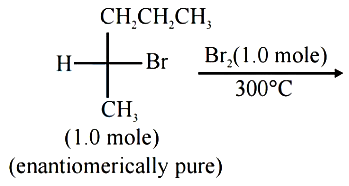 JEE Advanced 2016 Medium
 - Paragraph:
In hexagonal system of crystals, a frequently encountered arrangement of atoms is described as a hexagonal prism. Here, the top and bottom of the cell are regular hexagons and three atoms are sandwiched in between them. A space-filling model of this structure, called hexagonal close-packed (HCP), is constituted of a sphere on a flat surface surrounded in the same plane by six identical spheres as closely as possible. Three spheres are then placed over the first layer so that they touch each other and represent the second layer. Each one of the three spheres touches three spheres of the bottom layer. Finally, the second layer is covered with a third layer that is identical to the bottom layer in relative position. Assume radius of every sphere to be ' \(r\) '.
Question:
The empty space in this \(\mathrm{HCP}\) unit cell isJEE Advanced 2008 Medium - A solution of a metal ion when treated with \(\mathrm{KI}\) gives a red precipitate which dissolved in excess KI to give a colourless solution. Moreover, the solution of metal ion on treatment with a solution of cobalt (II) thiocyanate gives rise to a deep blue crystalline precipitqte. The metal ion isJEE Advanced 2007 Medium
More PYQs from JEE Advanced
- Paragraph:
\(RCONH _2\) is converted into \(RNH _2\) by means of Hofmann bromamide degradation.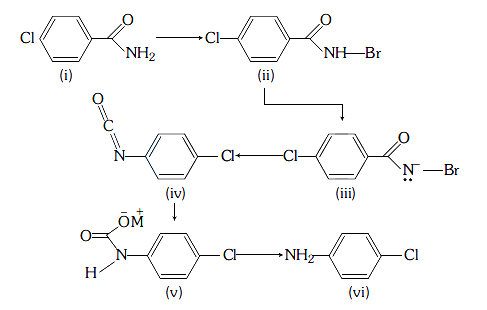
In this reaction, \(R \mathrm{CONHBr}\) is formed from which this reaction has derived its name. Electron donating group at phenyl activates the reaction. Hofmann degradation reaction is an intramolecular reaction.
Question:
How can the conversion of (i) to (ii) be brought about?JEE Advanced 2006 Easy - Different possible thermal decomposition pathways for peroxyesters are shown below. Match each pathway from List I with an appropriate structure from List II and select the correct answer using the code given below the lists.
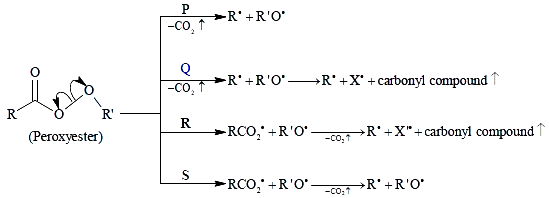
List – I List – II A Pathway P P. 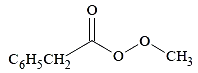
B. Pathway Q Q. 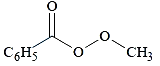
C. Pathway R R. 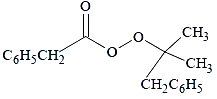
D. Pathway S S. 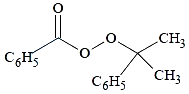 JEE Advanced 2014 Medium
 - Paragraph:
Copper is the most noble of the first row transition metals and occurs in small deposits in several countries. Ores of copper include chalcanthite \(\left(\mathrm{CuSO}_4 \cdot 5 \mathrm{H}_2 \mathrm{O}\right)\), atacamite \(\left(\mathrm{Cu}_2 \mathrm{Cl}(\mathrm{OH})_3\right)\), cuprite \(\left(\mathrm{Cu}_2 \mathrm{O}\right)\), copper glance \(\left(\mathrm{Cu}_2 \mathrm{~S}\right)\) and malachite \(\left(\mathrm{Cu}_2(\mathrm{OH})_2 \mathrm{CO}_3\right)\). However, 80\% of the world copper production comes from the ore chalcopyrite \(\left(\mathrm{CuFeS}_2\right)\). The extraction of copper from chalcopyrite involves partial roasting, removal of iron and self-reduction.
Question:
In self-reduction, the reducing species isJEE Advanced 2010 Medium - Two point-like objects of masses and are fixed at the two ends of a rigid massless rod of length . This system is suspended vertically from a rigid ceiling using a thin wire attached to its center of mass, as shown in the figure. The resulting torsional pendulum undergoes small oscillations. The torsional constant of the wire is . The angular frequency of the oscillations in . The value of is _____.
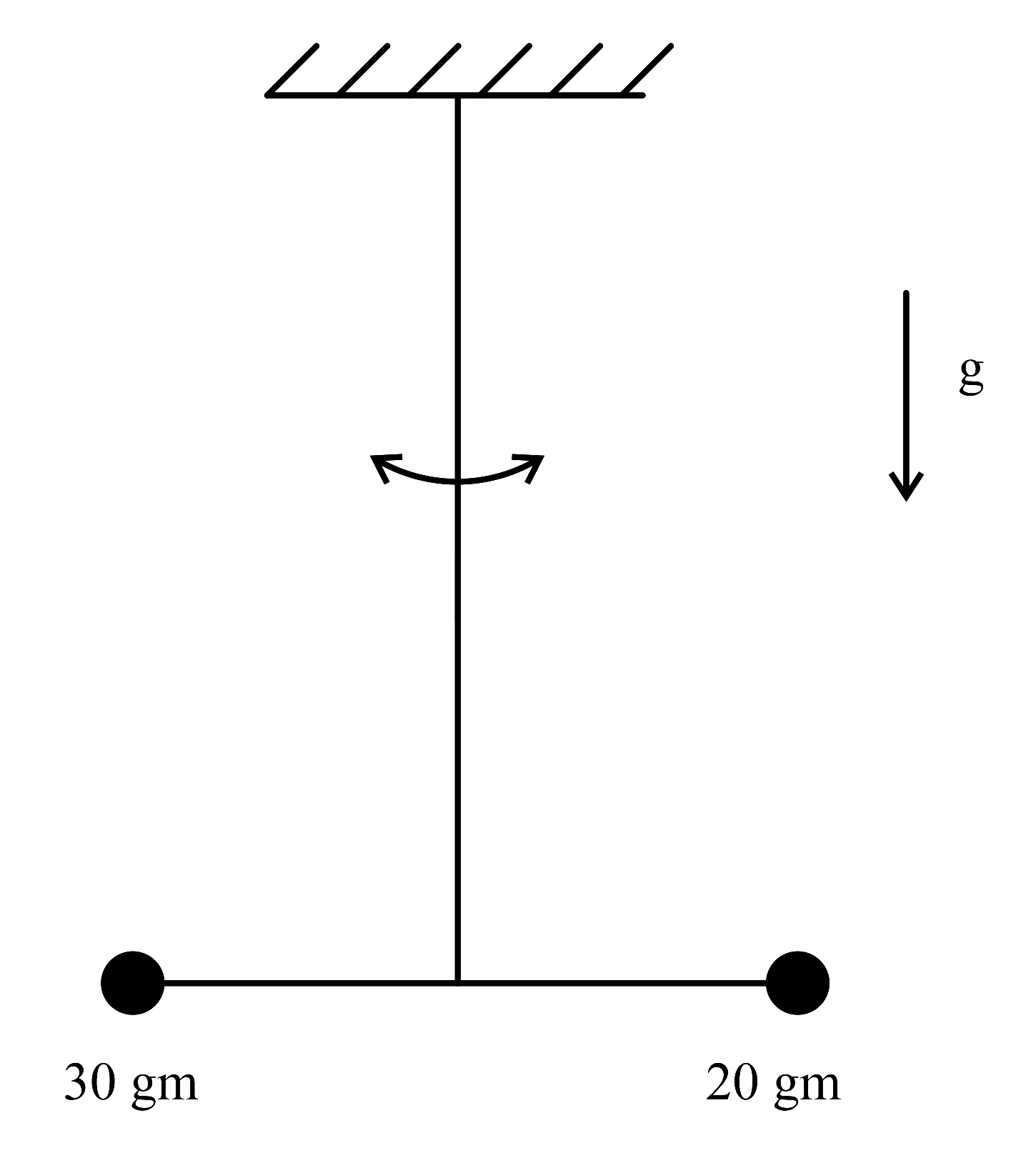 JEE Advanced 2023 Easy
 - A thin and uniform rod of mass and length is held vertical on a floor with large friction. The rod is released from rest so that it falls by rotating about its contact-point with the floor without slipping. Which of the following statement(s) is/are correct, when the rod makes an angle with vertical?
[ is the acceleration due to gravity]JEE Advanced 2019 Medium - The largest value of the non - negative integer a for which is _________JEE Advanced 2014 Medium