


JEE Advanced · Physics · 28. Nuclear Physics
Paragraph:
The mass of a nucleus \({ }_{Z}^{A} X\) is less than the sum of the masses of \((A-Z)\) number of neutrons and \(Z\) number of protons in the nucleus. The energy equivalent to the corresponding mass difference is known as the binding energy of the nucleus. A heavy nucleus of mass \(M\) can break into two light nuclei of masses \(m_{1}\) and \(m_{2}\) only if \(\left(m_{1}+m_{2}\right) \lt M\). Also two light nuclei of masses \(m_{3}\) and \(m_{4}\) can undergo complete fusion and form a heavy nucleus of mass \(M^{\prime}\) only if \(\left(m_{3}+m_{4}\right) \gt M^{\prime}\). The masses of some neutral atoms are given in the table below:

\(\left(1 u=932 M e V / c^{2}\right)\)
Question:
The correct statement is
- A The nucelus can emit an alpha particle.
- B The nucleus can emit a proton.
- C Deuteron and alpha particle can undergo complete fusion.
- D The nuclei and can undergo complete fusion.
Answer & Solution
Correct Answer
(C) Deuteron and alpha particle can undergo complete fusion.
Step-by-step Solution
Detailed explanation
is negative so reaction n is not possible.
is negative so reaction is not possible.
is positive so reaction is possible.
is positive so reaction is not possible.
See the Complete Solution
Get step-by-step explanations for this and 2.5 Lakh+ more JEE, NEET & CET questions.
- Unlock all solutions
- Practice the full chapter
- Track accuracy across PYQs
4.8 rated on Google Play · 14,000+ reviews
More questions from Physics
- Consider an electric field \(\mathbf{E}=E_0 \hat{\mathbf{x}}\) where \(\bar{E}_0\) is a constant. The flux through the shaded area ( as shown in the figure) due to this field is
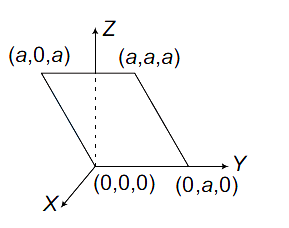 JEE Advanced 2011 Medium
 - Paragraph:
A small spherical monoatomic ideal gas bubble \(\left(\gamma=\frac{5}{3}\right)\) is trapped inside a liquid of density \(\rho_1\) (see figure). Assume that the bubble does not exchange any heat with the liquid. The bubble contains \(n\) moles of gas. The temperature of the gas when the bubble is at the bottom is \(T_0\), the height of the liquid is \(H\) and the atmospheric pressure is \(p_0\) (Neglect surface tension).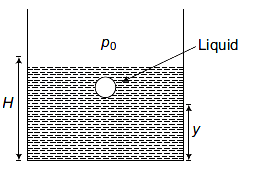
Question:
The buoyancy force acting on the gas bubble is (Assume \(R\) is the universal gas constant)JEE Advanced 2008 Hard - A composite block is made of slabs \(A, B, C, D\) and \(E\) of different thermal conductivities (given in terms of a constant, \(K\) ) and sizes (given in terms of length, \(L\) ) as shown in the figure. All slabs are of same width. Heat \(Q\) flows only from left to right through the blocks. Then, in steady state
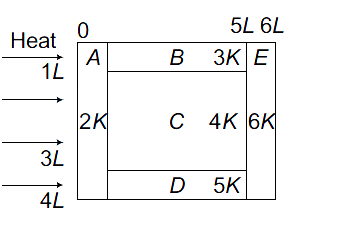 JEE Advanced 2011 Hard
 - During an experiment with a metre bridge, the galvanometer shows a null point when the jockey is pressed at using a standard resistance of ,as shown in the figure. The least count of the scale used in the metre bridge is . The unknown resistance is
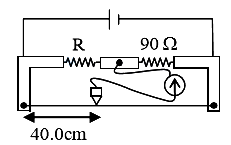 JEE Advanced 2014 Easy
 - The \(\beta\)-decay process, discovered around 1900 , is basically the decay of a neutron \((n)\). In the laboratory, a proton \((p)\) and an electron \(\left(e^{-}\right)\)are observed as the decay products of the neutron. Therefore, considering the decay of a neutron as a two-body decay process, it was predicted theoretically that the kinetic energy of the electron should be a constant. But experimentally, it was observed that the electron kinetic energy has continuous spectrum. Considering a three-body decay process, i.e.
\(n \rightarrow p+e^{-}+\bar{v}_{e}\), around 1930, Pauli explained the observed electron energy spectrum. Assuming the anti-neutrino \(\left(\bar{v}_{e}\right)\) to be massless and possessing negligible energy, and the neutron to be at rest, momentum and energy conservation principles are applied. From this calculation, the maximum kinetic energy of the electron is \(0.8 \times 10^{6} \mathrm{eV}\). The kinetic energy carried by the proton is only the recoil energy.
Question:
If the anti-neutrino had a mass of \(3 \mathrm{eV} / \mathrm{c}^{2}\) (where \(\mathrm{c}\) is the speed of light) instead of zero mass, what should be the range of the kinetic energy, \(K\), of the electron?JEE Advanced 2012 Hard - Two soap bubbles \(A\) and \(B\) are kept in a closed chamber where the air is maintained at pressure \(8 \mathrm{Nm}^{-2}\). The radii of bubbles \(A\) and \(B\) are \(2 \mathrm{~cm}\), respectively. Surface tension of the soap-water used to make bubbles is \(0.04\) \(\mathrm{Nm}^{-1}\). Find the ratio \(\frac{n_B}{n_A}\), where \(n_A\) and \(n_B\) are the number of moles of air in bubbles \(A\) and \(B\), respectively. [Neglect the effect of gravity]JEE Advanced 2009 Hard
More PYQs from JEE Advanced
- The tangent to the curve \(y=e^x\) drawn at the point \(\left(c, e^c\right)\) intersects the line joining the points \(\left(c-1, e^{c-1}\right)\) and \(\left(c+1, e^{c+1}\right)\)JEE Advanced 2007 Medium
- The electric field E is measured at a point , generated due to various charge distributions and the dependence of E on d is found to be different for different charge distributions. List-I contains different relations between E and d. List-II describes different electric charge distributions, along with their locations. Match the functions in List-I with the related charge distributions in List-II.
LIST -I LIST -II A) is independent of d P) A point charge at the origin B) \(E \propto \frac{1}{d}\) Q) A small dipole with point charges \(Q\) at \((0,0, l)\) and \(-\operatorname{Qat}(0,0, l)\). Take \(2 l \ll d\) C) \(E \propto \frac{1}{d^2}\) R) An infinite line charge coincident with the \(x\)-axis, with uniform linear charge density \(\lambda\) D) \(E \propto \frac{1}{d^3}\) S) Two infinite wires carrying uniform linear charge density parallel to the \(x\) - axis. The one along \((y-0, z=l)\) has a charge density \(+\lambda\) and the one along \((y=0, z=-l)\) has a charge density \(-\lambda\). Take \(2 l \ll d\) T) Infinite plane charge coincident with the \(x y\) - plane with uniform surface charge density JEE Advanced 2018 Medium - Concentration of and in a solution is and , respectively. Molar solubility of in the same solution is (expressed in scientific notation). The value of is
[Given: Solubility product of . For is very large and ]
If the numerical value has more than two decimal places, truncate/round-off the value to TWO decimal places.JEE Advanced 2022 Hard - Let \(a\) and \(b\) be non-zero and real numbers. Then, the equation \(\left(a x^2+b y^2+c\right)\left(x^2-5 x y+6 y^2\right)=0\) representsJEE Advanced 2008 Medium
- Let . Suppose and are the roots of the equation and and are the roots of the equation If and , then equalsJEE Advanced 2016 Medium
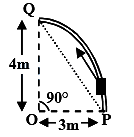
- Consider an elliptically shaped rail PQ in the vertical plane with and . A block of mass 1 kg is pulled along the rail from P to Q with a force of 18 N, which is always parallel to line PQ (see the figure given). Assuming no frictional losses, the kinetic energy of the block when it reaches Q is Joules. The value of n is (take acceleration due to gravity = )
 JEE Advanced 2014 Hard