


JEE Advanced · Physics · 27. Atomic Physics
Paragraph:
The key feature of Bohr's theory of spectrum of hydrogen atom is the quantization of angular momentum when an electron is revolving around a proton. We will extend this to a general rotational motion to find quantized rotational energy of a diatomic molecule assuming it to be rigid. The rule to be applied is Bohr's quantization condition.
Question:
In a CO molecule, the distance between \(\mathrm{C}\) (mass \(=12 \mathrm{amu}\) ) and \(\mathrm{O}\) (mass = \(16 \mathrm{amu}\) ), where \(1 \mathrm{amu}=\frac{5}{3} \times 10^{-27} \mathrm{~kg}\), is close to
- A \(2.4 \times 10^{-10} \mathrm{~m}\)
- B \(1.9 \times 10^{-10} \mathrm{~m}\)
- C \(1.3 \times 10^{-10} \mathrm{~m}\)
- D \(4.4 \times 10^{-11} \mathrm{~m}\)
Answer & Solution
Correct Answer
(C) \(1.3 \times 10^{-10} \mathrm{~m}\)
Step-by-step Solution
Detailed explanation
\(I=\mu r^2\) ( where \(\mu=\) reduced mass) \(\mu=\frac{m_1 m_2}{m_1+m_2}=\frac{48}{7} \mathrm{amu}\) \(=11.43 \times 10^{-27} \mathrm{~kg}\)
Substituting in \(I=\mu r^2\) we get,
\(
\begin{aligned}
r & =\sqrt{\frac{I}{\mu}}=\sqrt{\frac{1.87 \times 10^{-46}}{11.43 \times 10^{-27}}} \\
& =1.28 \times 10^{-10} \mathrm{~m}
\end{aligned}
\)
\(\therefore\) The correct answer is (c).
Substituting in \(I=\mu r^2\) we get,
\(
\begin{aligned}
r & =\sqrt{\frac{I}{\mu}}=\sqrt{\frac{1.87 \times 10^{-46}}{11.43 \times 10^{-27}}} \\
& =1.28 \times 10^{-10} \mathrm{~m}
\end{aligned}
\)
\(\therefore\) The correct answer is (c).
See the Complete Solution
Get step-by-step explanations for this and 2.5 Lakh+ more JEE, NEET & CET questions.
- Unlock all solutions
- Practice the full chapter
- Track accuracy across PYQs
4.8 rated on Google Play · 14,000+ reviews
More questions from Physics
- A vernier calipers has \(1 \mathrm{~mm}\) marks on the main scale. It has 20 equal divisions on the vernier scale which match with 16 main scale divisions. For this vernier calipers, the least count isJEE Advanced 2010 Medium
- A point source \(\mathrm{S}\) emits unpolarized light uniformly in all directions. At two points \(\mathrm{A}\) and \(\mathrm{B}\), the ratio \(r=I_A / I_B\) of the intensities of light is 2. If a set of two polaroids having \(45^{\circ}\) angle between their pass-axes is placed just before point \(\mathrm{B}\), then the new value of \(r\) will be ______JEE Advanced 2024 Easy
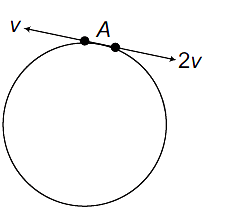
- Two small particles of equal masses start moving in opposite directions from a point \(A\) in a horizontal circular orbit. Their tangential velocities are \(v\) and \(2 v\) respectively, as shown in the figure. Between collisions, the particles move with constant speeds. After making how many elastic collisions, other than that at \(A\), these two particles will again reach the point \(A\) ?
 JEE Advanced 2009 Medium
 - A drop of liquid of radius having surface tension divides itself into K identical drops. In the process the total change in the surface energy . If then the value of isJEE Advanced 2017 Medium
- A particle of unit mass is moving along the x-axis under the influence of a force and its total energy is conserved. Four possible forms of the potential energy of the particle are given in column I (a and are constants). Match the potential energies in column I to the corresponding statement(s) in column II.
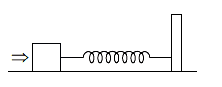
Column I Column II A. P. The force acting on the particle is zero at B. Q. The force acting on the particle is zero at . C. R. The force acting on the particle is zero at D. S. The particle experiences an attractive force towards in the region T. The particle with total energy can oscillate about the point JEE Advanced 2015 Hard - A block of mass \(0.18 \mathrm{~kg}\) is attached to a spring of force constant \(2 \mathrm{~N} / \mathrm{m}\). The coefficient of friction between the block and the floor is 0.1. Initially, the block is at rest and the spring is unstretched. An impulse is given to the block as shown in the figure. The block slides a distance of \(0.06 \mathrm{~m}\) and comes to rest for the first time. The initial velocity of the block in \(\mathrm{m} / \mathrm{s}\) is \(v=\frac{N}{10}\). Then, \(N\) is
 JEE Advanced 2011 Easy
More PYQs from JEE Advanced
- Consider a triangle \(A B C\) and let \(a, b\) and \(c\) denote the lengths of the sides opposite to vertices \(A, B\) and \(C\) respectively. Suppose \(a=6, b=10\) and the area of the triangle is \(15 \sqrt{3}\). If \(\angle A C B\) is obtuse and if \(r\) denotes the radius of the incircle of the triangle, then \(r^2\) is equal toJEE Advanced 2010 Easy
- A man walks a distance of 3 units from the origin towards the North-East \(\left(\mathrm{N} 45^{\circ} \mathrm{E}\right)\) direction. From there, he walks a distance of 4 units towards the North-West ( \(\mathrm{N} 45^{\circ} \mathrm{W}\) ) direction to reach a point \(P\). Then, the position of \(P\) in the Argand plane isJEE Advanced 2007 Easy
- Among the following, the paramagnetic compound isJEE Advanced 2007 Easy
- Statement 1 The geometrical isomer of the complex \(\left.\left[\mathrm{M}_{\left(\mathrm{NH}_3\right.}\right)_4 \mathrm{Cl}_2\right]\) are optically inactive.
Statement 2 Both geometrical isomers of the complex \(\left[\mathrm{M}\left(\mathrm{NH}_3\right)_4 \mathrm{Cl}_2\right]\) possess axis of symmetry.JEE Advanced 2008 Medium - The \(\beta\)-decay process, discovered around 1900 , is basically the decay of a neutron \((n)\). In the laboratory, a proton \((p)\) and an electron \(\left(e^{-}\right)\)are observed as the decay products of the neutron. Therefore, considering the decay of a neutron as a two-body decay process, it was predicted theoretically that the kinetic energy of the electron should be a constant. But experimentally, it was observed that the electron kinetic energy has continuous spectrum. Considering a three-body decay process, i.e.
\(n \rightarrow p+e^{-}+\bar{v}_{e}\), around 1930, Pauli explained the observed electron energy spectrum. Assuming the anti-neutrino \(\left(\bar{v}_{e}\right)\) to be massless and possessing negligible energy, and the neutron to be at rest, momentum and energy conservation principles are applied. From this calculation, the maximum kinetic energy of the electron is \(0.8 \times 10^{6} \mathrm{eV}\). The kinetic energy carried by the proton is only the recoil energy.
Question:
What is the maximum energy of the anti-neutrino?JEE Advanced 2012 Medium - The entropy versus temperature plot for phases and at bar pressure is given. and are entropies of the phases at temperatures and , respectively.
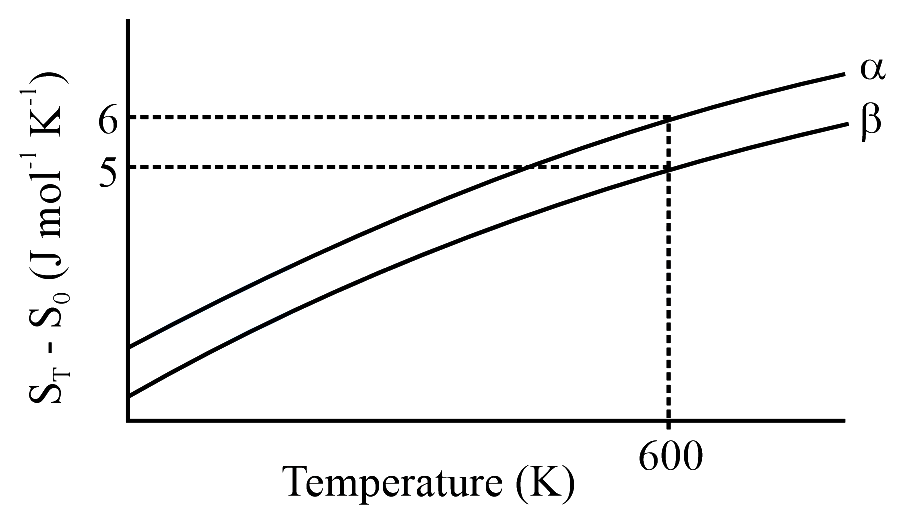 The transition temperature for to phase change is and . Assume is independent of temperature in the range of to and are heat capacities of and phases, respectively. The value of enthalpy change, (in ), at isJEE Advanced 2023 Medium