


JEE Advanced · Mathematics · 24. Differentiation
Let \(\mathbb{R}\) denote the set of all real numbers. Let \(f: \mathbb{R} \rightarrow \mathbb{R}\) and \(g: \mathbb{R} \rightarrow(0,4)\) be functions defined by \(f(x)=\log _e\left(x^2+2 x+4\right)\), and \(g(x)=\frac{4}{1+e^{-2 x}}\)
Define the composite function \(f \circ g^{-1}\) by \(\left(f \circ g^{-1}\right)(x)=\left(g^{-1}(x)\right)\), where \(g^{-1}\) is the inverse of the function \(g\).
Then the value of the derivative of the composite function \(f \circ g^{-1}\) at \(x=2\) is ________ .
- A 0.23
- B 0.94
- C 0.25
- D 0.12
Answer & Solution
Correct Answer
(C) 0.25
Step-by-step Solution
Detailed explanation
\(\begin{aligned} & \text { Let } \mathrm{h}(\mathrm{x})=\mathrm{f}\left(\mathrm{g}^{-1}(\mathrm{x})\right) \text { and } \mathrm{g}(0)=2 \\ & \begin{aligned} \mathrm{h}^{\prime}(\mathrm{x}) & =\mathrm{f}^{\prime}\left(\mathrm{g}^{-1}(\mathrm{x})\right) \cdot\left(\mathrm{g}^{-1}(\mathrm{x})\right)^{\prime} \\ \mathrm{h}^{\prime}(2) & =\mathrm{f}^{\prime}\left(\mathrm{g}^{-1}(2) \cdot\left(\mathrm{g}^{-1}\right)^{\prime}(2)\right. \\ & =\mathrm{f}^{\prime}(0) \cdot\left(\mathrm{g}^{-1}\right)^{\prime}(2)\end{aligned}\end{aligned}\)
Now
\(\begin{aligned}
& f(x)=\log _0\left(x^2+2 x+4\right) \\
& f^{\prime}(x)=\frac{2 x+2}{x^2+2 x+4} \\
& f^{\prime}(0)=\frac{1}{2} \\
& g(x)=\frac{4}{1+e^{-2 x}}, g(0)=2 \\
& g^{-1}(g(x))=x
\end{aligned}\)
\begin{array}{l|l}\left(\left(\mathrm{g}^{-1}\right)^{\prime}(\mathrm{g}(\mathrm{x}))\right) \mathrm{g}^{\prime}(\mathrm{x})=1 & \mathrm{~g}(\mathrm{x})=\frac{4}{1+\mathrm{e}^{-2 \mathrm{x}}} \\\left(\mathrm{g}^{-1}\right)^{\prime}(2)=\frac{1}{\mathrm{~g}^{\prime}(0)} & \mathrm{g}^{\prime}(\mathrm{x})=\frac{8 \mathrm{e}^{-2 \mathrm{x}}}{\left(1+\mathrm{e}^{-2 \mathrm{x}}\right)^2} \\=\frac{1}{2} & \mathrm{~g}^{\prime}(0)=\frac{8}{4}=2 \\So \mathrm{h}(2)=\frac{1}{4}=0.25 &\end{array}
Now
\(\begin{aligned}
& f(x)=\log _0\left(x^2+2 x+4\right) \\
& f^{\prime}(x)=\frac{2 x+2}{x^2+2 x+4} \\
& f^{\prime}(0)=\frac{1}{2} \\
& g(x)=\frac{4}{1+e^{-2 x}}, g(0)=2 \\
& g^{-1}(g(x))=x
\end{aligned}\)
\begin{array}{l|l}\left(\left(\mathrm{g}^{-1}\right)^{\prime}(\mathrm{g}(\mathrm{x}))\right) \mathrm{g}^{\prime}(\mathrm{x})=1 & \mathrm{~g}(\mathrm{x})=\frac{4}{1+\mathrm{e}^{-2 \mathrm{x}}} \\\left(\mathrm{g}^{-1}\right)^{\prime}(2)=\frac{1}{\mathrm{~g}^{\prime}(0)} & \mathrm{g}^{\prime}(\mathrm{x})=\frac{8 \mathrm{e}^{-2 \mathrm{x}}}{\left(1+\mathrm{e}^{-2 \mathrm{x}}\right)^2} \\=\frac{1}{2} & \mathrm{~g}^{\prime}(0)=\frac{8}{4}=2 \\So \mathrm{h}(2)=\frac{1}{4}=0.25 &\end{array}
See the Complete Solution
Get step-by-step explanations for this and 2.5 Lakh+ more JEE, NEET & CET questions.
- Unlock all solutions
- Practice the full chapter
- Track accuracy across PYQs
4.8 rated on Google Play · 14,000+ reviews
More questions from Mathematics
- Paragraph:
Consider the functions defined implicitly by the equation \(y^3-3 y+x=0\) on various intervals in the real line. If \(x \in(-\infty,-2) \cup(2, \infty)\), the equation implicitly defines a unique real valued differentiable function \(y=f(x)\). If \(x \in(-2,2)\), the equation implicitly defines a unique real valued differentiable function \(y=g(x)\), satisfying \(g(0)=0\).Question:
If \(f(-10 \sqrt{2})=2 \sqrt{2}\), then \(f^{\prime \prime}(-10 \sqrt{2})\) is equal toJEE Advanced 2008 Medium - Four fair dice \(D_{1}, D_{2}, D_{3}\) and \(D_{4}\); each having six faces numbered \(1,2,3,4,5\) and 6 are rolled simultaneously. The probability that \(D_{4}\) shows a number appearing on one of \(D_{1}, D_{2}\) and \(\mathrm{D}_{3}\) isJEE Advanced 2012 Medium
- Let denote the determinant of a square matrix . Let be the function defined by where
Let be a quadratic polynomial whose roots are the maximum and minimum values of the function , and . Then, which of the following is/are TRUE ?JEE Advanced 2022 Hard - Let \(M\) and \(N\) be two \(3 \times 3\) non-singular skew-symmetric matrices such that \(M N=N M\). If \(P^T\) denotes the transpose of \(P\), then \(M^2 N^2\left(M^T N\right)^{-1}\left(M N^{-1}\right)^T\) is equal toJEE Advanced 2011 Hard
- Let be defined by Then which of the following statements is(are) TRUE?JEE Advanced 2021 Easy
- Let \(p(x)\) be a real polynomial of least degree which has a local maximum at \(x=1\) and a local minimum at \(x=3\). If \(p(1)=6\) and \(p(3)=2\), then \(p^{\prime}(0)\) isJEE Advanced 2012 Medium
More PYQs from JEE Advanced
- The correct statement(s) about the compound given below is are
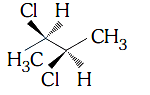 JEE Advanced 2008 Hard
 - Regarding the molecular orbital (MO) energy levels for homonuclear diatomic molecules, the INCORRECT statement(s) is(are)JEE Advanced 2025 Medium
- Paragraph:
Scientists are working hard to develop nuclear fusion reactor. Nuclei of heavy hydrogen, \({ }_1^2 \mathrm{H}\) known as deuteron and denoted by \(D\) can be thought of as a candidate for fusion reactor. The \(D\) - \(D\) reaction is \({ }_1^2 \mathrm{H}+{ }_1^2 \mathrm{H} \rightarrow{ }_2^3 \mathrm{He}+n+\) energy. In the core of fusion reactor. A gas of heavy hydrogen is fully ionized into deuteron nuclei and electrons. This collection of \({ }_1^4 \mathrm{H}\) nuclei and electrons is known as plasma. The nuclei move randomly in the reactor core and occasionally come close enough for nuclear fusion to take place. Usually, the temperatures in the reactor core are too high and no material wall can be used to confine the plasma. Special techniques are used which confine the plasma for a time \(t_0\) before the particles fly away from the core. If n is the density (number/volume) of deutrons, the product t \(_0\) is called Lawson number. In one of the criteria, \(a\) reactor is termed successful if Lawson number is greater than \(5 \times 10^{14} \mathrm{scm}^{-3}\).
It may be helpful to use the following : Boltzmann constant \(k=8.6 \times 10^{-5} \mathrm{eV} / \mathrm{K}\); \(\frac{e^2}{4 \pi \varepsilon_0}=1.44 \times 10^{-9} \mathrm{eVm}\)
Question:
Assume that two deuteron nuclei in the core of fusion reactor at temperature \(T\) are moving towards each other, each with kinetic energy \(1.5 \mathrm{kT}\), when the separation between them is large enough to neglect Coulomb potential energy. Also neglect any interaction from other particles in the core. The minimum temperature \(T\) required for them to reach a separation of \(4 \times 10^{-15} \mathrm{~m}\) is in the rangeJEE Advanced 2009 Medium - A trinitro compound, -tris-(-nitrophenyl) benzene, on complete reaction with an excess of gives a major product, which on treatment with an excess of at provides as the product. , upon treatment with excess of at room temperature, gives the product . Bromination of in aqueous medium furnishes the product . The compound upon treatment with an excess of phenol under basic conditions gives the product . The molar mass difference between compounds and is and between compounds and is .
The total number of carbon atoms and heteroatoms present in one molecule of \(S\) is
[Use: Molar mass (in \(\text{gmol} ^{-1}\) ): \(\text H =1,\text C =12,\text N=14,\text O =16,\) \(\text{Br} =80, \text{Cl} =35.5\) Atoms other than C and H are considered as heteroatoms]JEE Advanced 2023 Easy - Consider the following volume-temperature \((\mathrm{V}-\mathrm{T})\) diagram for the expansion of 5 moles of an ideal monoatomic gas.
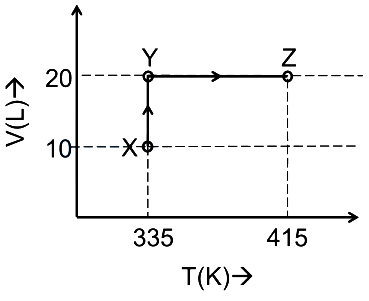
Considering only P-V work is involved, the total change in enthalpy (in Joule) for the transformation of state in the sequence \(\mathbf{X} \rightarrow \mathbf{Y} \rightarrow \mathbf{Z}\) is ________.
[Use the given data: Molar heat capacity of the gas for the given temperature range, \(\mathrm{C}_{\mathrm{V}, \mathrm{m}}=12 \mathrm{~J} \mathrm{~K}^{-1}\) \(\mathrm{mol}^{-1}\) and gas constant, \(\left.\mathrm{R}=8.3 \mathrm{~J} \mathrm{~K}^{-1} \mathrm{~mol}^{-1}\right]\)JEE Advanced 2024 Medium - Both \(\left[\mathrm{Ni}(\mathrm{CO})_4\right]\) and \(\left[\mathrm{Ni}(\mathrm{CN})_4\right]^{2-}\) are diamagnetic. The hybridisations of nickel in these complexes, respectively, areJEE Advanced 2008 Hard