


JEE Advanced · Mathematics · 18. Matrices
Let \(M\) and \(N\) be two \(3 \times 3\) non-singular skew-symmetric matrices such that \(M N=N M\). If \(P^T\) denotes the transpose of \(P\), then \(M^2 N^2\left(M^T N\right)^{-1}\left(M N^{-1}\right)^T\) is equal to
- A
\(M^2\)
- B
\(-N^2\)
- C
\(-M^2\)
- D
\(M N\)
Answer & Solution
Correct Answer
(C)
\(-M^2\)
Step-by-step Solution
Detailed explanation
Given, \(M^T=-M, N^T=-N\)
and \(\quad M N=N M\)
\[
\begin{aligned}
\therefore & M^2 N^2\left(M^T N\right)^{-1}\left(M N^{-1}\right)^T \\
& =M^2 N^2 N^{-1}\left(M^T\right)^{-1}\left(N^{-1}\right)^T \cdot M^T \\
& =M^2 N\left(N N^{-1}\right)(-M)^{-1}\left(N^T\right)^{-1}(-M) \\
& =M^2 N\left(-M^{-1}\right)(-N)^{-1}(-M) \\
& =-M^2 N M^{-1} N^{-1} M \\
& =-M \cdot(M N) M^{-1} N^{-1} M \\
& =-M(N M) M^{-1} N^{-1} M \\
& =-M N\left(N M^{-1}\right) N^{-1} M \\
& =-M\left(N N^{-1}\right) M=-M^2
\end{aligned}
\]
Note Here, non-singular word should not be used, since there is no non-singular \(3 \times 3\) skew-symmetric matrix.
and \(\quad M N=N M\)
\[
\begin{aligned}
\therefore & M^2 N^2\left(M^T N\right)^{-1}\left(M N^{-1}\right)^T \\
& =M^2 N^2 N^{-1}\left(M^T\right)^{-1}\left(N^{-1}\right)^T \cdot M^T \\
& =M^2 N\left(N N^{-1}\right)(-M)^{-1}\left(N^T\right)^{-1}(-M) \\
& =M^2 N\left(-M^{-1}\right)(-N)^{-1}(-M) \\
& =-M^2 N M^{-1} N^{-1} M \\
& =-M \cdot(M N) M^{-1} N^{-1} M \\
& =-M(N M) M^{-1} N^{-1} M \\
& =-M N\left(N M^{-1}\right) N^{-1} M \\
& =-M\left(N N^{-1}\right) M=-M^2
\end{aligned}
\]
Note Here, non-singular word should not be used, since there is no non-singular \(3 \times 3\) skew-symmetric matrix.
See the Complete Solution
Get step-by-step explanations for this and 2.5 Lakh+ more JEE, NEET & CET questions.
- Unlock all solutions
- Practice the full chapter
- Track accuracy across PYQs
4.8 rated on Google Play · 14,000+ reviews
More questions from Mathematics
- The value of
\(\sec ^{-1}\left(\frac{1}{4} \sum_{k=0}^{10} \sec (\frac{7 \pi}{12}+\frac{k \pi}{2}\right) \sec (\frac{7 \pi}{12}\) \(+\frac{(k+1) \pi}{2}))\) in the interval \(\left[-\frac{\pi}{4}, \frac{3 \pi}{4}\right]\) equalsJEE Advanced 2019 Medium - Which of the following is (are) NOT the square of a matrix with real entries?JEE Advanced 2017 Easy
- A straight line through the vertex \(P\) of a \(\triangle P Q R\) intersects the side \(Q R\) at the point \(S\) and the circumcircle of the \(\triangle P Q R\) at the point \(T\). If \(S\) is not the centre of the circumcircle, thenJEE Advanced 2008 Hard
- If \(0 < x < 1\), then \(\sqrt{1+x^2}\left[\left\{x \cos \left(\cot ^{-1} x\right)+\sin \left(\cot ^{-1} x\right)\right\}^2-1\right]^{\frac{1}{2}}\) is equal toJEE Advanced 2008 Medium
- Tangent is drawn at any point \(P\) of a curve which passes through \((1,1)\) cutting \(X\)-axis and \(Y\)-axis at \(A\) and \(B\), respectively. If \(A P: B P=3: 1\), thenJEE Advanced 2006 Hard
- \[
\text { Match the statements/expressions in Column I with the open intervals in Column II. }
\]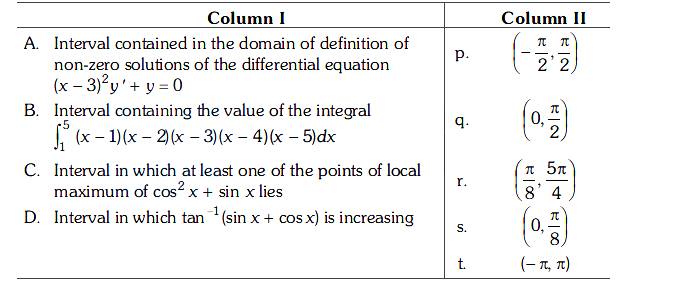 JEE Advanced 2009 Hard
More PYQs from JEE Advanced
- An optical arrangement consists of two concave mirrors and , and a convex lens with a common principal axis, as shown in the figure. The focal length of is . The radii of curvature of and are and , respectively. The distance between and is . A point object is placed at the mid-point between and on the axis. When the distance between and is , one of the images coincides with . The value of is _____(Consider the case which gives minimum value).
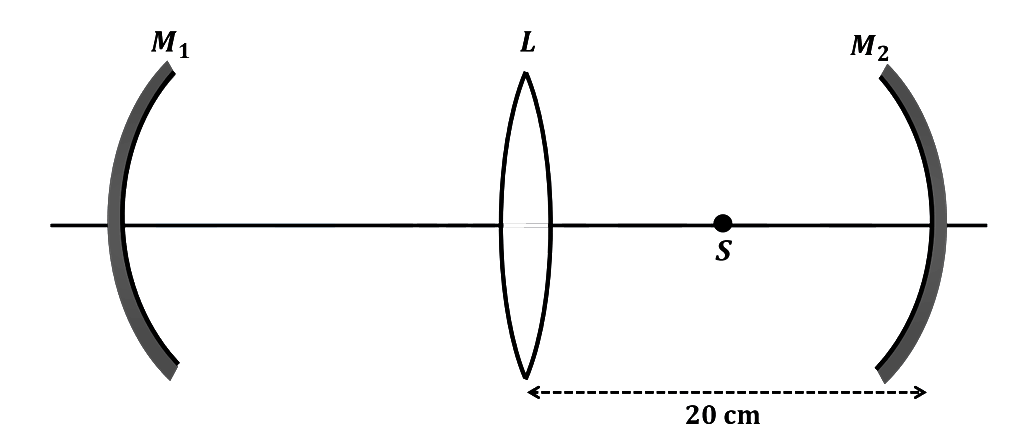 JEE Advanced 2023 Medium
 - A particle of mass \(m\) and charge \(q\), moving with velocity \(v\) enters Region II normal to the boundary as shown in the figure. Region II has a uniform magnetic field \(B\) perpendicular to the plane of the paper. The length of the Region II is \(l\). Choose the correct choice(s)
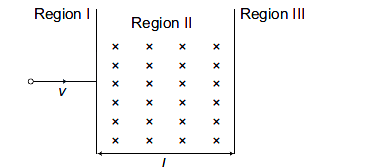 JEE Advanced 2008 Hard
 - Consider three planes
\[
P_1: x-y+z=1, P_2: x+y-z=-1
\]
and \(P_3: x-3 y+3 z=2\)
Let \(L_1, L_2\) and \(L_3\) be the lines of intersection of the planes \(P_2\) and \(P_3, P_3\) and \(P_1, P_1\) and \(P_2\), respectively.
Statement 1 Atleast two of the lines \(L_1, L_2\) and \(L_3\) are non-parallel.
Statement 2 The three planes do not have a common point.JEE Advanced 2008 Medium - Match the statements/expressions given in Column I with the values given in Column II.
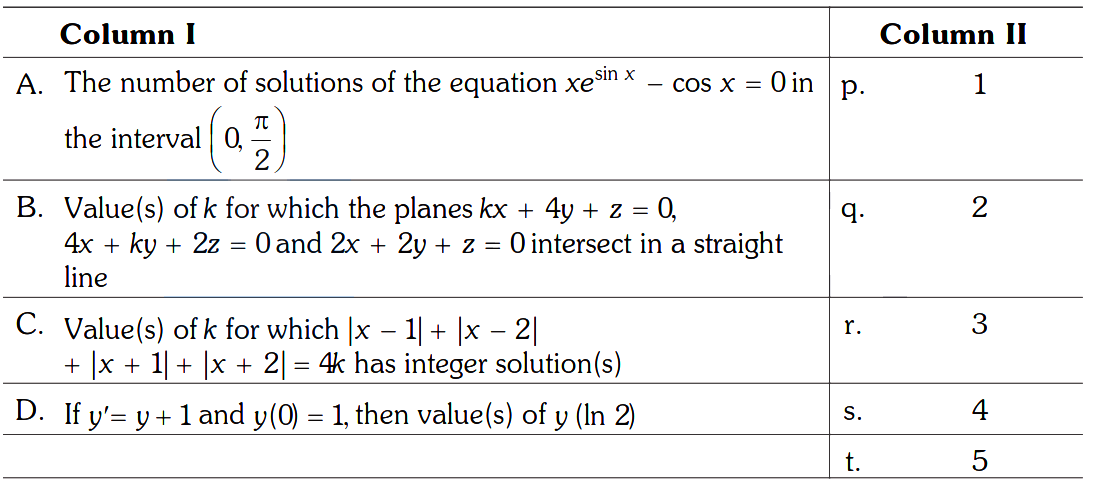 JEE Advanced 2009 Easy
 - In a \(\triangle A B C\) with fixed base \(B C\), the vertex \(A\) moves such that \(\cos B+\cos C=4 \sin ^2 \frac{A}{2}\). If \(a, b\) and \(c\) denote the lengths of the sides of the triangle opposite to the angles \(A, B\) and \(C\) respectively, thenJEE Advanced 2009 Medium
- Let \(f\) be a real-valued function defined on the interval \((0, \infty)\), by \(f(x)=\ln x+\int_0^x \sqrt{1+\sin t} d t\). Then which of the following statement(s) is (are) true ?JEE Advanced 2010 Medium