


JEE Advanced · Mathematics · 25. AOD
Let \(p(x)\) be a real polynomial of least degree which has a local maximum at \(x=1\) and a local minimum at \(x=3\). If \(p(1)=6\) and \(p(3)=2\), then \(p^{\prime}(0)\) is
- A 18
- B 9
- C 20
- D 24
Answer & Solution
Correct Answer
(B) 9
Step-by-step Solution
Detailed explanation
Since, \(p(x)\) has a local maximum at \(x=1\) and a local minimum at \(x=3\) and \(p(x)\) is a real polynomial of least degree.
Hence, let \(p^{\prime}(x)=k(x-1)(x-3)=k\left(x^{2}-4 x+3\right)\)
\(\Rightarrow p(x)=k\left(\frac{x^{3}}{3}-2 x^{2}+3 x\right)+c\)
Now, \(p(1)=6\) and \(p(3)=2\)
\(\begin{array}{l}
\Rightarrow \frac{4}{3} k+C=6 \text { and } 0+C=2 \Rightarrow k=3 \\
\therefore \quad p^{\prime}(x)=3(x-1)(x-3) \Rightarrow p^{\prime}(0)=9
\end{array}\)
Hence, let \(p^{\prime}(x)=k(x-1)(x-3)=k\left(x^{2}-4 x+3\right)\)
\(\Rightarrow p(x)=k\left(\frac{x^{3}}{3}-2 x^{2}+3 x\right)+c\)
Now, \(p(1)=6\) and \(p(3)=2\)
\(\begin{array}{l}
\Rightarrow \frac{4}{3} k+C=6 \text { and } 0+C=2 \Rightarrow k=3 \\
\therefore \quad p^{\prime}(x)=3(x-1)(x-3) \Rightarrow p^{\prime}(0)=9
\end{array}\)
See the Complete Solution
Get step-by-step explanations for this and 2.5 Lakh+ more JEE, NEET & CET questions.
- Unlock all solutions
- Practice the full chapter
- Track accuracy across PYQs
4.8 rated on Google Play · 14,000+ reviews
More questions from Mathematics
- If the distance between the plane \(A x-2 y+z=d\) and the plane containing the lines \(\frac{x-1}{2}=\frac{y-2}{3}=\frac{z-3}{4} \quad\) and \(\frac{x-2}{3}=\frac{y-3}{4}=\frac{z-4}{5}\) is \(\sqrt{6}\), then \(|d|\) isJEE Advanced 2010 Easy
- Paragraph:
Let \(P Q\) be a focal chord of the parabola \(y^{2}=4 a x\). The tangents to the parabola at \(P\) and \(Q\) meet at a point lying on the line \(y=2 x+a, a>0\).
Question:
Length of chord \(P Q\) isJEE Advanced 2013 Medium - Words of length are formed using the letters A, B, C, D, E, F, G, H, I, J. Let be the number of such words where no letter is repeated; and let be the number of such words where exactly one letter is repeated twice and no other letter is repeated. The,JEE Advanced 2017 Medium
- The smallest value of \(k\), for which both the roots of the equation \(x^2-8 k x+16\left(k^2-k+1\right)=0\) are real, distinct and have values atleast 4 , isJEE Advanced 2009 Easy
- Let be the function defined as if where . Let be a function such that for all . ThenJEE Advanced 2023 Hard
- Paragraph:
Let \(A\) be the set of all \(3 \times 3\) symmetric matrices all of whose entries are either 0 or 1 . Five of these entries are 1 and four of them are 0 .Question:
The number of matrices \(A\) in \(A\) for which the system of linear equations \(A\left[\begin{array}{l}x \\ y \\ z\end{array}\right]=\left[\begin{array}{l}1 \\ 0 \\ 0\end{array}\right]\) is is inconsistent, isJEE Advanced 2009 Hard
More PYQs from JEE Advanced
- A metal rod of length \(L\) and mass \(m\) is pivoted at one end. A thin disc of mass \(M\) and radius \(R( < L)\) is attached at its centre to the free end of the rod. Consider two ways the disc is attached. Case A-the disc is not free to rotate about its centre and case \(B\)-the disc is free to rotate about its centre. The rod-disc system performs
SHM in vertical plane after being released from the same displaced position. Which of the following statement(s) is/are true?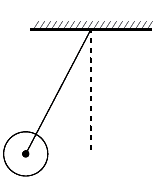 JEE Advanced 2011 Medium
 - The straight line \(2 x-3 y=1\) divides the circular region \(x^2+y^2 \leq 6\) into two parts. If \(S=\left\{\left(2, \frac{3}{4}\right),\left(\frac{5}{2}, \frac{3}{4}\right),\left(\frac{1}{4},-\frac{1}{4}\right),\left(\frac{1}{8}, \frac{1}{4}\right)\right\}\), then the number of point(s) in \(S\) lying inside the smaller part isJEE Advanced 2011 Medium
- Paragraph:
The figure shows a surface \(X Y\) separating two transparent media, medium-1 and medium-2. The lines \(a b\) and \(c d\) represent wavefronts of a light wave travelling in medium-1 and incident on \(X Y\). The lines ef and \(g h\) represent wavefronts of the light wave in medium-2 after refraction.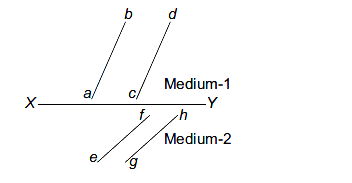
Question:
The phases of the light wave at \(c, d, e\) and \(f\) are \(\phi_c, \phi_d, \phi_e\) and \(\phi_f\), respectively. It is given that \(\phi_c \neq \phi_f\).JEE Advanced 2007 Medium - Consider a thin square plate floating on a viscous liquid in a large tank. The height of the liquid in the tank is much less than the width of the tank. The floating plate is pulled horizontally with a constant velocity . Which of the following statements is (are) true?JEE Advanced 2018 Easy
- A hot air balloon is carrying some passengers, and a few sandbags of mass each so that its total mass is . Its effective volume giving the balloon its buoyancy is . The balloon is floating at an equilibrium height of . When number of sandbags are thrown out, the balloon rises to a new equilibrium height close to with its volume remain unchanged. If the variation of the density of air with height from the ground is where and the value of is _________.JEE Advanced 2020 Hard
- The equilibrium \(2 \mathrm{Cu}^{\mathrm{I}} \rightleftharpoons \mathrm{Cu}^0+\mathrm{Cu}^{\text {II }}\) in aqueous medium at \(25^{\circ} \mathrm{C}\) shifts towards the left in the presence ofJEE Advanced 2011 Hard