


JEE Advanced · Mathematics · 32. Probability
Four fair dice \(D_{1}, D_{2}, D_{3}\) and \(D_{4}\); each having six faces numbered \(1,2,3,4,5\) and 6 are rolled simultaneously. The probability that \(D_{4}\) shows a number appearing on one of \(D_{1}, D_{2}\) and \(\mathrm{D}_{3}\) is
- A \(\frac{91}{216}\)
- B \(\frac{108}{216}\)
- C \(\frac{125}{216}\)
- D \(\frac{127}{216}\)
Answer & Solution
Correct Answer
(A) \(\frac{91}{216}\)
Step-by-step Solution
Detailed explanation
\(D_{4}\) can show a number appearing on one of \(D_{1}, D_{2}\) and \(D_{3}\) in the following cases.
Case \(\mathbf{I}: D_{4}\) shows a number which is shown by exactly one of \(D_{1}, D_{2}\) and \(D_{3}\).
\(D_{4}\) shows a number in \({ }^{6} C_{1}\) ways.
One out of \(D_{1}, D_{2}\) and \(D_{3}\) can be selected in \({ }^{3} C_{1}\) ways.
[The selected die shows the same number as on \(D_{4}\) in one way and rest two dice show the different number in 5 ways each, ]
\(\therefore\) Number of ways
\(={ }^{6} C_{1} \times{ }^{3} C_{1} \times 1 \times 5 \times 5=450\)
Case II : \(D_{4}\) shows a number which is shown by exactly two of \(D_{1}, D_{2}\) and \(D_{3}\).
Number of ways
\(={ }^{6} C_{1} \times{ }^{3} C_{2} \times 1 \times 1 \times 5=90\)
Case III : \(D_{4}\) shows a number which is shown by all three dice \(D_{1}, D_{2}\) and \(D_{3}\).
Number of ways
\(={ }^{6} C_{1} \times{ }^{3} C_{3} \times 1 \times 1 \times 1=6\)
\(\therefore\) Total number of favourable ways \(=450+90+6=546\) Total ways \(=6 \times 6 \times 6 \times 6\)
\(\therefore\) Required Probability \(=\frac{546}{6 \times 6 \times 6 \times 6}=\frac{91}{216}\)
Case \(\mathbf{I}: D_{4}\) shows a number which is shown by exactly one of \(D_{1}, D_{2}\) and \(D_{3}\).
\(D_{4}\) shows a number in \({ }^{6} C_{1}\) ways.
One out of \(D_{1}, D_{2}\) and \(D_{3}\) can be selected in \({ }^{3} C_{1}\) ways.
[The selected die shows the same number as on \(D_{4}\) in one way and rest two dice show the different number in 5 ways each, ]
\(\therefore\) Number of ways
\(={ }^{6} C_{1} \times{ }^{3} C_{1} \times 1 \times 5 \times 5=450\)
Case II : \(D_{4}\) shows a number which is shown by exactly two of \(D_{1}, D_{2}\) and \(D_{3}\).
Number of ways
\(={ }^{6} C_{1} \times{ }^{3} C_{2} \times 1 \times 1 \times 5=90\)
Case III : \(D_{4}\) shows a number which is shown by all three dice \(D_{1}, D_{2}\) and \(D_{3}\).
Number of ways
\(={ }^{6} C_{1} \times{ }^{3} C_{3} \times 1 \times 1 \times 1=6\)
\(\therefore\) Total number of favourable ways \(=450+90+6=546\) Total ways \(=6 \times 6 \times 6 \times 6\)
\(\therefore\) Required Probability \(=\frac{546}{6 \times 6 \times 6 \times 6}=\frac{91}{216}\)
See the Complete Solution
Get step-by-step explanations for this and 2.5 Lakh+ more JEE, NEET & CET questions.
- Unlock all solutions
- Practice the full chapter
- Track accuracy across PYQs
4.8 rated on Google Play · 14,000+ reviews
More questions from Mathematics
- The number of points in , for which , is:JEE Advanced 2013 Hard
- Two lines and are coplanar. Then can take value(s)JEE Advanced 2013 Easy
- If \(f(x)\) is twice differentiable function such that \(f(a)=0, f(b)=2, f(c)=1, f(d)=2\), \(f(e)=0\), where \(a < b < c < d < e\), then the minimum number of zeros of \(g(x)=\left\{f^{\prime}(x)\right\}^2+f^{\prime \prime}(x) \cdot f(x)\) in the interval \([a, e]\) isJEE Advanced 2006 Medium
- Let \(f(x)\) be a continuously differentiable function on the interval \((0, \infty)\) such that \(f(1)=2\) and \(\underset{t \rightarrow x}{\lim} \frac{t^{10} f(x)-x^{10} f(t)}{t^9-x^9}=1\) for each \(x>0\). Then, for all \(x>0, f(x)\) is equal toJEE Advanced 2024 Medium
- Let the function \(f:[1, \infty) \rightarrow \mathbb{R}\) be defined by
\(f(t)=\left\{\begin{array}{cc}(-1)^{n+1} 2, & \text { if } t=2 n-1, n \in \mathbb{N}, \\ \frac{(2 n+1-t)}{2} f(2 n-1)+\frac{(t-(2 n-1))}{2} f(2 n+1), & \text { if } 2 n-1 < t < 2 n+1, n \in \mathbb{N} .\end{array}\right.\)
Define \(g(x)=\int_1^x f(t) d t, x \in(1, \infty)\). Let \(\alpha\) denote the number of solutions of the equation \(g(x)=0\) in the interval \((1,8]\) and \(\beta=\lim _{x \rightarrow 1^+} \frac{g(x)}{x-1}\). Then the value of \(\alpha+\beta\) is equal to ________.JEE Advanced 2024 Medium - Let
Let be all the points of local maximum of and be all the points of local minimum of
Then which of the following options is/are correct?JEE Advanced 2019 Hard
More PYQs from JEE Advanced
- For each positive integer , let . If then the value of (where is the greatest integer less than or equal to ) is ____JEE Advanced 2018 Medium
- A trinitro compound, -tris-(-nitrophenyl) benzene, on complete reaction with an excess of gives a major product, which on treatment with an excess of at provides as the product. , upon treatment with excess of at room temperature, gives the product . Bromination of in aqueous medium furnishes the product . The compound upon treatment with an excess of phenol under basic conditions gives the product . The molar mass difference between compounds and is and between compounds and is .
The number of heteroatoms present in one molecule of \(R\) is [Use: Molar mass (in \(\text{g mol} -1\) ): \(H =1,\) \(C =12, N=14, O =16,\) \(Br =80, Cl =35.5\) Atoms other than C and H are considered as heteroatoms]JEE Advanced 2023 Medium - A biconvex lens of focal length \(15 \mathrm{~cm}\) is in front of a plane mirror. The distance between the lens and the mirror is 10 \(\mathrm{cm}\). A small object is kept at a distance of \(30 \mathrm{~cm}\) from the lens. The final image isJEE Advanced 2010 Medium
- A mixture of two salts is used to prepare a solution

The correct option (s) for the salt mixture is(are)JEE Advanced 2021 Medium - Match the reactions in List-I with the features of their products in List-II and choose the correct option.
List - I List - II (P) 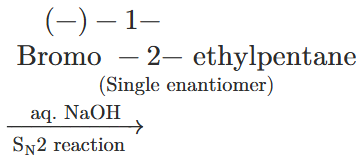
1. Inversion of configuration (Q) 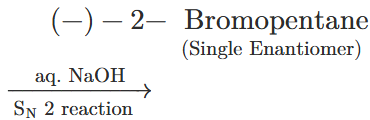
2. Retention of configuration (R) 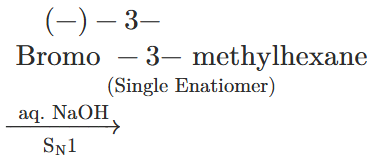
3. Mixture of enantiomers (S) 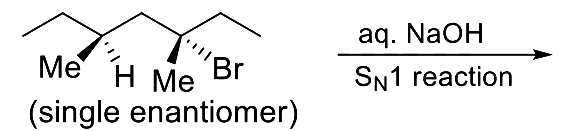
4. Mixture of structural isomers 5. Mixture of diastereomers JEE Advanced 2023 Hard - Paragraph:
Let \(A, B, C\) be three sets of complex numbers as defined below.
\(A=\{z ; \operatorname{lm} z \geq 1\} ; B=\{z:|z-2-i|=3\} ;\) \(C=\{z: \operatorname{Re}((1-i) z)=\sqrt{2}\}\).
Question:
Let \(z\) be any point in \(A \cap B \cap C\). The \(|z+1-i|^2+|z-5-i|^2\) lies betweenJEE Advanced 2008 Easy