


JEE Advanced · Chemistry · 6. Thermodynamics (C)
Consider the following volume-temperature \((\mathrm{V}-\mathrm{T})\) diagram for the expansion of 5 moles of an ideal monoatomic gas.
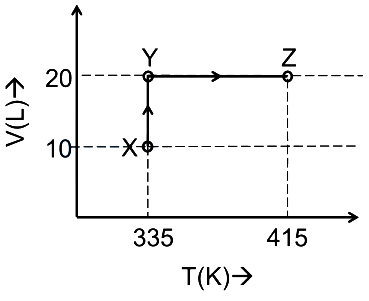
Considering only P-V work is involved, the total change in enthalpy (in Joule) for the transformation of state in the sequence \(\mathbf{X} \rightarrow \mathbf{Y} \rightarrow \mathbf{Z}\) is ________.
[Use the given data: Molar heat capacity of the gas for the given temperature range, \(\mathrm{C}_{\mathrm{V}, \mathrm{m}}=12 \mathrm{~J} \mathrm{~K}^{-1}\) \(\mathrm{mol}^{-1}\) and gas constant, \(\left.\mathrm{R}=8.3 \mathrm{~J} \mathrm{~K}^{-1} \mathrm{~mol}^{-1}\right]\)
- A 8120
- B 854
- C 2638
- D 1245
Answer & Solution
Correct Answer
(A) 8120
Step-by-step Solution
Detailed explanation
For ideal gas
\(\Delta \mathrm{H}=\mathrm{nC}_{\mathrm{P}} \Delta \mathrm{T}\)
\(\because \quad \mathrm{C}_{\mathrm{P}}=\mathrm{C}_{\mathrm{V}}+\mathrm{R}=12+8.3=20.3 \mathrm{~J} / \mathrm{K}\)-mole
\(\therefore \Delta H=5 \times 20.3 \times(415-335)\)
\(\Delta H=8120\) Joule
\(\Delta \mathrm{H}=\mathrm{nC}_{\mathrm{P}} \Delta \mathrm{T}\)
\(\because \quad \mathrm{C}_{\mathrm{P}}=\mathrm{C}_{\mathrm{V}}+\mathrm{R}=12+8.3=20.3 \mathrm{~J} / \mathrm{K}\)-mole
\(\therefore \Delta H=5 \times 20.3 \times(415-335)\)
\(\Delta H=8120\) Joule
See the Complete Solution
Get step-by-step explanations for this and 2.5 Lakh+ more JEE, NEET & CET questions.
- Unlock all solutions
- Practice the full chapter
- Track accuracy across PYQs
4.8 rated on Google Play · 14,000+ reviews
More questions from Chemistry
- Paragraph:
The coordination number of \(\mathrm{Ni}^{2+}\) is 4 .
\(\mathrm{NiCl}_2+\mathrm{KCN}\) (excess) \(\rightarrow A\) (cyano complex)
\(\mathrm{NiCl}_2+\) conc. \(\mathrm{HCl}\) (excess) \(\rightarrow B\) (chloro complex)
Question:
The hybridization of \(A\) and \(B\) areJEE Advanced 2006 Medium - Atoms of metals and form face-centred cubic (fcc) unit cell of edge length , body-centred cubic (bcc) unit cell of edge length , and simple cubic unit cell of edge length , respectively. If and , then the correct statement(s) is(are)
[Given: , and are molar masses of metals , and , respectively. , and are atomic radii of metals , and , respectively.]JEE Advanced 2023 Medium - The colour of light absorbed by an aqueous solution of \(\mathrm{CuSO}_{4}\) is:JEE Advanced 2012 Medium
- Match the chemical substance in Column I with type of polymers/type of bond in Column II. Indicate your answer by darkening the appropriate bubbles of \(4 \times 4\) matrix given in the ORS.
Column I Column II A. Cellulose p. Natural polymer B. Nylon-6,6 q. Synthetic polymer C. Protein r. Amide linkage D. Sucrose s. Glycoside linkage JEE Advanced 2007 Easy - Choose the correct option(s) from the followingJEE Advanced 2019 Medium
- The correct order of the wavelength maxima of the absorption band in the ultraviolet-visible region for the given complexes isJEE Advanced 2025 Medium
More PYQs from JEE Advanced
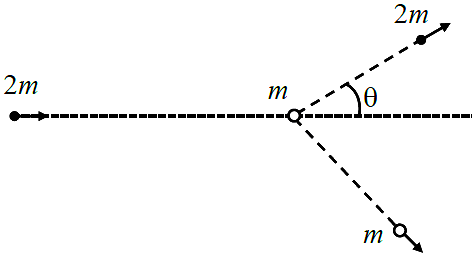
- In a scattering experiment, a particle of mass \(2 m\) collides with another particle of mass \(m\), which is initially at rest. Assuming the collision to be perfectly elastic, the maximum angular deviation \(\theta\) of the heavier particle, as shown in the figure, in radians is:
 JEE Advanced 2025 Hard
 - Let \(\int(x)=\left\{\begin{array}{r}x^{2}\left|\cos \frac{\pi}{x}\right|, \quad x \neq 0 \\ 0, \quad x=0\end{array}, x \in R\right.\) then \(\int\) isJEE Advanced 2012 Medium
- The isotope having a mass 12.014 u undergoes - decay to has an excited state of the nucleus at 4.041 MeV above its ground state. If decays to the maximum kinetic energy of the - particle in units of MeV is ( where c is the speed of light in vacuum).JEE Advanced 2016 Medium
- Consider a body of mass at rest at the origin at time . A force is applied on the body, where . The torque acting on the body about the origin at time . Which of the following statements is (are) true?JEE Advanced 2018 Medium
- The sides of a right-angled triangle are in arithmetic progression. If the triangle has area 24 square units, then what is the length of its smallest side?JEE Advanced 2017 Medium
- For the reaction, \(\mathbf{X}(s) \rightleftharpoons \mathbf{Y}(s)+\mathbf{Z}(g)\), the plot of \(\ln \frac{p_{\mathbf{Z}}}{p^{\theta}}\) versus \(\frac{10^{4}}{T}\) is given below (in solid line), where \(p_{\mathbf{Z}}\) is the pressure (in bar) of the gas \(\mathbf{Z}\) at temperature \(T\) and \(p^{\theta}=1\) bar.
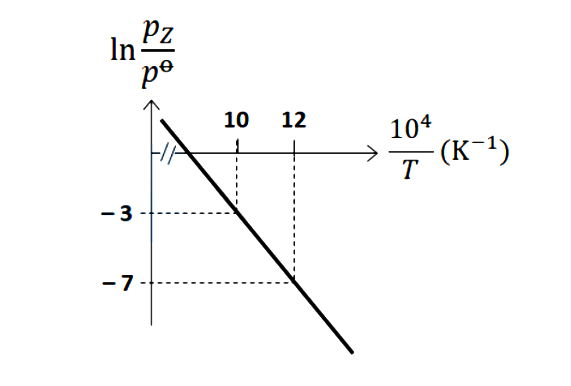
(Given, \(\frac{\mathrm{d}(\ln K)}{\mathrm{d}\left(\frac{1}{T}\right)}=-\frac{\Delta H^{\theta}}{R}\), where the equilibrium constant, \(K=\frac{p_{z}}{p^{\theta}}\) and the gas constant, \(\mathrm{R}=8.314 \mathrm{~J} \mathrm{~K}^{-1} \mathrm{~mol}^{-1}\) )
The value of (in ) for the given reaction, at is ___.JEE Advanced 2021 Hard