


JEE Advanced · Mathematics · 16. Limits
Let \(f(x)\) be a continuously differentiable function on the interval \((0, \infty)\) such that \(f(1)=2\) and \(\underset{t \rightarrow x}{\lim} \frac{t^{10} f(x)-x^{10} f(t)}{t^9-x^9}=1\) for each \(x>0\). Then, for all \(x>0, f(x)\) is equal to
- A \(\frac{31}{11 x}-\frac{9}{11} x^{10}\)
- B \(\frac{9}{11 x}+\frac{13}{11} x^{10}\)
- C \(\frac{-9}{11 x}+\frac{31}{11} x^{10}\)
- D \(\frac{13}{11 x}+\frac{9}{11} x^{10}\)
Answer & Solution
Correct Answer
(B) \(\frac{9}{11 x}+\frac{13}{11} x^{10}\)
Step-by-step Solution
Detailed explanation
\(\begin{aligned} & \lim _{t \rightarrow x} \frac{t^{10} f(x)-x^{10} f(t)}{t^9-x^9}=1 \\ & \Rightarrow \lim _{t \rightarrow x} \frac{10 t^9 f(x)-x^{10} f^{\prime}(t)}{9 t^8}=1\end{aligned}\)
\(\begin{aligned} & \Rightarrow 10 x f(x)-x^2 f^{\prime}(x)=9 \\ & \Rightarrow x^2 f^{\prime}(x)=10 x f(x)-9 \\ & \Rightarrow f^{\prime}(x)=\frac{10 f(x)}{x}-\frac{9}{x^2} \\ & \Rightarrow \frac{d y}{d x}-\frac{10}{x} y=-\frac{9}{x^2} \\ & \Rightarrow y \cdot \frac{1}{x^{10}}=\int-\frac{9}{x^2} \cdot \frac{1}{x^{10}} d x \\ & \Rightarrow \frac{y}{x^{10}}=\frac{9}{11 x^{11}}+c...(1)\end{aligned}\)
\(\begin{aligned} & \because \mathrm{f}(1)=2 \Rightarrow \frac{2}{1}=\frac{9}{11}+\mathrm{c} \Rightarrow \mathrm{c}=\frac{13}{11} \\ & \therefore \mathrm{f}(\mathrm{x})=\frac{9}{11 \mathrm{x}}+\frac{13}{11} \mathrm{x}^{10}\end{aligned}\)
\(\Rightarrow\) Option (2) is correct.
\(\begin{aligned} & \Rightarrow 10 x f(x)-x^2 f^{\prime}(x)=9 \\ & \Rightarrow x^2 f^{\prime}(x)=10 x f(x)-9 \\ & \Rightarrow f^{\prime}(x)=\frac{10 f(x)}{x}-\frac{9}{x^2} \\ & \Rightarrow \frac{d y}{d x}-\frac{10}{x} y=-\frac{9}{x^2} \\ & \Rightarrow y \cdot \frac{1}{x^{10}}=\int-\frac{9}{x^2} \cdot \frac{1}{x^{10}} d x \\ & \Rightarrow \frac{y}{x^{10}}=\frac{9}{11 x^{11}}+c...(1)\end{aligned}\)
\(\begin{aligned} & \because \mathrm{f}(1)=2 \Rightarrow \frac{2}{1}=\frac{9}{11}+\mathrm{c} \Rightarrow \mathrm{c}=\frac{13}{11} \\ & \therefore \mathrm{f}(\mathrm{x})=\frac{9}{11 \mathrm{x}}+\frac{13}{11} \mathrm{x}^{10}\end{aligned}\)
\(\Rightarrow\) Option (2) is correct.
See the Complete Solution
Get step-by-step explanations for this and 2.5 Lakh+ more JEE, NEET & CET questions.
- Unlock all solutions
- Practice the full chapter
- Track accuracy across PYQs
4.8 rated on Google Play · 14,000+ reviews
More questions from Mathematics
- Let \(a_1, a_2, a_3, \ldots, a_{11}\) be real numbers satisfying \(a_1=15,27-2 a_2>0\) and \(a_k=2 a_{k-1}-a_{k-2}\) for \(k=3,4, \ldots, 11\).
If \(\frac{a_1^2+a_2^2+\ldots+a_{11}^2}{11}=90\), then the value of \(\frac{a_1+a_2+\ldots+a_{11}}{11}\) is equal toJEE Advanced 2010 Medium - The normal at a point \(P\) on the ellipse \(x^2+4 y^2=16\) meets the \(x\)-axis at \(Q\). If \(M\) is the mid-point of the line segment \(P Q\), then the locus of \(M\) intersects the latusrectum of the given ellipse at the pointsJEE Advanced 2009 Hard
- Let \(z_1\) and \(z_2\) be two distinct complex numbers and let \(z=(1-t) z_1+t z_2\) for some real number \(t\) with \(0 < t < 1\). If \(\arg (w)\) denotes the principal argument of a non-zero complex number \(w\), thenJEE Advanced 2010 Hard
- The value of \(b\) for which the equations \(x^2+b x-1=0, x^2+x+b=0\) have one root in common isJEE Advanced 2011 Hard
- Let be two planes. Then, which of the following statement(s) is (are) TRUE?JEE Advanced 2018 Medium
- Let and be twice differentiable functions such that and are continuous functions on . Suppose and thenJEE Advanced 2016 Medium
More PYQs from JEE Advanced
- A train is moving along a straight line with a constant acceleration a. A boy standing in the train throws a ball forward with a speed of \(10 \mathrm{~m} / \mathrm{s}\), at an angle of \(60^{\circ}\) to the horizontal. The boy has to move forward by \(1.15 \mathrm{~m}\) inside the train to catch the ball back at the initial height. The acceleration of the train in \(\mathrm{m} / \mathrm{s}^2\), isJEE Advanced 2011 Medium
- The correct statements about the oxoacids, are,JEE Advanced 2017 Medium
- Silver (atomic weight \(=108 \mathrm{~g} \mathrm{~mol}^{-1}\) ) has a density of \(10.5 \mathrm{~g} \mathrm{~cm}^{-3}\). The number of silver atoms on a surface of area \(10^{-12} \mathrm{~m}^2\) can be expressed in scientific notation as \(y \times 10^x\). The value of \(x\) isJEE Advanced 2010 Easy
- The total number of lone pairs of electrons in isJEE Advanced 2015 Easy
- Let \(f\) be a real-valued function defined on the interval \((-1,1)\) such that \(e^{-x} f(x)=2+\int_0^x \sqrt{t^4+1} d t, \quad\) for all \(x \in(-1,1)\) and let \(f^{-1}\) be the inverse function of \(f\). Then \(\left(f^{-1}\right)^{\prime}(2)\) is equal toJEE Advanced 2010 Hard
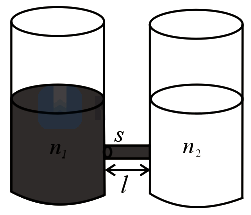
- As shown schematically in the figure, two vessels contain water solutions (at temperature ) of potassium permanganate of different concentrations and molecules per unit volume with When they are connected by a tube of small length and cross-sectional area starts to diffuse from the left to the right vessel through the tube. Consider the collection of molecules to behave as dilute ideal gases and the difference in their partial pressure in the two vessels causing the diffusion. The speed of the molecules is limited by the viscous force on each molecule, where is a constant. Neglecting all terms of the order . Which of the following is/are correct? ( is the Boltzmann constant)
 JEE Advanced 2020 Hard