


JEE Advanced · Mathematics · 25. AOD
Let
Let be all the points of local maximum of and be all the points of local minimum of
Then which of the following options is/are correct?
- A for every
- B
- C for every
- D for every
Answer & Solution
Correct Answer
(D) for every
Step-by-step Solution
Detailed explanation
…(i)
for maxima/minima
maxima/minima will occur
Where
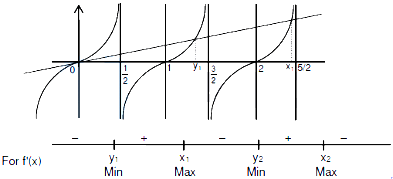
Case
For example
In at point
and at
at
hence from equation (i)
in goes from positive to negative
hence is maxima
Similarly … are point of maxima and all lies in
Case
In
for example at
at
and at
hence from equation (i)
in goes from negative to positive
so, for the minima
and for the maxima
Hence …
now,
Similarly,
…(b)
Therefore …(c)
Now consider
From (b) and (c)
for maxima/minima
maxima/minima will occur
Where
Case
For example
In at point
and at
at
hence from equation (i)
in goes from positive to negative
hence is maxima
Similarly … are point of maxima and all lies in
Case
In
for example at
at
and at
hence from equation (i)
in goes from negative to positive
so, for the minima
and for the maxima
Hence …
now,
Similarly,
…(b)
Therefore …(c)
Now consider
From (b) and (c)
See the Complete Solution
Get step-by-step explanations for this and 2.5 Lakh+ more JEE, NEET & CET questions.
- Unlock all solutions
- Practice the full chapter
- Track accuracy across PYQs
4.8 rated on Google Play · 14,000+ reviews
More questions from Mathematics
- Let be a invertible matrix with real entries and let denote the identity matrix. , then which of the following statements is/are ALWAYS TRUE?JEE Advanced 2020 Easy
- Let \(L\) be a normal to the parabola \(y^2=4 x\). If \(L\) passes through the point \((9,6)\), then \(L\) is given byJEE Advanced 2011 Medium
- let be defined by
List – I List – II (A) is (P) Onto but not one – one (B) is (Q) neither continuous nor one-one (C) of is (R) differentiable but not one-one (D) is (S) continuous and one-one JEE Advanced 2014 Medium - If satisfies the differential equation and thenJEE Advanced 2017 Medium
- Let \(\alpha\) and \(\beta\) be the roots of \(x^2-6 x-2=0\) with \(\alpha>\beta\). If \(a_n=\alpha^n-\beta^n\) for \(n \geq 1\), then the value of \(\frac{a_{10}-2 a_8}{2 a_9}\) isJEE Advanced 2011 Medium
- Let be a differentiable function such that and . Then,JEE Advanced 2016 Medium
More PYQs from JEE Advanced
- A cube of unit volume contains \(35 \times 10^7\) photons of frequency \(10^{15} \mathrm{~Hz}\). If the energy of all the photons is viewed as the average energy being contained in the electromagnetic waves within the same volume, then the amplitude of the magnetic field is \(\alpha \times 10^{-9} \mathrm{~T}\). Taking permeability of free space \(\mu_0=4 \pi \times 10^{-7} \mathrm{Tm} / \mathrm{A}\), Planck's constant \(h=6 \times 10^{-34} \mathrm{Js}\) and \(\pi=\frac{22}{7}\), the value of \(\alpha\) is_______JEE Advanced 2025 Hard
- Consider the following reversible reaction:
The activation energy of the backward reaction exceeds that of the forward reaction by (in ). If the pre-exponential factor of the forward reaction is times that of the reverse reaction, the absolute value of for the reaction at is ____.
(Given; and is the Gibbs energy)JEE Advanced 2018 Medium - Let and let be given by thenJEE Advanced 2014 Hard
- The electrochemical cell shown below is a concentration cell. \(\mathrm{M} \mid \mathrm{M}^{2+}\) (saturated solution of a sparingly soluble salt, \(\left.\mathrm{MX}_{2}\right) \| \mathrm{M}^{2 \perp}\left(0.001 \mathrm{~mol} \mathrm{dm}^{-3}\right) \mid \mathrm{M}\).
The emf of the cell depends on the difference in concentrations of \(\mathrm{M}^{2+}\) ions at the two electrodes. The emf of the cell at \(298 \mathrm{~K}\) is \(0.059 \mathrm{~V}\).
Question:
The value of \(\Delta \mathrm{G}\left(\mathrm{kJ} \mathrm{mol}^{-1}\right)\) for the given cell is (take 1 \(\mathrm{F}=96500 \mathrm{Cmol}^{-1}\) )JEE Advanced 2012 Medium - Let \(f(x)=2+\cos x\) for all real \(x\).
Statement I For each real \(t\), there exists a point \(c\) in \([t, t+\pi]\) such that \(f^{\prime}(c)=0\).
Statement II \(f(t)=f(t+2 \pi)\) for each real \(t\).JEE Advanced 2007 Easy - Tangents drawn from the point \(P(1,8)\) to the circle \(x^2+y^2-6 x-4 y-11=0\) touch the circle at the points \(A\) and \(B\). The equation of the circumcircle of \(\triangle P A B\) isJEE Advanced 2009 Medium