


JEE Advanced · Chemistry · 24. Haloalkanes & Haloarenes
Match the reactions in List-I with the features of their products in List-II and choose the correct option.
| List - I | List - II |
(P) 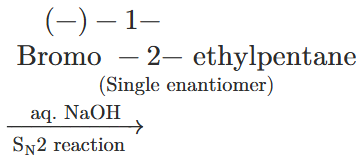 | 1. Inversion of configuration |
(Q) 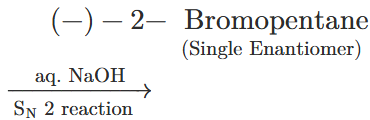 | 2. Retention of configuration |
(R) 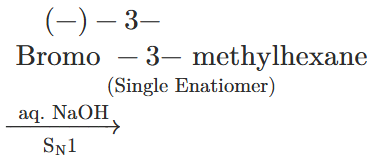 | 3. Mixture of enantiomers |
(S) 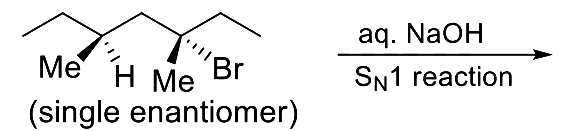 | 4. Mixture of structural isomers |
| 5. Mixture of diastereomers |
- A
- B
- C
- D
Answer & Solution
Correct Answer
(B)
Step-by-step Solution
Detailed explanation
\(1-\underset{\text { (Single enantiomer) }}{\text { Bromo }-2-\text { ethylpentane }} \xrightarrow[\text S _{\text N } 2 \text { reaction }]{\text { aq. } \text{NaOH} }\) \(2-\text{ethylpentanol}\) In the above reaction the chiral carbon is not involving in the reaction as reaction takes place via formation of transition state but not through formation of intermediate.
See the Complete Solution
Get step-by-step explanations for this and 2.5 Lakh+ more JEE, NEET & CET questions.
- Unlock all solutions
- Practice the full chapter
- Track accuracy across PYQs
4.8 rated on Google Play · 14,000+ reviews
More questions from Chemistry
- Paragraph:
Properties such as boiling point, freezing point and vapour pressure of a pure solvent change when solute molecules are added to get homogeneous solution. These are called colligative properties. Applications of colligative properties are very useful in day-to-day life. One of its examples is the use of ethylene glycol and water mixture as anti-freezing liquid in the radiator automobiles.
A solution \(M\) is prepared by mixing ethanol and water. The mole fraction of ethanol in the mixtrue is \(0.9\)
Given Freezing point depression constant of water \(\left(k^{\text {water }}\right)=1.86 \mathrm{~K} \mathrm{~kg} \mathrm{~mol}^{-1}\)
Freezing point depression constant of ethanol \(\left(k_f^{\text {ethanol }}\right)=2.0 \mathrm{Kkg} \mathrm{mol}^{-1}\)
Boiling point elevation constant of water \(\left(k_b^{\text {water }}\right)=0.52 \mathrm{Kkg} \mathrm{mol}^{-1}\)
Boiling point elevation constant of ethanol \(\left(k_b^{\text {ethanol }}\right)=1.2 \mathrm{Kkg} \mathrm{mol}^{-1}\)
Standard freezing point of water \(=273 \mathrm{~K}\)
Standard freezing point of ethanol \(=155.7 \mathrm{~K}\)
Standard boiling point of water \(=373 \mathrm{~K}\)
Standard boiling point of ethanol \(=351.5 \mathrm{~K}\)
Vapour pressure of pure water \(=328 \mathrm{~mm}\) of \(\mathrm{Hg}\)
Vapour pressure of pure ethanol \(=40 \mathrm{~mm}\) of \(\mathrm{Hg}\)
Molecular weight of water \(=18 \mathrm{~g} \mathrm{~mol}^{-1}\)
Molecular weight of ethanol \(=46 \mathrm{~g} \mathrm{~mol}^{-1}\)
In answering the following questions, consider the solutions to be ideal dilute solutions and solutes to be non-volatile and non-dissociative.
Question:
The freezing point of the solution \(M\) isJEE Advanced 2008 Medium - Paragraph:
Tollen's reagent is used for the detection of aldehyde when a solution of \(\mathrm{AgNO}_3\) is added to glucose with \(\mathrm{NH}_4 \mathrm{OH}\) then gluconic acid is formed
\(\mathrm{Ag}^{+}+e^{-} \rightarrow \mathrm{Ag} E_{\text {red }}^{\circ}=0.8 \mathrm{~V} \)
\( \mathrm{C}_6 \mathrm{H}_{12} \mathrm{O}_6+\mathrm{H}_2 \mathrm{O} \rightarrow \text { Gluconic acid }\)\(\left(\mathrm{C}_6 \mathrm{H}_{12} \mathrm{O}_7\right)+2 \mathrm{H}^{+}+2 e^{-} ; -E_{\mathrm{red}}^{\circ}=\) \(-0.05 \mathrm{~V} \)
\( \mathrm{Ag}\left(\mathrm{NH}_3\right)_2^{+}+e^{-} \rightarrow \mathrm{Ag}(s)+2 \mathrm{NH}_3 ;\) \(E_{\mathrm{red}}^{\circ}=0.337 \mathrm{~V}\)
[Use \(2.303 \times \frac{R T}{F}=0.0592\) and \(\frac{F}{R T}=38.92\) at \(298 \mathrm{~K}\) ]
Question:
Ammonia is always added in this reaction. Which of the following must be incorrect?JEE Advanced 2006 Medium - Among PbS, CuS, HgS, MnS, , NiS, CoS, and , the total number of black coloured sulphides isJEE Advanced 2014 Easy
- The correct statement(s) for orthoboric acid is/areJEE Advanced 2014 Easy
- Statement 1 There is a natural asymmetry between converting work to heat and converting heat to work.
Statement 2 No process is possible in which the sole result in the absorption of heat from a reservoir and its complete conversion into work.JEE Advanced 2008 Hard - Electrolysis of dilute aq. \(\mathrm{NaCl}\) solution was carried out by passing \(10 \mathrm{~mA}\) current. The time required to liberate \(0.01\) mole of \(\mathrm{H}_2\) gas at the cathode is (1 Faraday \(=96500 \mathrm{C} \mathrm{mol}^{-1}\) )JEE Advanced 2008 Hard
More PYQs from JEE Advanced
- Let the vectors \(\mathbf{P Q}, \mathbf{Q R}, \mathbf{R S}, \mathbf{S T}, \mathbf{T U}\) and UP represent the sides of a regular hexagon.
Statement I PQ \(\times(\mathbf{R S}+\mathbf{S T}) \neq \mathbf{0}\)
Statement II \(\mathbf{P Q} \times \mathbf{R S}=\mathbf{0}\) and \(\mathbf{P Q} \times \mathbf{S Q} \neq \mathbf{0}\)JEE Advanced 2007 Medium - In a circuit shown in the figure, the capacitor is initially uncharged and the key is open. In this condition, a current of flows through the resistor. The key is closed at time . Which of the following statement(s) is(are) correct?
[Given : ]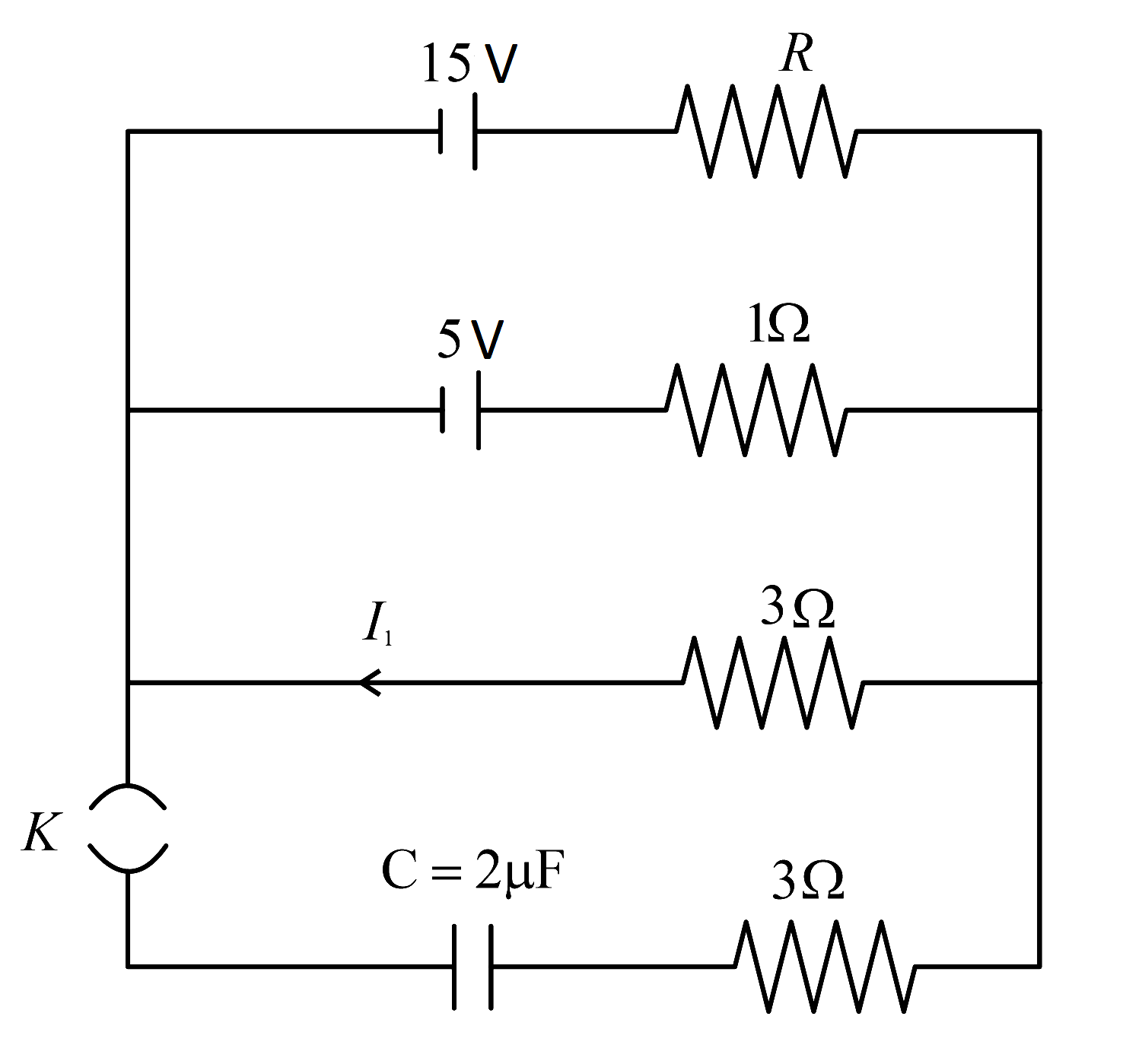 JEE Advanced 2023 Medium
 - For the octahedral complexes of in (thiocyanato-S) and in ligand environments, the difference between the spin-only magnetic moments in Bohr magnetons (when approximated to the nearest integer) is
[Atomic number of Fe = 26]JEE Advanced 2015 Medium - Let be the set of all complex numbers satisfying . Then which of the following statements is/are TRUE?JEE Advanced 2020 Hard
- For the process \(\mathrm{H}_2 \mathrm{O}(\mathrm{l})\) (1 bar, \(\left.273 \mathrm{~K}\right) \longrightarrow \mathrm{H}_2 \mathrm{O}(\mathrm{g})\) (1 bar, \(\left.373 \mathrm{~K}\right)\), the correct set of thermodynamic parameters isJEE Advanced 2007 Medium
- For 'invert sugar', the correct statement(s) is (are)
(Given: specific rotations of sucrose, maltose, glucose and fructose in aqueous solution are and , respectively)JEE Advanced 2016 Easy