


JEE Advanced · Mathematics · 16. Limits
Let the function \(f:[1, \infty) \rightarrow \mathbb{R}\) be defined by
\(f(t)=\left\{\begin{array}{cc}(-1)^{n+1} 2, & \text { if } t=2 n-1, n \in \mathbb{N}, \\ \frac{(2 n+1-t)}{2} f(2 n-1)+\frac{(t-(2 n-1))}{2} f(2 n+1), & \text { if } 2 n-1 < t < 2 n+1, n \in \mathbb{N} .\end{array}\right.\)
Define \(g(x)=\int_1^x f(t) d t, x \in(1, \infty)\). Let \(\alpha\) denote the number of solutions of the equation \(g(x)=0\) in the interval \((1,8]\) and \(\beta=\lim _{x \rightarrow 1^+} \frac{g(x)}{x-1}\). Then the value of \(\alpha+\beta\) is equal to ________.
- A 5
- B 10
- C 12
- D 9
Answer & Solution
Correct Answer
(A) 5
Step-by-step Solution
Detailed explanation
\(\mathrm{f}(\mathrm{t})=\left\{\begin{array}{ccc}2 & ; & \mathrm{t}=1 \\ 4-2 \mathrm{t} & ; & 1 < \mathrm{t} < 3 \\ -2 & ; & \mathrm{t}=3 \\ -8-2 \mathrm{t} & ; & 3 < \mathrm{t} < 5 \\ 2 & ; & \mathrm{t}=5 \\ 12-2 \mathrm{t} & ; & 5 < \mathrm{t} < 7 \\ -2 & ; & \mathrm{t}=7 \\ -16+2 \mathrm{t} & ; & 7 < \mathrm{t} < 9\end{array}\right.\)
\(g(x)=\int_1^x f(t) d t \Rightarrow g^{\prime}(x)=f(x)\)
for \(x \in(1,8]\)
\(g(x)=0 \Rightarrow x=3,5,7 \therefore \alpha=3\)
\(\beta=\lim _{x \rightarrow 1^{+}} \frac{g(x)}{x-1}\)
Apply L'Hospital's
\(\begin{aligned} & =\frac{g^{\prime}\left(1^{+}\right)}{1}=f\left(1^{+}\right) \\ & \beta=2 \\ & \therefore \alpha+\beta=5\end{aligned}\)
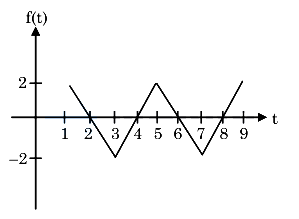
\(g(x)=\int_1^x f(t) d t \Rightarrow g^{\prime}(x)=f(x)\)
for \(x \in(1,8]\)
\(g(x)=0 \Rightarrow x=3,5,7 \therefore \alpha=3\)
\(\beta=\lim _{x \rightarrow 1^{+}} \frac{g(x)}{x-1}\)
Apply L'Hospital's
\(\begin{aligned} & =\frac{g^{\prime}\left(1^{+}\right)}{1}=f\left(1^{+}\right) \\ & \beta=2 \\ & \therefore \alpha+\beta=5\end{aligned}\)
See the Complete Solution
Get step-by-step explanations for this and 2.5 Lakh+ more JEE, NEET & CET questions.
- Unlock all solutions
- Practice the full chapter
- Track accuracy across PYQs
4.8 rated on Google Play · 14,000+ reviews
More questions from Mathematics
- Paragraph:
Let \(U_1\) and \(U_2\) be two urns such that \(U_1\) contains 3 white and 2 red balls and \(U_2\) contains only 1 white ball. A fair coin is tossed. If head appears then 1 ball is drawn at random from \(U_1\) and put into \(U_2\). However, if tail appears then 2 balls are drawn at random from \(U_1\) and put into \(U_2\). Now, 1 ball is drawn at random from \(U_2\).Question:
The probability of the drawn ball from \(U_2\) being white isJEE Advanced 2011 Medium - Paragraph:
Read the following passage and answer the questions.
For every function \(f(x)\) which is twice differentiable, these will be good approximation of \(\int_a^b f(x) d x \cong\left(\frac{b-a}{2}\right)\{f(a)+f(b)\}\). Now, if we take \(c=\frac{a+b}{2}\), then using above again, we get \(\int_a^b f(x) d x=\int_a^c f(x) d x+\int_c^b f(x) d x \cong \frac{b-a}{4}\{f(a)+f(b)+2 f(c)\}\) and so on.
We get approximation for value of \(\int_a^b f(x) d x\).Question:
Good approximation of \(\int_0^{\pi / 2} \sin x d x\), isJEE Advanced 2006 Easy - Let be a positive real number. Let and be the functions defined by and .
Then the value of is ______.JEE Advanced 2022 Medium - If the adjoint of a \(3 \times 3\) matrix \(P\) is \(\left[\begin{array}{lll}1 & 4 & 4 \\ 2 & 1 & 7 \\ 1 & 1 & 3\end{array}\right]\), then the possible value(s) of the determinant of \(P\) is (are)JEE Advanced 2012 Easy
- Let the straight line \(\mathrm{y}=2 \mathrm{x}\) touch a circle with center \((0, \alpha), \alpha>0\), and radius \(\mathrm{r}\) at a point \(\mathrm{A}_1\). Let \(\mathrm{B}_1\) be the point on the circle such that the line segment \(A_1 B_1\) is a diameter of the circle. Let \(\alpha+r=5+\sqrt{5}\).
Match each entry in List-I to the correct entry in List-II.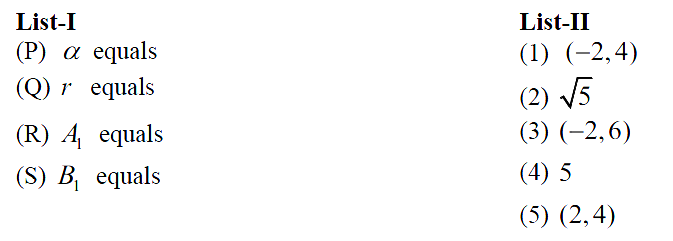
The correct option isJEE Advanced 2024 Easy - Suppose that
Box-I contains red, blue and green balls,
Box-ll contains red, blue and green balls,
Box-III contains blue, green and yellow balls,
Box-IV contains green, orange and white balls.
A ball is chosen randomly from Box-l; call this ball . If is red then a ball is chosen randomly from Box-ll, if is blue then a ball is chosen randomly from Box-III, and if is green then a ball is chosen randomly from Box-IV. The conditional probability of the event 'one of the chosen balls is white' given that the event 'at least one of the chosen balls is green' has happened, is equal toJEE Advanced 2022 Medium
More PYQs from JEE Advanced
- The monomer (X) involved in the synthesis of Nylon 6,6 gives positive carbylamine test. If 10 moles of \(\mathbf{X}\) are analyzed using Dumas method, the amount (in grams) of nitrogen gas evolved is ______ .
Use: Atomic mass of N (in amu) = 14JEE Advanced 2025 Medium - The plot given below shows curves (where, is the pressure and is the temperature) for two solvents and and isomolal solutions of in these solvents. is completely dissociates in both the solvents.
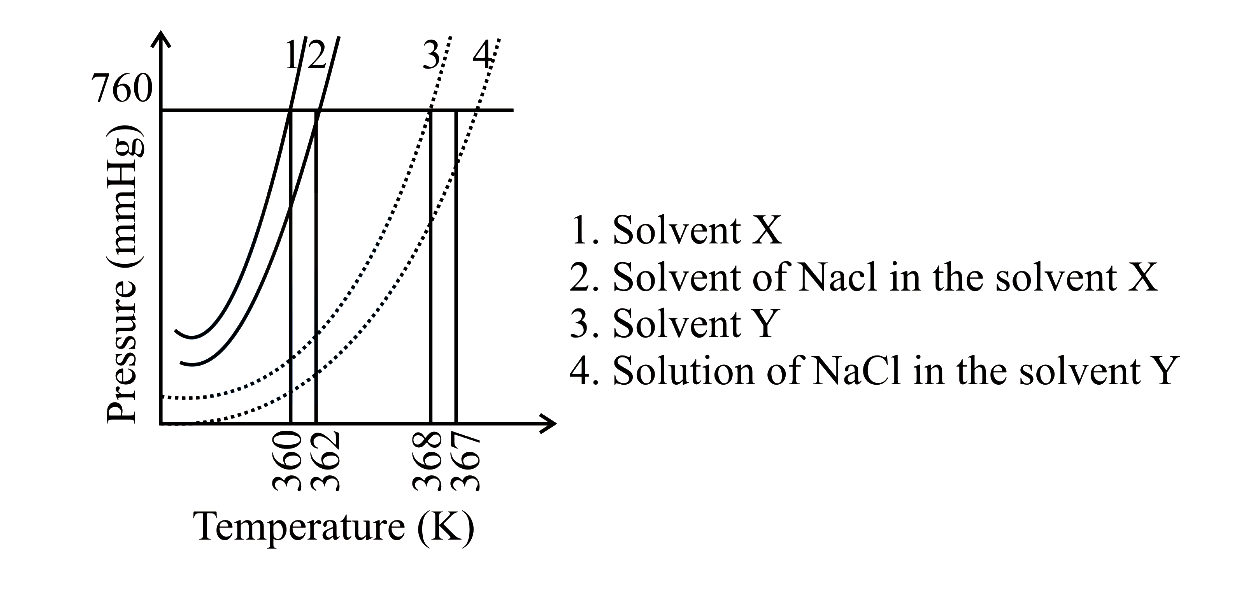
On the addition of equal number of moles of a non-volatile solute in equal amount (in ) of these solvents, the elevation of boiling point of solvent is three times that of solvent . The solute is known to undergo dimerization in these solvents. If the degree of dimerization is in the solvent , the degree of dimerization in the solvent is _______.JEE Advanced 2018 Hard - Match the reactions in Column I with appropriate types of steps/reactive intermediate involved in these reactions as given in Column II.
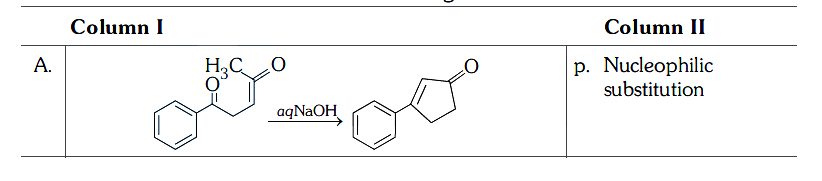
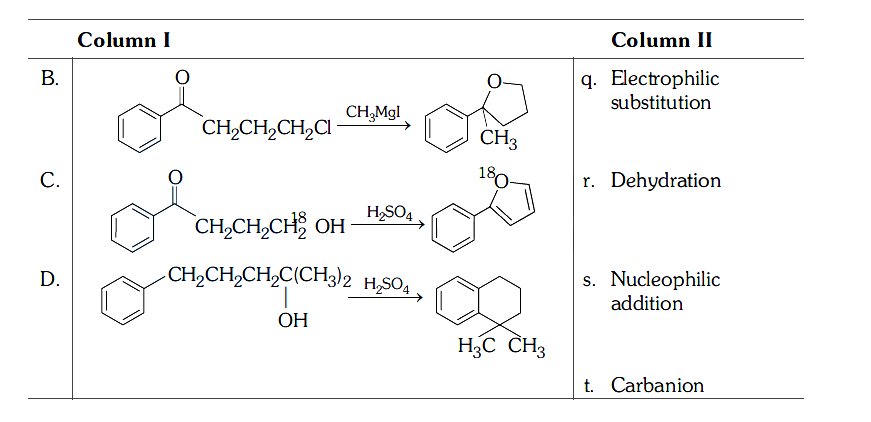 JEE Advanced 2011 Medium
 - A solid sphere of radius \(R\) has a charge \(Q\) distributed in its volume with a charge density \(\rho=k r^a\), where \(k\) and \(a\) are constants and \(r\) is the distance from its centre. If the electric field at \(r=\frac{R}{2}\) is \(\frac{1}{8}\) times that at \(r=R\), find the value of \(a\).JEE Advanced 2009 Medium
- Paragraph:
Chemical reactions involve interaction of atoms and molecules. A large number of atoms/molecules (approximately \(6.023 \times 10^{23}\) ) are present in a few grams of any chemical compound varying with their atomic/molecular masses. To handle such large numbers conveniently, the mole concept was introduced. This concept has implications in diverse areas such as analytical chemistry, biochemistry, electrochemistry and radiochemistry. The following example illustrates a typical case, involving chemical/electrochemical reaction, which requires a clear understanding of the mole concept.
A \(4.0\) molar aqueous solution of \(\mathrm{NaCl}\) is prepared and \(500 \mathrm{~mL}\) of this solution is electrolysed. This leads to the evolution of chlorine gas at one of electrodes (atomic mass: \(\mathrm{Na}=23, \mathrm{Hg}=200 ; 1\) faraday \(=96500\) coulombs).
Question:
The total number of moles of chlorine gas evolved isJEE Advanced 2007 Medium - For every pair of continuous functions such that then the correct statement (s) is (are)JEE Advanced 2014 Hard