


JEE Advanced · Chemistry · 29. Biomolecules
Paragraph :
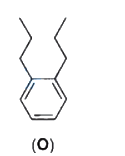
Treatment of compound \(\mathbf{O}\) with \(\mathrm{KMnO}_{4} / \mathrm{H}^{+}\)gave \(\mathbf{P}\), which on heating with ammonia gave \(\mathbf{Q}\). The compound \(\mathbf{Q}\) on treatment with \(\mathrm{Br}_{2} / \mathrm{NaOH}\) produced \(\mathbf{R}\). On strong heating, \(\mathbf{Q}\) gave \(\mathbf{S}\), which on further treatment with ethyl \(2-\)bromopropanoate in the presence of \(\mathrm{KOH}\) followed by acidification, gave a compound \(\mathbf{T}\).
Question :
The compound \(\mathbf{T}\) is
- A Glycine
- B Alanine
- C Valine
- D Serine
Answer & Solution
Correct Answer
(B) Alanine
Step-by-step Solution
Detailed explanation
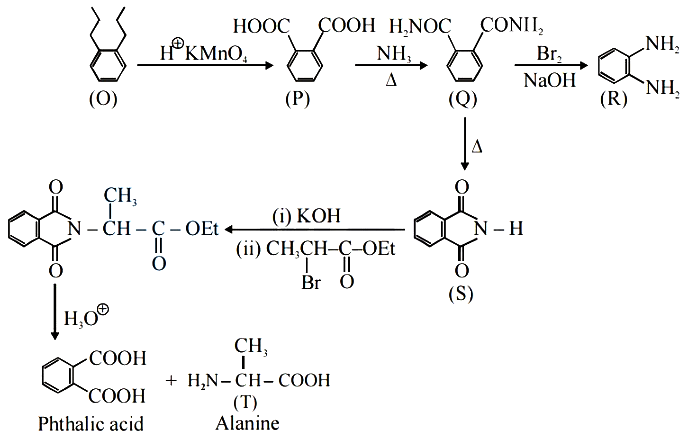
Q to R is Hoffmann's bromamide degradation reaction
S to T is Gabriel's phthalimide systhesis
See the Complete Solution
Get step-by-step explanations for this and 2.5 Lakh+ more JEE, NEET & CET questions.
- Unlock all solutions
- Practice the full chapter
- Track accuracy across PYQs
4.8 rated on Google Play · 14,000+ reviews
More questions from Chemistry
- \(\mathrm{Ag}^{+}+\mathrm{NH}_3 \rightleftharpoons\left[\mathrm{Ag}\left(\mathrm{NH}_3\right)\right]^{+} ; k_1=3.5 \times 10^{-3}\) \(\left[\mathrm{Ag}\left(\mathrm{NH}_3\right)\right]^{+}+\mathrm{NH}_3 \rightleftharpoons\left[\mathrm{Ag}\left(\mathrm{NH}_3\right)_2\right]^{+} ; k_2\) \(=1.7 \times 10^{-3}\) then the formation constant of \(\left[\mathrm{Ag}\left(\mathrm{NH}_3\right)_2\right]^{+}\)isJEE Advanced 2006 Medium
- Aqueous solution of \(\text{Na} _2\text S_2\text O _3\) on reaction with \(\text{Cl} _2\) givesJEE Advanced 2008 Medium
- An organic compound \(\mathbf{P}\) having molecular formula \(\mathrm{C}_6 \mathrm{H}_6 \mathrm{O}_3\) gives ferric chloride test and does not have intramolecular hydrogen bond. The compound \(\mathbf{P}\) reacts with 3 equivalents of \(\mathrm{NH}_2 \mathrm{OH}\) to produce oxime \(\mathbf{Q}\). Treatment of \(\mathbf{P}\) with excess methyl iodide in the presence of \(\mathrm{KOH}\) produces compound \(\mathbf{R}\) as the major product. Reaction of \(\mathbf{R}\) with excess iso-butylmagnesium bromide followed by treatment with \(\mathrm{H}_3 \mathrm{O}^{+}\)gives compound \(\mathrm{S}\) as the major product.
The total number of methyl \(\left(-\mathrm{CH}_3\right)\) group(s) in compound \(\mathbf{S}\) is ________. (consider maximum value if there are two values)JEE Advanced 2024 Hard - The reduction potential , in of is
\(\left[\right.\)Given: \(E _{\left( MnO _4^{-}( aq ) / MnO _2(s)\right)}^{ o }=1.68 V ;\) \( E _{\left( MnO _2(s) / Mn ^{2+}( aq )\right)}^{ o }=\) \(1.21 V ; E _{\left( Mn ^{2+}( aq ) / Mn ( s )\right)}^{ o }\) \(=-1.03 V]\)
Truncate/round-off the value to TWO decimal places.JEE Advanced 2022 Medium - Consider the following volume-temperature \((\mathrm{V}-\mathrm{T})\) diagram for the expansion of 5 moles of an ideal monoatomic gas.
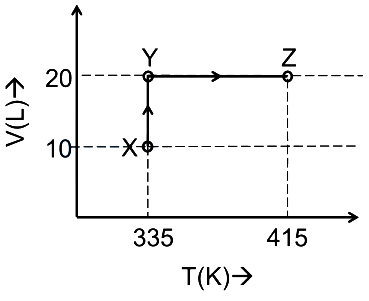
Considering only P-V work is involved, the total change in enthalpy (in Joule) for the transformation of state in the sequence \(\mathbf{X} \rightarrow \mathbf{Y} \rightarrow \mathbf{Z}\) is ________.
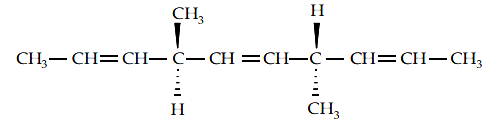
[Use the given data: Molar heat capacity of the gas for the given temperature range, \(\mathrm{C}_{\mathrm{V}, \mathrm{m}}=12 \mathrm{~J} \mathrm{~K}^{-1}\) \(\mathrm{mol}^{-1}\) and gas constant, \(\left.\mathrm{R}=8.3 \mathrm{~J} \mathrm{~K}^{-1} \mathrm{~mol}^{-1}\right]\)JEE Advanced 2024 Medium - The number of optically active products obtained from the complete ozonolysis of the given compound is :
 JEE Advanced 2012 Hard
More PYQs from JEE Advanced
- An aqueous solution of X is added slowly to an aqueous solution of Y as shown in List I. The variation in conductivity of these reactions is given in List II. Match List I with List II and select the correct using answer the code given below the lists :
List - I List - II a. \(\underset{\quad\quad~~ X }{( C _2 H _5)_3 N}+\underset{ Y }{CH _3 COOH}\) p. Conductivity decreases and then increases b. \(\underset{\quad\quad~~ X }{KI (0.1 M )}+\underset{ Y }{AgNO _3(0.01 M )}\) q. Conductivity decreases and then does not change much c. \(\underset{\text X }{CH _3 COOH}+\underset{\text Y }{KOH}\) r. Conductivity increases and then
does not change muchd. \(\underset{\text X }{NaOH}+\underset{\text Y }{HI}\) s. Conductivity does not change much and
then increasesJEE Advanced 2013 Medium - The positon vector \(\vec{r}\) of a particle of mass m is given by the following equation \(\vec{r}(t)=\alpha t^3 \hat{i} +\beta t^2 \hat{j}\), where \(\alpha=\frac{10}{3} m s^{-3}, \beta=5 m s^{-2}\) and \(m=0.1 kg\). At \(t=1 s\), which of the following statements (s) is (are) true about the particle?JEE Advanced 2016 Easy
- An organic compound rotates plane-polarized light. It produces pink color with neutral solution. What is the total number of all the possible isomers for this compound?JEE Advanced 2020 Hard
- A solution of colourless salt \(\mathrm{H}\) on boiling with excess \(\mathrm{NaOH}\) produces a non-flammable gas. The gas evolution ceases after sometime. Upon addition of \(\mathrm{Zn}\) dust to the same solution, the gas evolution restarts. The colourless salt (s) \(\mathrm{H}\) is (are)JEE Advanced 2008 Medium
- Let be a quadrilateral in a plane, where and . If and , then the interval(s) that contain(s) the value of is/areJEE Advanced 2022 Medium
- A charged particle is introduced at the origin with a given initial velocity . A uniform electric field and a uniform magnetic field exist everywhere. The velocity , electric field and a uniform magnetic field are given in the columns below
In which case will the particle move in a straight line with a constant velocity?Column 1 Column 2 Column 3 1. Electron with (i) (P) 2. Electron with (ii) (Q) 3.Proton with =0 (iii) (R) 4. Proton with (iv) (S) JEE Advanced 2017 Easy