


JEE Advanced · Physics · 20. Magnetism & Current
A charged particle is introduced at the origin with a given initial velocity . A uniform electric field and a uniform magnetic field exist everywhere. The velocity , electric field and a uniform magnetic field are given in the columns below
| Column 1 | Column 2 | Column 3 |
| 1. Electron with | (i) | (P) |
| 2. Electron with | (ii) | (Q) |
| 3.Proton with =0 | (iii) | (R) |
| 4. Proton with | (iv) | (S) |
- A
- B
- C
- D
Answer & Solution
Correct Answer
(A)
Step-by-step Solution
Detailed explanation
Given: A charged particle is introduced at the origin \((x=0, y=0, z=0)\). initial velocity \(=\vec{v}\),
uniform electric field \(\vec{E}\).
uniform magnetic field \(\vec{B}\).
Also the values are given the table.
we need to find the cases where the particle will move in a straight line with constant velocity.
To move a particle with constant velocity;
Fnet \(=0\),
\(\Rightarrow\) The electric force \(=\) magnetic fore e.
\(\begin{gathered}
q E=q v B . \\
E=v B .
\end{gathered}\)
Now checking the options.
\(\begin{aligned}
&\text { A) (II) (iii) (s). } \\
&\text { (II) }=\vec{v}=\frac{E_0}{B_0} \hat{y} \text {. } \\
&\text { (iii) }=\vec{E}=-E_0 \hat{x} \\
&(s)=\vec{B}=B_0 \hat{Z} \text {. } \\
&-E_0 \hat{x}=E_0 \hat{B O} \hat{y}(B O \hat{z}) \\
\end{aligned}\)
\(\therefore\) (II) (iii) (s) is the correct option
uniform electric field \(\vec{E}\).
uniform magnetic field \(\vec{B}\).
Also the values are given the table.
we need to find the cases where the particle will move in a straight line with constant velocity.
To move a particle with constant velocity;
Fnet \(=0\),
\(\Rightarrow\) The electric force \(=\) magnetic fore e.
\(\begin{gathered}
q E=q v B . \\
E=v B .
\end{gathered}\)
Now checking the options.
\(\begin{aligned}
&\text { A) (II) (iii) (s). } \\
&\text { (II) }=\vec{v}=\frac{E_0}{B_0} \hat{y} \text {. } \\
&\text { (iii) }=\vec{E}=-E_0 \hat{x} \\
&(s)=\vec{B}=B_0 \hat{Z} \text {. } \\
&-E_0 \hat{x}=E_0 \hat{B O} \hat{y}(B O \hat{z}) \\
\end{aligned}\)
\(\therefore\) (II) (iii) (s) is the correct option
See the Complete Solution
Get step-by-step explanations for this and 2.5 Lakh+ more JEE, NEET & CET questions.
- Unlock all solutions
- Practice the full chapter
- Track accuracy across PYQs
4.8 rated on Google Play · 14,000+ reviews
More questions from Physics
- A point source \(\mathrm{S}\) emits unpolarized light uniformly in all directions. At two points \(\mathrm{A}\) and \(\mathrm{B}\), the ratio \(r=I_A / I_B\) of the intensities of light is 2. If a set of two polaroids having \(45^{\circ}\) angle between their pass-axes is placed just before point \(\mathrm{B}\), then the new value of \(r\) will be ______JEE Advanced 2024 Easy
- Paragraph:
Modern trains are based on Maglev technology in which trains are magnetically leviated, which runs its EDS Maglev system.
There are coils on both sides of wheels. Due to motion of train, current induces in the coil of track which levitate it. This is in accordance with Lenz's law. If trains lower down then due to Lenz's law a repulsive force increases due to which train gets uplifted and if it goes much high then there is a net downward force disc to gravity. The advantage of Maglev train is that there is no friction between the train and the track, thereby reducing power consumption and enabling the train to attain very high speeds.
Disadvantage of Maglev train is that as it slows down the electromagnetic forces decreases and it becomes difficult to keep it leviated and as it moves forward according to Lenz law, there is an electromagnetic drag force.
Question:
Which force causes the train to elevate up?JEE Advanced 2006 Easy - Two coherent monochromatic point sources and of wavelength are placed symmetrically on either side of the center of the circle as shown. The sources are separated by a distance This arrangement produces interference fringes visible as alternate bright and dark spots on the circumference of the circle. The angular separation between two consecutive bright spots is . Which of the following options is/are correct?
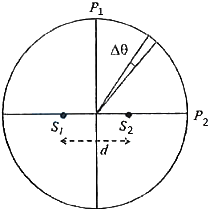 JEE Advanced 2017 Medium
 - Column I contains a list of processes involving expansion of an ideal gas. Match this with Column II describing the thermodynamic change during this process. Indicate your answer by darkening the appropriate bubbles of the \(4 \times 4\) matrix given in the ORS.
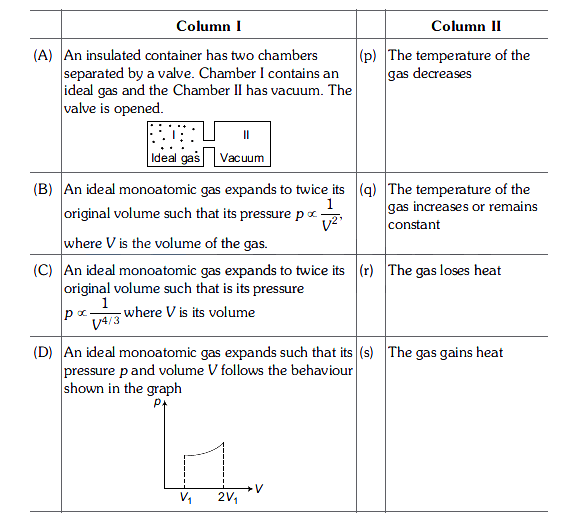 JEE Advanced 2008 Hard
 - Paragraph :
A spray gun is shown in the figure where a piston pushes air out of a nozzle. A thin tube of uniform cross section is connected to the nozzle. The other end of the tube is in a small liquid container. As the piston pushes air through the nozzle, the liquid from the container rises into the nozzle and is sprayed out. For the spray gun shown, the radii of the piston and the nozzle are \(20 \mathrm{~mm}\) and \(1 \mathrm{~mm}\), respectively. The upper end of the container is open to the atmosphere.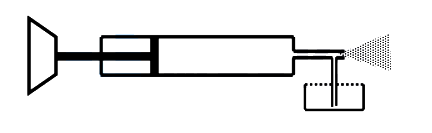
Question :
If the density of air is \(\rho_{a}\) and that of the liquid \(\rho_{\ell}\), then for a given piston speed the rate (volume per unit time) at which the liquid is sprayed will be proportional toJEE Advanced 2014 Easy - A rocket is launched normal to the surface of the Earth, away from the Sun, along the line joining the Sun and the Earth. The Sun is times heavier than the Earth and is at a distance times larger than the radius of the Earth. The escape velocity from Earth's gravitational field is . The minimum initial velocity required for the rocket to be able to leave the Sun-Earth system is closest to
(Ignore the rotation and revolution of the Earth and the presence of any other planet)JEE Advanced 2017 Medium
More PYQs from JEE Advanced
- Let \(I=\int \frac{e^x}{e^{4 x}+e^{2 x}+1} d x, J=\int \frac{e^{-x}}{e^{-4 x}+e^{-2 x}+1} d x\).
Then, for an arbitrary constant \(C\), the value of \(J-I\) equalsJEE Advanced 2008 Easy - In a photoemission experiment, the maximum kinetic energies of photoelectrons from metals and are and , respectively, and they are related by . In this experiment, the same source of monochromatic light is used for metals and while a different source of monochromatic light is used for the metal . The work functions for metals and are and , respectively. The energy of the incident photon used for metal , in is ___.JEE Advanced 2021 Medium
- At time \(t=0\), a battery of \(10 \mathrm{~V}\) is connected across points \(A\) and \(B\) in the given circuit. If the capacitors have no charge initially, at what time (in second) does the voltage across them become \(4 \mathrm{~V}\) ?
[Take \(: \ln 5=1.6, \ln 3=1.1]\)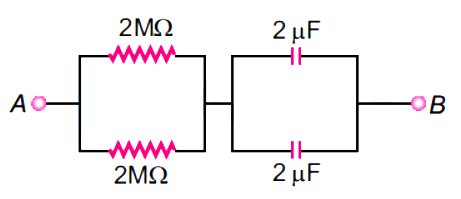 JEE Advanced 2010 Medium
 - Paragraph:
Let \(V_r\) denotes the sum of the first \(r\) terms of an arithmetic progression \((A P)\) whose first term is \(r\) and the common difference is \((2 r-1)\). Let \(T_r=V_{r+1}-V_r-2\) and \(Q_r=T_{r+1}-T_r\) for \(r=1,2, \ldots\)
Question:
\(T_r\) is alwaysJEE Advanced 2007 Hard - In thermodynamics, the work done is given by . For a system undergoing a particular process, the work done is,
. This equation is applicable to aJEE Advanced 2020 Hard - Paragraph :
Phase space diagrams are useful tools in analyzing all kinds of dynamical problems. They are especially useful in studying the changes in motion as initial position and momentum are changed. Here we consider some simple dynamical systems in one-dimension. For such systems, phase space is a plane in which position is plotted along horizontal axis and momentum is plotted along vertical axis. The phase space diagram is \(x(t) v s p(t)\) curve in this plane. The arrow on the
curve indicates the time flow. For example, the phase space diagram for a particle moving with constant velocity is a straight line as shown in the figure. We use the sign convention in which position or momentum upwards (or to right) is positive and downwards (or to left) is negative.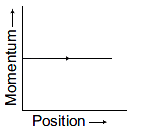
Question :
The phase space diagram for simple harmonic motion is a circle centered at the origin. In the figure, the two circles represent the same oscillator but for different initial conditions, and \(E_1\) and \(E_2\) are the total mechanical energies respectively. Then,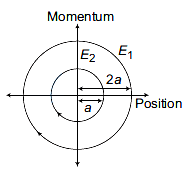 JEE Advanced 2011 Easy