


JEE Advanced · Chemistry · 17. Electrochemistry
An aqueous solution of X is added slowly to an aqueous solution of Y as shown in List I. The variation in conductivity of these reactions is given in List II. Match List I with List II and select the correct using answer the code given below the lists :
| List - I | List - II |
| a. \(\underset{\quad\quad~~ X }{( C _2 H _5)_3 N}+\underset{ Y }{CH _3 COOH}\) | p. Conductivity decreases and then increases |
| b. \(\underset{\quad\quad~~ X }{KI (0.1 M )}+\underset{ Y }{AgNO _3(0.01 M )}\) | q. Conductivity decreases and then does not change much |
| c. \(\underset{\text X }{CH _3 COOH}+\underset{\text Y }{KOH}\) | r. Conductivity increases and then does not change much |
| d. \(\underset{\text X }{NaOH}+\underset{\text Y }{HI}\) | s. Conductivity does not change much and then increases |
- A a-r;b-s;c-q;d-p;
- B a-q;b-s;c-r;d-p;
- C a-p;b-r;c-s;d-q;
- D a-p;b-s;c-q;d-r;
Answer & Solution
Correct Answer
(A) a-r;b-s;c-q;d-p;
Step-by-step Solution
Detailed explanation
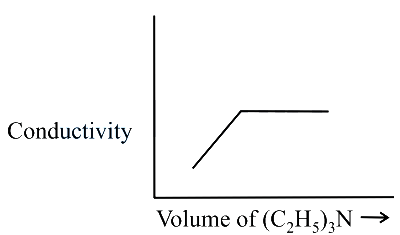
p) (C2H5)3 N added to CH3COOH
(C2H5)3 NH+ and CH3COO- ions generated in solution, conductivity increases & then remains constant as (C2H5)3 N is not dissociated when in excess.
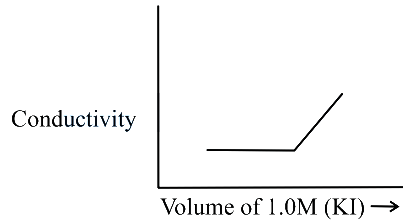
q) KIeq added to AgNO3
ions replaced by
conductivity does not change till complete precipitation but later on with additional KI(aq) added conductivity will increase.
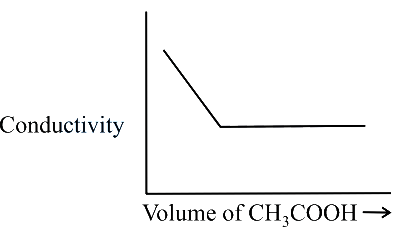
r) On addition of acetic acid to KOH. KOH fully dissociated replaced by
\(CH _3 COOH +\left( K ^{+}+ OH ^{-}\right) \longrightarrow[ CH _3 COO ^{-}\) \(+ K ^{+}]+ H _2 O\)
The net result is replacement of OH- by CH3COO- ions whose ionic mobility is less so conductivity will decrease first and then will not change much due to addition of CH3COOH(in excess) which will not be dissociated
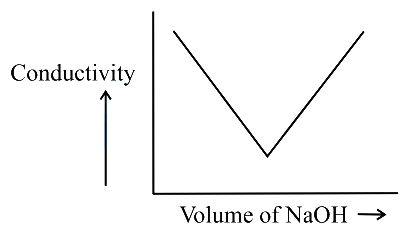
s) On addition of NaOH to HI
there will be replacement of H+ by Na+ whose mobility is less than H+ which means conductivity will decrease first & then due to adding NaOH which is a strong electrolyte which fully dissociates, so conductivity will increase.
(C2H5)3 NH+ and CH3COO- ions generated in solution, conductivity increases & then remains constant as (C2H5)3 N is not dissociated when in excess.
q) KIeq added to AgNO3
ions replaced by
conductivity does not change till complete precipitation but later on with additional KI(aq) added conductivity will increase.
r) On addition of acetic acid to KOH. KOH fully dissociated replaced by
\(CH _3 COOH +\left( K ^{+}+ OH ^{-}\right) \longrightarrow[ CH _3 COO ^{-}\) \(+ K ^{+}]+ H _2 O\)
The net result is replacement of OH- by CH3COO- ions whose ionic mobility is less so conductivity will decrease first and then will not change much due to addition of CH3COOH(in excess) which will not be dissociated
s) On addition of NaOH to HI
there will be replacement of H+ by Na+ whose mobility is less than H+ which means conductivity will decrease first & then due to adding NaOH which is a strong electrolyte which fully dissociates, so conductivity will increase.
See the Complete Solution
Get step-by-step explanations for this and 2.5 Lakh+ more JEE, NEET & CET questions.
- Unlock all solutions
- Practice the full chapter
- Track accuracy across PYQs
4.8 rated on Google Play · 14,000+ reviews
More questions from Chemistry
- For a reaction, , the plots of with time at temperatures are given below.
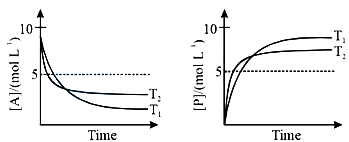
If , the correct statement(s) is (are)
(Assume are independent of temperature and ratio of is greater than . Here H, S , G and K are enthalpy, entropy, Gibbs energy and equilibrium constant, respectively.)JEE Advanced 2018 Hard - To form a complete monolayer of acetic acid on \(1 \mathrm{~g}\) of charcoal, \(100 \mathrm{~mL}\) of \(0.5 \mathrm{M}\) acetic acid was used. Some of the acetic acid remained unadsorbed. To neutralize the unadsorbed acetic acid, 40 \(\mathrm{mL}\) of \(1 \mathrm{M} \mathrm{NaOH}\) solution was required. If each molecule of acetic acid occupies \(\mathbf{P} \times 10^{-23} \mathrm{~m}^2\) surface area on charcoal, the value of \(\mathbf{P}\) is _______ [Use given data: Surface area of charcoal \(=1.5 \times 10^2 \mathrm{~m}^2 \mathrm{~g}^{-1} ;\) Avogadro's number \(\left(\mathrm{N}_{\mathrm{A}}\right)=6.0 \times 10^{23}\) \(\left.\mathrm{mol}^{-1}\right]\)JEE Advanced 2024 Medium
- Upon treatment with ammoniacal , the metal ion that precipitates as a sulphide isJEE Advanced 2013 Easy
- is ethylenediaminetetraacetate ion. The total number of N - Co - O bond angles in complex ion isJEE Advanced 2013 Hard
- Paragraph:
Chemical reactions involve interaction of atoms and molecules. A large number of atoms/molecules (approximately \(6.023 \times 10^{23}\) ) are present in a few grams of any chemical compound varying with their atomic/molecular masses. To handle such large numbers conveniently, the mole concept was introduced. This concept has implications in diverse areas such as analytical chemistry, biochemistry, electrochemistry and radiochemistry. The following example illustrates a typical case, involving chemical/electrochemical reaction, which requires a clear understanding of the mole concept.
A \(4.0\) molar aqueous solution of \(\mathrm{NaCl}\) is prepared and \(500 \mathrm{~mL}\) of this solution is electrolysed. This leads to the evolution of chlorine gas at one of electrodes (atomic mass: \(\mathrm{Na}=23, \mathrm{Hg}=200 ; 1\) faraday \(=96500\) coulombs).
Question:
The total number of moles of chlorine gas evolved isJEE Advanced 2007 Medium - Among and the number of molecules containing covalent bond between two atoms of the same kind is __________JEE Advanced 2019 Medium
More PYQs from JEE Advanced
- A light beam is travelling from Region I to Region IV (refer figure). The refractive index in Region I, II, III and IV are \(n_0, \frac{n_0}{2}, \frac{n_0}{6}\) and \(\frac{n_0}{8}\), respectively. The angle of incidence \(\theta\) for which the beam just misses entering Region IV is
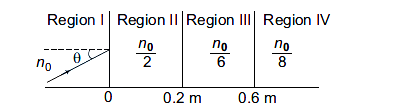 JEE Advanced 2008 Easy
 - Column I contains a list of processes involving expansion of an ideal gas. Match this with Column II describing the thermodynamic change during this process. Indicate your answer by darkening the appropriate bubbles of the \(4 \times 4\) matrix given in the ORS.
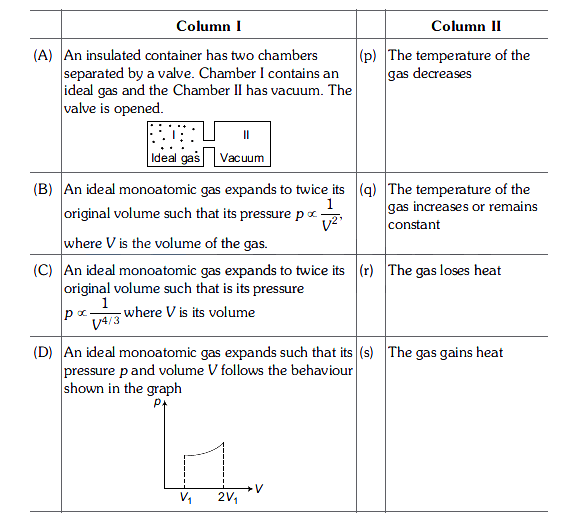 JEE Advanced 2008 Hard
 - Let \(f_{1}:(0, \infty) \rightarrow \mathbb{R}\) and \(f_{2}:(0, \infty) \rightarrow \mathbb{R}\) be defined by
\[
f_{1}(x)=\int_{0}^{x} \prod_{j=1}^{21}(t-j)^{j} d t, \quad x>0
\]
and
\(
f_{2}(x)=98(x-1)^{50}-600(x-1)^{49}+2450, \quad x>0
\)
where, for any positive integer \(n\) and real numbers \(a_{1}, a_{2}, \ldots, a_{n}, \prod_{i=1}^{n} a_{i}\) denotes the product of \(a_{1}, a_{2}, \ldots, a_{n} .\) Let \(m_{i}\) and \(n_{i}\), respectively, denote the number of points of local minima and the number of points of local maxima of function \(f_{i}, i=1,2\), in the interval \((0, \infty)\).
The value of is _____.JEE Advanced 2021 Medium - In a Young's double slit experiment, the slit separation is and the screen distance is A parallel beam of light of wavelength is incident on the slits at angle as shown in figure. On the screen, the point is equidistant from the slits and distance is Which of the following statement(s) is/are correct?
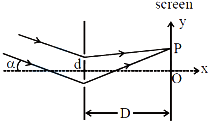 JEE Advanced 2019 Easy
 - Let be given by
Then which of the following options is/are correct?JEE Advanced 2019 Medium - Concentration of and in a solution is and , respectively. Molar solubility of in the same solution is (expressed in scientific notation). The value of is
[Given: Solubility product of . For is very large and ]
If the numerical value has more than two decimal places, truncate/round-off the value to TWO decimal places.JEE Advanced 2022 Hard