


JEE Advanced · Chemistry · 17. Electrochemistry
Paragraph:
Tollen's reagent is used for the detection of aldehyde when a solution of \(\mathrm{AgNO}_3\) is added to glucose with \(\mathrm{NH}_4 \mathrm{OH}\) then gluconic acid is formed
\(\mathrm{Ag}^{+}+e^{-} \rightarrow \mathrm{Ag} E_{\text {red }}^{\circ}=0.8 \mathrm{~V} \)
\( \mathrm{C}_6 \mathrm{H}_{12} \mathrm{O}_6+\mathrm{H}_2 \mathrm{O} \rightarrow \text { Gluconic acid }\left(\mathrm{C}_6 \mathrm{H}_{12} \mathrm{O}_7\right)\) \(+~2 \mathrm{H}^{+}+2 e^{-} ; -E_{\mathrm{red}}^{\circ}=-0.05 \mathrm{~V} \)
\( \mathrm{Ag}\left(\mathrm{NH}_3\right)_2^{+}+e^{-} \rightarrow \mathrm{Ag}(s)+2 \mathrm{NH}_3 ;\) \(E_{\mathrm{red}}^{\circ}=0.337 \mathrm{~V}\)
[Use \(2.303 \times \frac{R T}{F}=0.0592\) and \(\frac{F}{R T}=38.92\) at \(298 \mathrm{~K}\) ]
Question:
When ammonia is added to the solution, \(\mathrm{pH}\) is raised to 11 . Which half-cell reaction is affected by \(\mathrm{pH}\) and by how much?
- A \(E_{\text {oxd }}\) will increase by a factor of \(0.65\) from \(E_{\text {oxd }}^{\circ}\)
- B \(E_{\text {oxd }}\) will decrease by a factor of \(0.65\) from \(E_{\text {oxd }}^{\circ}\)
- C \(E_{\text {red }}\) will increase by a factor of \(0.65\) from \(E_{\text {red }}^{\circ}\)
- D \(E_{\text {red }}\) will decrease by a factor of \(0.65\) from \(E_{\text {red }}^{\circ}\)
Answer & Solution
Correct Answer
(C) \(E_{\text {red }}\) will increase by a factor of \(0.65\) from \(E_{\text {red }}^{\circ}\)
Step-by-step Solution
Detailed explanation
On increasing concentration of \(\mathrm{NH}_3\), the concentration of \(\mathrm{H}^{+}\)ion decreases, therefore
\(E_{\mathrm{red}} =E_{\mathrm{red}}^{\circ}-\frac{0.0592}{n} \log _{10}\left[\mathrm{H}^{+}\right]^2 \)
\( =0-\frac{0.0592}{2} \times 2 \log _{10} 10^{-11} \quad\)\(\left(\because \mathrm{pH}=11 ; \therefore\left[\mathrm{H}^{+}\right]=10^{-11} \mathrm{M}\right) \)
\( =-0.0592 \times 11=0.6512 \mathrm{~V}=0.65 \mathrm{~V}\)
\(E_{\text {red }}\) increased by a factor of \(0.65\) from \(E_{\text {red }}^{\circ}\).
\(E_{\mathrm{red}} =E_{\mathrm{red}}^{\circ}-\frac{0.0592}{n} \log _{10}\left[\mathrm{H}^{+}\right]^2 \)
\( =0-\frac{0.0592}{2} \times 2 \log _{10} 10^{-11} \quad\)\(\left(\because \mathrm{pH}=11 ; \therefore\left[\mathrm{H}^{+}\right]=10^{-11} \mathrm{M}\right) \)
\( =-0.0592 \times 11=0.6512 \mathrm{~V}=0.65 \mathrm{~V}\)
\(E_{\text {red }}\) increased by a factor of \(0.65\) from \(E_{\text {red }}^{\circ}\).
See the Complete Solution
Get step-by-step explanations for this and 2.5 Lakh+ more JEE, NEET & CET questions.
- Unlock all solutions
- Practice the full chapter
- Track accuracy across PYQs
4.8 rated on Google Play · 14,000+ reviews
More questions from Chemistry
- Among the following complexes \((K-P), \mathrm{K}_3\left[\mathrm{Fe}(\mathrm{CN})_6\right](K)\),
\(\left[\right.\) Co \(\left.\left(\mathrm{NH}_3\right)_6\right] \mathrm{Cl}_3(L), \mathrm{Na}_3\left[\mathrm{Co}(\mathrm{ox})_3\right](M)\),
\(\left[\mathrm{Ni}\left(\mathrm{H}_2 \mathrm{O}\right)_6\right] \mathrm{Cl}_2(\mathrm{~N}) ; \mathrm{K}_2\left[\mathrm{Pt}(\mathrm{CN})_4\right](\mathrm{O})\) and \(\left[\mathrm{Zn}\left(\mathrm{H}_2 \mathrm{O}\right)_6\right]\left(\mathrm{NO}_3\right)_2(P)\)
the diamagnetic complexes areJEE Advanced 2011 Medium - The number of hydroxyl group(s) in Q is
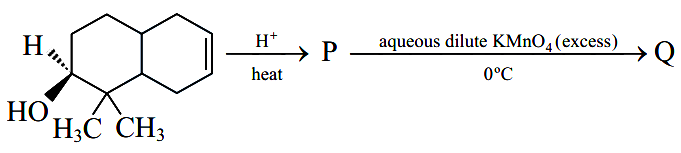 JEE Advanced 2015 Medium
 - Match the transformation in Column I with appropriate options in Column II.
Column I Column II A. \(CO _2(s) \rightarrow CO _2(g)\) p. Phase transition B. \(CaCO _3(s) \rightarrow CaO (s)\) \(+~ CO _2(g)\) q. Allotropic change C. \(2 H \rightarrow H _2(g)\) r. \(\Delta\text{H}\) is positive D. \(P _{\text {(white, solid) }} \rightarrow P _{\text {(red, solid) }}\) s. \(\Delta\text{S}\) is positive t. \(\Delta\text{S}\) is negative JEE Advanced 2011 Easy - The periodic table consists of 18 groups. An isotope of copper, on bombardment with protons, undergoes a nuclear reaction yielding element \(X\) as shown below. To which group, element \(X\) belongs in the periodic table?
\({ }_{29}^{63} \mathrm{Cu}+{ }_{1}^{1} \mathrm{H} \rightarrow 6_{0}^{1} n+{ }_{2}^{4} \alpha+2{ }_{1}^{1} \mathrm{H}+\mathrm{X}\)JEE Advanced 2012 Easy - A linear octasaccharide (molar mass \(=1024 \mathrm{~g} \mathrm{~mol}^{-1}\) ) on complete hydrolysis produces three monosaccharides: ribose, 2-deoxyribose and glucose. The amount of 2-deoxyribose formed is \(58.26 \%(\mathrm{w} / \mathrm{w})\) of the total amount of the monosaccharides produced in the hydrolyzed products. The number of ribose unit(s) present in one molecule of octasaccharide is \(\qquad\)
Use : Molar mass \(\left(\right.\) in \(\left.\mathrm{g} \mathrm{mol}^{-1}\right)\) : ribose \(=150,2\)-deoxyribose \(=134\), glucose \(=180\); Atomic mass (in amu): \(\mathrm{H}=1, \mathrm{O}=16\)JEE Advanced 2025 Hard - The option(s) in which at least three molecules follow Octet Rule is(are)JEE Advanced 2024 Easy
More PYQs from JEE Advanced
- Passing \(\mathrm{H}_2 \mathrm{~S}\) gas into a mixture of \(\mathrm{Mn}^{2+}, \mathrm{Ni}^{2+}, \mathrm{Cu}^{2+}\) and \(\mathrm{Hg}^{2+}\) ions in an acidified aqueous solution precipitatesJEE Advanced 2011 Medium
- To check the principle of multiple proportions, a series of pure binary compounds were analysed and their composition is tabulated below. The correct option(s) is(are)
Compound Weight of Weight of JEE Advanced 2022 Hard - A source (S) of sound has frequency \(240 \mathrm{~Hz}\). When the observer \((\mathrm{O})\) and the source move towards each other at a speed \(v\) with respect to the ground (as shown in Case 1 in the figure), the observer measures the frequency of the sound to be \(288 \mathrm{~Hz}\). However, when the observer and the source move away from each other at the same speed \(v\) with respect to the ground (as shown in Case 2 in the figure), the observer measures the frequency of sound to be \(n \mathrm{~Hz}\). The value of \(n\) is ______
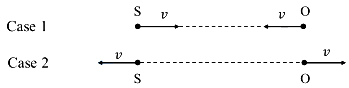 JEE Advanced 2024 Easy
 - The total number of carboxylic acid groups in the product P is
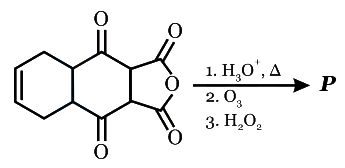 JEE Advanced 2013 Medium
 - A block \((B)\) is attached to two unstretched \(S_1\) and \(S_2\) with spring constants \(k\) and \(4 k\), respectively (see figure I). The other ends are attached to identical supports \(M_1\) and \(M_2\) not attached to the walls. The springs and supports have negligible mass. There is no friction anywhere. The block \(B\) is displaced towards wall 1 by a small distance \(x\) (figure II) and released. The block returns and moves a maximum distance \(y\) towards wall 2 . Displacements \(x\) and \(y\) are measured with respect to the equilibrium position of the block \(B\). The ratio \(\frac{y}{-1}\) is
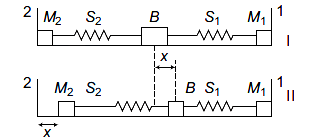 JEE Advanced 2008 Medium
 - Regarding the molecular orbital (MO) energy levels for homonuclear diatomic molecules, the INCORRECT statement(s) is(are)JEE Advanced 2025 Medium