


JEE Advanced · Chemistry · 4. Chemical Bonding
The option(s) in which at least three molecules follow Octet Rule is(are)
- A \(\mathrm{CO}_2, \mathrm{C}_2 \mathrm{H}_4, \mathrm{NO}\) and \(\mathrm{HCl}\)
- B \(\mathrm{NO}_2, \mathrm{O}_3, \mathrm{HCl}\) and \(\mathrm{H}_2 \mathrm{SO}_4\)
- C \(\mathrm{BCl}_3, \mathrm{NO}, \mathrm{NO}_2\) and \(\mathrm{H}_2 \mathrm{SO}_4\)
- D \(\mathrm{CO}_2, \mathrm{BCl}_3, \mathrm{O}_3\) and \(\mathrm{C}_2 \mathrm{H}_4\)
Answer & Solution
Correct Answer
(D) \(\mathrm{CO}_2, \mathrm{BCl}_3, \mathrm{O}_3\) and \(\mathrm{C}_2 \mathrm{H}_4\)
Step-by-step Solution
Detailed explanation
Option A: \(\mathrm{CO}_2, \mathrm{C}_2 \mathrm{H}_4, \mathrm{NO}\) and HCl
1. \(\mathrm{CO}_2\) : Carbon dioxide follows the octet rule. Carbon forms double bonds with two oxygen atoms, allowing it to have 8 electrons in its valence shell.
2. \(\mathrm{C}_2 \mathrm{H}_4\) : Ethylene follows the octet rule. Each carbon forms a double bond with the other carbon and single bonds with two hydrogen atoms, resulting in 8 electrons in the valence shell of the carbons.
3. NO: Nitric oxide does not follow the octet rule. It has an odd number of electrons, making it a free radical.
4. HCl: Hydrogen chloride follows the octet rule. Chlorine has 8 electrons in its valence shell when bonded with hydrogen.
Thus, three molecules \(\mathrm{CO}_2, \mathrm{C}_2 \mathrm{H}_4\), and HCl follow the octet rule here.
Option B: \(\mathrm{NO}_2, \mathrm{O}_3, \mathrm{HCl}\) and \(\mathrm{H}_2 \mathrm{SO}_4\)
1. \(\mathrm{NO}_2\) : Nitrogen dioxide does not follow the octet rule. It has an odd number of electrons.
2. \(\mathrm{O}_3\) : Ozone follows the octet rule. It has a resonance structure that allows each oxygen atom to have 8 electrons in its valence shell.
3. HCl: As mentioned, hydrogen chloride follows the octet rule.
4. \(\mathrm{H}_2 \mathrm{SO}_4\) : Sulfuric acid follows the octet rule. All atoms achieve stable configurations through bonding.
Thus, three molecules \(\mathrm{O}_3, \mathrm{HCl}\), and \(\mathrm{H}_2 \mathrm{SO}_4\) follow the octet rule in this option.
Option C: \(\mathrm{BCl}_3, \mathrm{NO}_2, \mathrm{NO}_2\) and \(\mathrm{H}_2 \mathrm{SO}_4\)
1. \(\mathrm{BCl}_3\) : Boron trichloride does not follow the octet rule. Boron has only 6 electrons in its valence shell.
2. NO: As mentioned, nitric oxide does not follow the octet rule.
3. \(\mathrm{NO}_2\) : As mentioned, nitrogen dioxide does not follow the octet rule.
4. \(\mathrm{H}_2 \mathrm{SO}_4\) : Sulfuric acid follows the octet rule.
Thus, only one molecule, \(\mathrm{H}_2 \mathrm{SO}_4\). follows the octet rule in this option.
Option D: \(\mathrm{CO}_2, \mathrm{BCl}_3, \mathrm{O}_3\) and \(\mathrm{C}_2 \mathrm{H}_4\)
1. \(\mathrm{CO}_2\) : As mentioned, carbon dioxide follows the octet rule.
2. \(\mathrm{BCl}_3\) : As mentioned, boron trichloride does not follow the octet rule.
3. \(\mathrm{O}_3\) : As mentioned, ozone follows the octet rule.
4. \(\mathrm{C}_2 \mathrm{H}_4\) : As mentioned, ethylene follows the octet rule.
Thus, three molecules \(\mathrm{CO}_2, \mathrm{O}_3\), and \(\mathrm{C}_2 \mathrm{H}_4\) follow the octet rule in this option.
Conclusion: The correct options are Option A and Option D, both having at least three molecules that follow the octet rule.
1. \(\mathrm{CO}_2\) : Carbon dioxide follows the octet rule. Carbon forms double bonds with two oxygen atoms, allowing it to have 8 electrons in its valence shell.
2. \(\mathrm{C}_2 \mathrm{H}_4\) : Ethylene follows the octet rule. Each carbon forms a double bond with the other carbon and single bonds with two hydrogen atoms, resulting in 8 electrons in the valence shell of the carbons.
3. NO: Nitric oxide does not follow the octet rule. It has an odd number of electrons, making it a free radical.
4. HCl: Hydrogen chloride follows the octet rule. Chlorine has 8 electrons in its valence shell when bonded with hydrogen.
Thus, three molecules \(\mathrm{CO}_2, \mathrm{C}_2 \mathrm{H}_4\), and HCl follow the octet rule here.
Option B: \(\mathrm{NO}_2, \mathrm{O}_3, \mathrm{HCl}\) and \(\mathrm{H}_2 \mathrm{SO}_4\)
1. \(\mathrm{NO}_2\) : Nitrogen dioxide does not follow the octet rule. It has an odd number of electrons.
2. \(\mathrm{O}_3\) : Ozone follows the octet rule. It has a resonance structure that allows each oxygen atom to have 8 electrons in its valence shell.
3. HCl: As mentioned, hydrogen chloride follows the octet rule.
4. \(\mathrm{H}_2 \mathrm{SO}_4\) : Sulfuric acid follows the octet rule. All atoms achieve stable configurations through bonding.
Thus, three molecules \(\mathrm{O}_3, \mathrm{HCl}\), and \(\mathrm{H}_2 \mathrm{SO}_4\) follow the octet rule in this option.
Option C: \(\mathrm{BCl}_3, \mathrm{NO}_2, \mathrm{NO}_2\) and \(\mathrm{H}_2 \mathrm{SO}_4\)
1. \(\mathrm{BCl}_3\) : Boron trichloride does not follow the octet rule. Boron has only 6 electrons in its valence shell.
2. NO: As mentioned, nitric oxide does not follow the octet rule.
3. \(\mathrm{NO}_2\) : As mentioned, nitrogen dioxide does not follow the octet rule.
4. \(\mathrm{H}_2 \mathrm{SO}_4\) : Sulfuric acid follows the octet rule.
Thus, only one molecule, \(\mathrm{H}_2 \mathrm{SO}_4\). follows the octet rule in this option.
Option D: \(\mathrm{CO}_2, \mathrm{BCl}_3, \mathrm{O}_3\) and \(\mathrm{C}_2 \mathrm{H}_4\)
1. \(\mathrm{CO}_2\) : As mentioned, carbon dioxide follows the octet rule.
2. \(\mathrm{BCl}_3\) : As mentioned, boron trichloride does not follow the octet rule.
3. \(\mathrm{O}_3\) : As mentioned, ozone follows the octet rule.
4. \(\mathrm{C}_2 \mathrm{H}_4\) : As mentioned, ethylene follows the octet rule.
Thus, three molecules \(\mathrm{CO}_2, \mathrm{O}_3\), and \(\mathrm{C}_2 \mathrm{H}_4\) follow the octet rule in this option.
Conclusion: The correct options are Option A and Option D, both having at least three molecules that follow the octet rule.
See the Complete Solution
Get step-by-step explanations for this and 2.5 Lakh+ more JEE, NEET & CET questions.
- Unlock all solutions
- Practice the full chapter
- Track accuracy across PYQs
4.8 rated on Google Play · 14,000+ reviews
More questions from Chemistry
- Assuming mixing is NOT operative, the paramagnetic species among the following isJEE Advanced 2014 Hard
- The correct statement(s) about surface properties is(are)JEE Advanced 2017 Easy
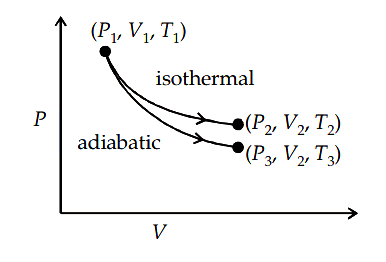
- The reversible expansion of an ideal gas under adiabatic and isothermal conditions is shown in the figure. Which of the following statement(s) is (are) correct?
 JEE Advanced 2012 Medium
 - Using the data provided, calculate the multiple bond energy \(\left(\mathrm{kJ} \mathrm{mol}^{-1}\right)\) of a \(\mathrm{C} \equiv \mathrm{C}\) bond in \(\mathrm{C}_{2} \mathrm{H}_{2}\). That energy is (take the bond energy of a \(\mathrm{C}-\mathrm{H}\) bond as \(350 \mathrm{~kJ} \mathrm{~mol}^{-1}\) ) \(2 \mathrm{C}(\mathrm{s})+\mathrm{H}_{2}(\mathrm{~g}) \longrightarrow \mathrm{HC}=\mathrm{CH}(\mathrm{g}) ; \Delta \mathrm{H}=\) \(225 \mathrm{~kJ} \mathrm{~mol}^{-1}\) \(2 \mathrm{C}(\mathrm{s}) \longrightarrow 2 \mathrm{C}(\mathrm{g}) ; \Delta \mathrm{H}=1410 \mathrm{~kJ} \mathrm{~mol}^{-1}\) \(\mathrm{H}_{2}(\mathrm{~g}) \longrightarrow 2 \mathrm{H}(\mathrm{g}) ; \Delta \mathrm{H}=330 \mathrm{~kJ} \mathrm{~mol}^{-1}\)JEE Advanced 2012 Hard
- \(\mathrm{Ag}^{+}+\mathrm{NH}_3 \rightleftharpoons\left[\mathrm{Ag}\left(\mathrm{NH}_3\right)\right]^{+} ; k_1=3.5 \times 10^{-3}\) \(\left[\mathrm{Ag}\left(\mathrm{NH}_3\right)\right]^{+}+\mathrm{NH}_3 \rightleftharpoons\left[\mathrm{Ag}\left(\mathrm{NH}_3\right)_2\right]^{+} ; k_2\) \(=1.7 \times 10^{-3}\) then the formation constant of \(\left[\mathrm{Ag}\left(\mathrm{NH}_3\right)_2\right]^{+}\)isJEE Advanced 2006 Medium
- One mole of an ideal gas at in thermal contact with its surroundings expands isothermally from to against a constant pressure of . In this process, the change in entropy of the surroundings in is:JEE Advanced 2016 Medium
More PYQs from JEE Advanced
- A signal which can be green or red with probability \(\frac{4}{5}\) and \(\frac{1}{5}\) respectively, is received by station \(A\) and then transmitted to station B. The probability of each station receiving the signal correctly is \(\frac{3}{4}\). If the signal received at station \(B\) is green, then the probability that the original signal green isJEE Advanced 2010 Hard
- \(75.2 \mathrm{~g}\) of \(\mathrm{C}_6 \mathrm{H}_5 \mathrm{OH}\) (phenol) is dissolved in a solvent of \(K_f=14\). If the depression in freezing point is \(7 \mathrm{~K}\), then find the \(\%\) of phenol that dimerises.JEE Advanced 2006 Medium
- A Hydrogen-like atom has atomic number . Photons emitted in the electronic transitions from level to level in these atoms are used to perform photoelectric effect experiment on a target metal. The maximum kinetic energy of the photoelectrons generated is . If the photoelectric threshold wavelength for the target metal is , the value of is _____.
[Given and , where is the Rydberg constant, is the Planck’s constant and is the speed of light in vacuum]JEE Advanced 2023 Medium - Let complex numbers α and lie on circles and respectively. If satisfies the equationJEE Advanced 2013 Hard
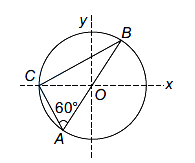
- Consider a system of three charges \(\frac{q}{3}, \frac{q}{3}\) and \(-\frac{2 q}{3}\) placed at points \(A, B\) and \(C\), respectively, as shown in the figure. Take \(O\) to be the centre of the circle of radius \(R\) and angle \(C A B=60^{\circ}\).
 JEE Advanced 2008 Medium
 - Let be a cube root of unity. Then the minimum of the set distinct nonzero integers equals ________JEE Advanced 2019 Medium